| Volume 08 | Issue 2 | January 14, 2008 |
Welcome to Monday Morning in Washington, D.C., published weekly by The Arc of the United States. We will bring to you news of interest to self advocates and their families, volunteers, professionals, and supporters of the disability movement. Please send any comments to mmwdc@thearc.org. You are welcome to reproduce and distribute items from Monday Morning in Washington, D.C., but please credit Monday Morning in Washington, D.C. (The Arc of the United States, 2007).
The Arc of the United States advocates for the rights and full participation of all children and adults with intellectual and developmental disabilities. Together with our network of members and affiliated chapters, we improve systems of supports and services; connect families; inspire communities; and influence public policy.
[NOTE: Having trouble reading this newsletter? Read it online.] [Past Issues]
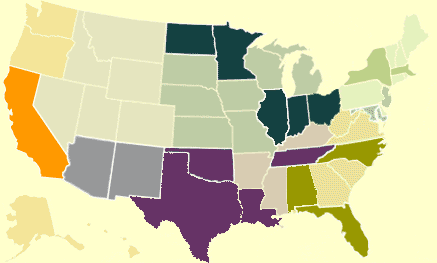
FVND Share the Wealth Week of January 7, 2008
United We Ride (UWR)
UWR is a Federal interagency initiative aimed at improving the availability, quality, and efficient delivery of transportation services for older adults, people with disabilities, and individuals with lower incomes. This work is in response to an Executive Order http://www.unitedweride.gov/1_ENG_HTML.htm Fact sheet available http://www.unitedweride.gov/1_1390_ENG_HTML.htm
The Centers for Medicare and Medicaid Services had published a final regulation on the school-based administration and school-based transportation services on December 28, the day before the bill was signed into law.The 12/28 regulation can be found at: http://a257.g.akamaitech.net/7/257/2422/01jan20071800/edocket.access.gpo.gov/2007/pdf/07-6220.pdf.
The Center on Education Policy recently released the sixth annual report on state high school exit exams in the United States
Since 2002, CEP has performed the most comprehensive study into the policy, practice, implementation and impact of state high school exit exams. The report, based on information collected from 26 states with current or planned exit exams, shows that exit exams remain a force in American education, currently affecting the majority of U.S. high school students. The report highlights recent developments in state implementation, including withholding diplomas, and recommendations to increase the effectiveness of the exams. The report also contains expanded areas of reporting on changes that have occurred over the past year in intervention (strategies used to raise initial pass rates) and remediation (strategies used to raise cumulative pass rates) at both the state and local levels with an emphasis on those efforts aimed at closing the achievement gaps. The report is now available on line at http://www.cep-dc.org/index.cfm?fuseaction=document.showDocumentByID&nodeID=1&DocumentID=224
FREE ONLINE Partners in Policymaking classes offered
Five online courses are now available to anyone who would like to increase their knowledge and skills: http://www.partnersinpolicymaking.com/online.html
[nectac-enotes] NECTAC eNotes - January 11, 2008
Current issue of eNotes can be viewed online at http://www.nectac.org/enotes/enotes.asp
The Commonwealth Fund has published a report entitled Developmental Screening in Primary Care: The Effectiveness of Current Practice and Recommendations for Improvement
The report finds that developmental delays in early childhood are significantly under-identified by primary care providers. The author suggests that financial, educational, and other barriers to physicians' use of developmental screening tools need to be addressed. The report is available at http://www.commonwealthfund.org/publications/publications_show.htm?doc_id=605625
The National Survey of Child and Adolescent Well-Being (NSCAW)
The Survey has been collecting longitudinal data on child abuse and neglect since 1997, using firsthand information from victims, caregivers, and caseworkers to examine the short- and long-term effects of child maltreatment. NSCAW has recently published the following two research briefs: 1) Need for Early Intervention Services Among Infants and Toddlers in Child Welfare and 2) Special Health Care Needs Among Children in Child Welfare Need for Early Intervention They are available online at http://www.acf.hhs.gov/programs/opre/abuse_neglect/nscaw/index.html
The Division for Early Childhood (DEC) at the Council for Exceptional Children (CEC) recently published a paper entitled Promoting Positive Outcomes for Children with Disabilities: Recommendations for Curriculum, Assessment and Program Evaluation.It is available at http://www.dec-sped.org/pdf/positionpapers/Prmtg_Pos_Outcomes_Companion_Paper.pdf
Eligibility for Benefits Update: How to Appeal a Decision on Your Social Security Disability Claim Online
This is the starting point to request a review of SSA's medical decision about your eligibility for disability benefits. There are two parts to this Internet Appeal process: (1) an Appeal Request Internet form and, (2) an Appeal Disability Report that gives us more information about your condition. You can complete both forms online. This information has recently been updated, and is can be accessed by visiting this link: http://www.disabilityinfo.gov/digov-public/public/DisplayPage.do?parentFolderId=169
REFERENCE POINTS:
Mental Health Resources
ENTERING THE WORLD OF WORK: WHAT YOUTH WITH MENTAL HEALTH NEEDS SHOULD KNOW ABOUT ACCOMMODATIONS
A fact sheet that provides information on disclosure, accommodations and examples of reasonable accommodations for youth with mental health needs entering the workforce. The fact sheet can be found at http://www.dol.gov/odep/pubs/fact/transitioning.htm
WHAT MAKES A DIFFERENCE FOR TRANSITION AGE YOUTH WITH MENTAL HEALTH NEEDS?
This Power Point presentation provides a comparison of European American and African American perspectives on community integration. Presented by J. Kruzich, T. Johnson, R. Tisino and C. Clark as part of the Washington State Adolescent Health Conference Partnership for Healthy Youth Conference, SeaTac, WA. Download the PDF at http://www.rtc.pdx.edu/PDF/presWA_State_partnership_conference07.pdf
SAMSHA REPORT TO CONGRESS PROMOTES RESILIENCE AND SUPPORT
A recent report to Congress from the Substance Abuse and Mental Health Services Administration (SAMHSA) encourages evidence-based programs that offer family support. The report summarizes the evidence base that shows family-focused programs to be successful in strengthening parenting skills and child resilience. Suggestions on how to better reach families with these interventions are provided.
http://mentalhealth.samhsa.gov/publications/allpubs/svp%2D0186/
SUBSTANCE ABUSE RESOURCES NOW AVAILABLE IN SEVERAL LANGUAGES
The Multi-Language Initiative of the Center for Substance Abuse Treatment has released several substance abuse-related publications for speakers of languages other than English. Aimed toward youth, adults, and families of people seeking substance abuse treatment, these publications include frequently-asked questions and lists of support groups. Select publications are available in Spanish, Russian, Navajo, Chinese, Korean, and Vietnamese.
http://kap.samhsa.gov/mli/index.htm
NEW "KNOWLEDGE PATH" FROM MCH
A knowledge path has been compiled by the Maternal and Child Health [MCH]
Library [http://www.mchlibrary.info/] at Georgetown University. It offers a selection of current, high-quality resources about children and adolescents with emotional, behavioral, and mental health challenges. Resources tap into the health, education, social services, and juvenile justice literature. The path identifies tools for staying abreast of new developments in mental health care and for conducting further research. Separate sections present resources for families and schools. The final part of the knowledge path presents resources about specific emotional, behavioral, and mental health challenges. The knowledge path is aimed at health professionals, program administrators, policymakers, educators, and families, and it will be updated periodically. For more information go to
www.mchlibrary.info/KnowledgePaths/kp_Mental_Conditions.html .
NEW PUBLICATIONS FROM THE NATIONAL INSTITUTE OF MENTAL HEALTH -
EATING DISORDERS
Eating disorders frequently appear during adolescence or young adulthood, but some reports indicate that they can develop during childhood or later in adulthood. Women and girls are much more likely than males to develop an eating disorder. Eating disorders are real, treatable medical illnesses with complex underlying psychological and biological causes. They frequently co-exist with other psychiatric disorders such as depression, substance abuse, or anxiety disorders. This booklet that describes symptoms, causes, and treatments of eating disorders with information on getting help and coping and can be found at
http://www.nimh.nih.gov/health/publications/eating-disorders/summary.shtml
SOCIAL PHOBIA (Social Anxiety Disorder)
This booklet is about one kind of anxiety disorder called social phobia. Social phobia is a strong fear of being judged by others and of being embarrassed. This fear can be so strong that it gets in the way of going to work or school or doing other everyday things. Social phobia usually starts during the child or teen years, usually at about age 13. Without treatment, social phobia can last for many years or a lifetime. Treatments are available that can give relief to people who have Social Phobia and help them live a more normal life. For more information go to http://www.nimh.nih.gov/health/publications/social-phobia-social-anxiety-disorder.shtml
GENERALIZED ANXIETY DISORDER
This booklet is about another kind of anxiety disorder called generalized anxiety disorder, or GAD. GAD develops slowly. It often starts during the time between childhood and middle age. Symptoms may get better or worse at different times, and often are worse during times of stress. People with GAD may visit a doctor many times before for symptoms such as headaches or trouble falling asleep, but don't always get the help they need right away. It may take doctors some time to be sure that a person has GAD instead of something else. Treatments are available that can give relief to people who have GAD and help them live a more normal life. For more information go to http://www.nimh.nih.gov/health/publications/generalized-anxiety-disorder.shtml
REFERENCE POINTS: "Rolling": A Documentary
Physician and filmmaker Gretchen Berland gave video cameras to three Los Angeles residents who use wheelchairs and asked them to document their everyday lives. The result is Rolling, a frank and witty documentary that sheds light on the daily challenges of living with limited mobility. Galen Buckwalter, a clinical psychologist who became paralyzed when he was 17, is one of the participants in the film. He mounted a camera to his wheelchair and chronicled his life - from doctor's visits to family camping trips. Buckwalter identifies himself as a "proud gimp," and voices his frustration that, not only is he defined as disabled, but he is also expected to "feel and act disabled." Though the film began as Berland's attempt to document the experience of using a wheelchair, she says, "In the end, it's really about life. It's not about feeling sorry for someone with a disability." The documentary was featured on National Public Radio's "Talk of the Nation" and more information and short clips from the documentary can be found at their web site, http://www.npr.org/templates/story/story.php?storyId=17993638. Dr. Berland recently wrote an article about the documentary for the New England Journal of Medicine, which can be found at http://content.nejm.org/cgi/content/full/357/25/2533
FOR REFERENCE POINTS: "Aligning High School Graduation Requirements with the Real World"
Achieve, Inc., a bipartisan, non-profit organization formed by the nation's governors and business leaders in 1996, developed this December 2007 policy brief featuring lessons learned by states that have put higher graduation requirements in place. It addresses challenges of policy design as well as strategies for implementation, communication and coalition building. For more information go to http://www.achieve.org/files/AchievePolicyBriefDec18.pdf
hcbs.org > Clearinghouse CLIPS: January 10, 2008
Administration of Mental Health Services by Medicaid Agencies
Summary: This report provides a state-by-state analysis of how Medicaid agencies are exercising their responsibilities for mental health services. The report is based on telephone interviews and explores how state Medicaid agencies are addressing the organization, funding, policy, management and data issues that arise from increased responsibility for mental health services. Review the findings which indicated how States have taken varying approaches to providing services.
Topic(s): Mental Health
Source: SAMHSA
More Info: http://www.hcbs.org/moreInfo.php/nb/doc/2125
CMS Direct Service Workforce Demonstration Promising Practices in Marketing, Recruitment and Selection Interventions
Summary: The Centers for Medicare and Medicaid Services (CMS) initiated a demonstration project to improve the Direct Service Community Workforce to test the effectiveness of different workforce interventions on the retention and recruitment of Direct Service Workers (DSWs). This report identifies promising practices in direct service worker marketing, recruitment, and selection across the CMS grantees.
Topic(s): Workforce
Source: The Lewin Group & the Research and Training Center
More Info: http://www.hcbs.org/moreInfo.php/nb/doc/2111
Funding Sources Successfully Used by States to Support Development of Integrated, Affordable, and Accessible Community Housing
Summary: This guide offers a quick reference on housing resources that can be used to create integrated, affordable, and accessible housing and basic information on how to use these resources. Including community strategies that increase the amount of integrated, affordable, and accessible housing units that usually fall into three general categories: development of housing units; access to existing housing units; and asset development.
Topic(s): Accessibility, Aging Issues, Consumer Direction, Housing, Long-Term Care, Physical Disabilities, Transition/Diversion from Institutions
Source: ILRU
More Info: http://www.hcbs.org/moreInfo.php/nb/doc/2112
Medicaid Home and Community-Based Service Programs: Data Update - Dec 2007
Summary: The national percentage of Medicaid spending on home and community-based services (HCBS) has more than doubled from 1992 to 2004. This report presents a summary of the main trends to emerge for the three Medicaid HCBS programs and the results of a survey of policies such as eligibility criteria and waiting lists.
Topic(s): Consumer Direction, Deficit Reduction Act, Long-Term Care, Waiver
Source: Kaiser Commission on Medicaid and the Uninsured
More Info: http://www.hcbs.org/moreInfo.php/nb/doc/2110
Personal Assistance Services Cooperatives: Final Report
Summary: A study was conducted on consumer-directed personal assistance services (PAS) cooperatives, with an emphasis on workplace PAS. This report presents case studies of seven cooperatives, describes advantages of consumer-run cooperatives, identifies funding issues and sources, and presents considerations for those contemplating starting. It contains a review of the literature which reveals only a few examples of successful consumer-directed PAS cooperatives in the US, however, they show promise.
Topic(s): Consumer Direction
Source: The Center on Personal Assistance Services (CPAS)
More Info: http://www.hcbs.org/moreInfo.php/nb/doc/2118
Building on the Ticket: A New Paradigm for Investing in Economic Self-Sufficiency for People with Significant Disabilities
Summary: The Ticket to Work Panel released its final report to the President and Congress. Included are five recommendations including the idea of extending the Medicaid Infrastructure Grant and Demonstration to Maintain Independence and Employment program through 2014, creating a panel and an advocate position within the Social Security Administration to enhance beneficiary perspective, publish the final rule, create a demonstration project and examine the impact of changing the disability definition.
Topic(s): Developmental/Psychiatric Disabilities, Medicaid Infrastructure Grant, Physical Disabilities, Workforce
Source: Ticket to Work and Work Incentives Advisory Panel
More Info: http://www.hcbs.org/moreInfo.php/nb/doc/2124
Free Publications from the Feds -ex. how to file effective complaints - all free
The US DOE is offering publications...you go to their website, check the ones you want, and they sent them to you for free. Here is the link http://www.edpubs.ed.gov/webstore/Content/search.asp
disABLEDperson Inc. announces its Spring 2008 Nationally Based College Scholarship Competition for Disabled College Students.
disABLEDperson Inc. will be holding their spring 08 nationally based scholarship competition for disABLED college students beginning January 7th 2008 and ending February 15th 2008 for the sum of $750.00 (Seven Hundred and Fifty). The winner will be announced on our website at www.disABLEDperson.com on March 5th 2008. We are proud to help the disabled community.
Please pay attention to the rules of this scholarship competition. They will be strictly enforced. Any essay that does not follow all the rules will be disqualified. To participate is simple, you need to do the following; it is a two step process. The first step is to go to www.disABLEDperson.com/articles/spring08.asp . Once there, you need to completely fill out the form and submit it. The next step is to write an essay that answers the question on that page and email the essay to us in the body of an email to disabledpersons@aol.com .
PLEASE DO NOT FORGET TO PUT YOUR NAME ON THE ESSAY IN THE EMAIL.
To view the essay question Click Here - http://www.disabledperson.com/articles/spring08.asp
The American Association on Intellectual and Developmental Disabilities (AAIDDVisit www.aaidd.org/FYI/ to access current and past issues of this monthly newsletter. Subscribe at www.responsetrack.net/aaidd/sign_up
AAFP LAUNCHES NEW TOOL: THE FAMILY HEALTH ADVOCATEThe American Academy of Family Physicians (AAFP) has launched a web-based tool designed to recruit motivated consumers who will advocate for the family health issues they care about. The new site, The Family Health Advocate, shares information on issues such as the cost of health insurance and patient-centered medical homes, providing links for consumers to contact their elected officials and tips for making effective contact. Consumers can sign up to receive Action Alerts on issues, as well as a monthly e-newsletter. Go to http://www.familyhealthadvocate.org.
New Products added to the Quality Mall
"Emergency Response Training" -
http://www.qualitymall.org/products/prod1.asp?prodid=4369
"Including Samuel" -
http://www.qualitymall.org/products/prod1.asp?prodid=4374
LONG-TERM CARE RECOMMENDATIONS
National Commission for Quality Long-Term Care Recommends Adequate Supports
for Family Caregivers
On December 3, 2007, the National Commission for Quality Long-Term Care
released its final report, "From Isolation to Integration: Recommendations
to Improve Quality Long-Term Care." The recommendations focus broadly on
quality of care, workforce issues, technology and financing long-term care.
In particular, the report recognizes the significant contributions family
caregivers make to long-term care, and it recommends that adequate supports
be available. These supports include assessments of caregivers' needs,
voluntary training and respite, technical help from health care
professionals and a reliable back-up system of direct care workers.
http://www.qualitylongtermcarecommission.org/reports.html
Working Life: Towards a Lifestyle of Employment For All
In this Webinar training series you will learn about challenges and opportunities in expanding integrated employment and how Customized Employment relies on a negotiated rather than competitive approach to employment. Other topics covered include Discovery, Customized Planning Meetings, and more.
This four part series will take place on January 28, February 4, 11 and 25 from 1:30pm to 3:00pm (EST). For more detailed information and to register, click on the link below. It is a TASH and APSE webinar series sponsored by the Institute for Community Inclusion, and will include a presentation by John Butterworth (of ICI).
2008 TASH Webinar Series - https://www.tash.org/dev/tashstore/ONSCategory.aspx?catid=4
[arch] New and Updated Data in FCA's "Caregiving Across the States"
New “Caregiving Across the States” Interactive Database
The National Center on Caregiving at Family Caregiver Alliance (FCA) is pleased to announce the addition of new and updated data in its online resource, Caregiving Across the States.
The database includes a separate profile for each state and the District of Columbia. Profiles contain the state's background characteristics related to caregiving and aging, as well as information on publicly-funded caregiver support programs.
You'll find the updated data in the Selected State Background Characteristics sections of the State Profiles. NEW state-by-state data include:
In addition, key updates for each state include:
This interactive database, accessible in map format on the FCA website, is a valuable resource to inform state administrators and policymakers about support programs for family caregivers of adults with chronic illnesses or disabilities. It also allows caregivers and service providers to access information they need to seek assistance and benefits for themselves or their clients.
To learn more about the family caregiving landscape in your state, visit FCA's Caregiving Across the States webpage or copy and paste the following URL into your browser: http://caregiver.org/caregiver/jsp/content_node.jsp?nodeid=12720.
For more information, contact Amy Friedrich-Karnik at (800) 445-8106 or email afriedrich@caregiver.org.
Increasing Affordable, Accessible, Integrated Housing - One State's Strategy
to Increase LIHTC units. Information Bulletin #236 (1/08)
The Disability Law Center in Boston (Massachusetts'"P&A"), nine
Independent Living Centers throughout Massachusetts, and the Statewide ILC
recently filed their recommendations to the MA Department of Housing and
Community Development (DHCD) regarding the MA 2008 allocation of
Low-Income Housing Tax Credits to increase the number of units for persons
on SSI.
These recommendations were submitted as part of the federally-mandated
Qualified Allocation Plan (QAP) process, with which States must comply
each year. Because LIHTC is the largest growing federal housing program
in the country and because these advocates warrant KUDOS, we want other
advocates to know what the MA advocacy community is requesting.
Throughout the country, the extremely competitive demand for LIHTC exceeds
the supply by nearly 3 to 1, which means that Housing Finance Agencies
throughout the country could do exactly what the MA advocates are
requesting. Here's a summary of their recommendations. For a full copy,
go to http://www.dlc-ma.org/QAP_Comments.doc
First, according to the most recent data available, nationally only 7% of
LIHTC were targeted to households with incomes at or below 30% of the Area
Median Income. Even though the MA's LIHTC program had exceeded the
national average by requiring, as a threshold, that 10% of all LIHTC units
had to be already targeted to households whose incomes are at or below 30%
of the Area Median Income, the MA advocates recommended that the 2008 QAP
have an additional threshold requirement for another10% of the units to be
targeted to persons with "very low incomes"(i.e., on SSI) with
disabilities through project based vouchers - well below 30% of the AMI.
Second, the MA recommended that developers who are awarded LIHTC as a
result of the competitive process be required to submit a plan to ensure
that the additional 10% of the units will be made available to "very low
income" persons with disabilities.
Third, to ensure people with disabilities are integrated, the advocates
recommended that MA alter its policy so that LIHTC projects will assure
integration by not having more than 15% of the total units in a project
occupied by people with disabilities (absent a compelling programmatic
reason for intensive specialized services that cannot be provided in an
integrated setting).
Fourth, the MA advocates recommended that "visitability" should be a
threshold requirement for ALL new construction and renovation of existing
housing units. This is in addition to DHCD's current extra points for
developers that provide Universal Design.
In a number of other Information Bulletins in the last few years, we have
described the LIHTC process and what advocates should be doing.
MA is one great example. What's happening in your State with LIHTCs? Are there similar coalitions as exist in MA? Has your P&A and ILCs taken
similar initiatives to increase the supply of Accessible, Affordable,
Integrated housing via LIHTCs?
Steve Gold, The Disability Odyssey continues
Back issues of other Information Bulletins are available online at
http://www.stevegoldada.com
with a searchable Archive at this site divided into different subjects. To
contact Steve Gold directly, write to stevegoldada@cs.com or call 215-627-7100.
If you would like to sign up to receive the Monday Morning in Washington, DC, just click on this URL and sign up. http://info.thearc.org/cgi-bin/lyris.pl?join=mmwdc
Until Next week
The Arc of the United States,1010 Wayne Avenue, Ste. 650,Silver Spring, MD 20910, Phone: 301-565-3842, Fax: 301-565-3843, Email: mmwdc@info.thearc.org, Web: www.thearc.org
Disclaimer: MMWDC publishes information about issues and events that we believe to be important and likely to be of interest to advocates and others interested in inclusion of persons with disabilities in all parts of society. However, MMWDC and The Arc of the United States and TheArcLink Incorporated do not necessarily endorse all events, sponsoring organizations and reports which appear.