| Volume 08 | Issue 19 | May 12, 2008 |
Welcome to Monday Morning in Washington, D.C., published weekly by The Arc of the United States. We will bring to you news of interest to self advocates and their families, volunteers, professionals, and supporters of the disability movement. Please send any comments to mmwdc@thearc.org. You are welcome to reproduce and distribute items from Monday Morning in Washington, D.C., but please credit Monday Morning in Washington, D.C. (The Arc of the United States, 2007).
The Arc of the United States advocates for the rights and full participation of all children and adults with intellectual and developmental disabilities. Together with our network of members and affiliated chapters, we improve systems of supports and services; connect families; inspire communities; and influence public policy.
[NOTE: Having trouble reading this newsletter? Read it online.] [Past Issues]
[nectac-enotes] NECTAC eNotes - May 8, 2008
Current and past issues of eNotes can be viewed online at http://www.nectac.org/enotes/enotes.asp
May 2008 NCPAD Monthly Newsletter, Vol. 7, Issue 5
A monthly publication of NCPAD - the NATIONAL CENTER on PHYSICAL ACTIVITY and DISABILITY www.ncpad.org
2008 Believable Hope Conference - Your Early Intervention Resource
Now is your chance to create real hope for people with disabilities and their families at the 2008 Believable Hope ConferenceREFERENCE POINTS:
Conference and Workshop Updates Added to the TATRA Website
REFERENCE POINTS is an activity of TATRA, a project of PACER Center
REFERENCE POINTS Conference and workshop updates feature NEW additions to the listing of transition related national and regional conferences maintained on PACER Center's TATRA Project web site. To see our complete calendar of events, please visit us at http://www.pacer.org/tatra/calendar.asp.
REFERENCE POINTS:
Guidance and Career Counselors' Toolkit: Advising High School Students with Disabilities on Postsecondary Options
This 192 page resource from the HEATH Resource Center, contains answers to counselors' most frequently asked questions about postsecondary opportunities for students with disabilities. Students and their families are encouraged use the toolkit to help guide their transition planning for college and career. The online toolkit can be found at http://www.heath.gwu.edu/files/active/1/Toolkit.pdf
Fifth Freedom Network
Self Advocates Becoming Empowered (SABE)! - CALL FOR PRESENTATIONS
This is your chance to share what you know with others.
Do we have your presentation yet? Don't Delay! The deadline is getting close, and spots are filling quickly!
DEADLINE - THURSDAY, MAY 15
Don’t miss out on the opportunity to participate in the largest gathering of self advocates in the country. You are invited to lead one of over 70 workshops at the National Self Advocacy Conference on September 4 – 7, 2008 in Indianapolis, Indiana. All workshops are led by self-advocates, on topics that they choose to present. There is no limit to the number of presentations you can submit, so gather up your friends and come up with a topic…or two…or three!
Don’t delay – the deadline is Thursday, May 15, 2008!
Notification of acceptance will be mailed on June 15, 2008.
GENERAL INSTRUCTIONS
EDUCATIONAL OBJECTIVES
Each proposal must address at least one of the following
educational objectives:
Submitting your proposal is easy! Click here http://www.sabe2008.org/register/presenter.aspx to register online!
For more information contact: Julia Rupp, Chief Operations Officer, Community Mental Health Center, 285 Bielby Road, Lawrenceburg, IN 47025, 812-532-3405, cell 513-600-1858
The HEATH Resource Center
National Conversation on Advising Self-Advocacy Groups
What: Teleconferences on advising self-advocacy groups.
Where: The comfort of your office or home
Teleconference #3: Growing with the Self-Advocacy Movement -
June 2, 2008 - 90 minutes (3pm ET)
Registration Deadline: May 26, 2008
Event is supported by Self-Advocate Leadership Network. SALN is a partnership between self-advocates across the country and staff at the Human Services Research Institute.http://www.hsri.org/leaders/
National Reinventing Quality Conference, Baltimore, August 10-12
You are invited to the national Reinventing Quality Conference, this year being held on the beautiful Baltimore waterfront, August 10-12. This conference features leading edge programs and practices in quality services for persons with developmental disabilities. For the conference brochure, list of speakers, schedule, hotel and registration information, visit our web site at: http://www.reinventingquality.org
The HEATH Resource Center
Financial Aid/Scholarships K-12 & Higher Ed
The Paralelles Media Group and Foundation announced it is unveiling "Cash for College," a unique raffle with a truly remarkable prize: the winner gets to select the student of their choice to receive $100,000 towards any accredited school in the U.S. for grades K-12, College, or Graduate School. The Paralelles Media Group and Foundation announced it is unveiling "Cash for College," a unique raffle with a truly remarkable prize: the winner gets to select the student of their choice to receive $100,000 towards any accredited school in the U.S. for grades K-12, College, or Graduate School. http://www.heath.gwu.edu/node/837
http://www.ela.org/scholarships/scholarships_process.html
SCHOLARSHIP GUIDELINES
We commend all applicants for their achievements to date and wish everyone the best of luck in the application process. ELA Scholarships are available only to women graduate students with physical disabilities who are enrolled in a college or university in the United States. These scholarships are awarded on an objective and nondiscriminatory basis. Scholarships range between $500 and $2,000.
NCSER Introduces New Research Program
The National Center for Special Education Research (NCSER) within the
Institute of Education Sciences has created a new research grant
program -- Systemic Interventions and Policies for Special Education -- called Systems.
The new program supports research related to systems-level practices and
policies for kindergarten through grade 12. Previously, NCSER offered
three focused research topics related to systems-level practices in
special education: Assessment for Accountability, Response to
Intervention, and Individualized Education Programs. Applicants may
continue to propose projects in these areas under the Systems program.
However, the Systems program will also accept proposals relevant to other
special education systems-level programs and policies, such as recruitment
or retention of special educators and other related service providers,
systems-level strategies for improving inclusion, and access to the
general curriculum.
More information about the Systems program can be found at http://ies.ed.gov/ncser/funding/2009_84324A/index.asp?rfa=rgt09a. Or
contact Kristen Lauer, 202-219-0377, kristen.lauer@ed.gov.
2006 HOME Investment Partnership Funds - Information Bulletin #246 (5/08)
The HOME program is one of the largest federally funded housing programs
that affect low-income people with disabilities. HOME funds can be used
both for single family or multifamily units and for homebuyer assistance,
new construction, rehabilitation and tenant-based rental assistance.
State agencies receive about 40% of the total HOME funds and the remaining
60% is divided among local "participating jurisdictions," based on the
size of their populations.
As with the Low-Income Housing Tax Credit program (which is 100%
administered by a State Housing Finance Agency), HOME funds must be
targeted to specific incomes.[See #245]. As with the LIHTC program, there
are incredible differences among the States.
Because so many people with disabilities' sole source of income is their
monthly SSI grants, their incomes are approximately 18-20% of the Area
Median Income. Therefore, knowing at what income level a state "targets"
its HOME funds is critical. For example, in those States with Money
Follows the Person grants, each person transitioned from an institution
could receive a HOME "Tenant-Based Rental Assistance," a fancy term for a
housing voucher - if the State really wanted to assist these folks to
leave the institutions.
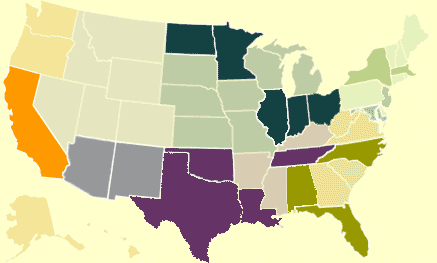
Below by State is the percent of HOME assisted units targeted in 2006 at
or below 30% of the Area Median Income. These targets are discretionary! Just as with LIHTC, States could target 100% or zero percent of their HOME
funds at the SSI level or at 30% or below AMI level.
Where a State targets its HOME funds is, in very large part, how effective
the disability advocates are in the State. If your State does not target
the lowest income people with disabilities, disability advocates should be
examining ways to force your State to increase the percentage of units
that are targeted at or below the 30% of the AMI. The National Council of
State Housing Agencies, which collects and publishes this information, did
not have it available for every State. If your State is not listed, go to
your State housing agency and find out what percentage of the HOME units
were targeted at or below 30% of the AMI. Remember, also, that HOME funds
are subject to the Consolidated Plan process! This information must be
made available.
To read a list of states please go to http://www.stevegoldada.com/stevegoldada/archive.php?cat=Housing
Steve Gold, The Disability Odyssey continues
2006 Tenant Based Rental Assistance vouchers with HOME Funds. Information Bulletin #247 (5/08).
HOME Investment Partnership funds can be used for new construction,
rehabilitation, and acquisition in either home ownership or rental units.
HOME funds can also be used for Tenant-Based Rental Assistance - housing
vouchers that tenants can use to supplement their rental payments. These
are very similar to the Housing Choice Vouchers, aka, Section 8 vouchers.
Federal HOME funds are distributed in each State so that 60% of the HOME
funds awarded to a State are allocated to local "Participating
Jurisdictions" based on population size. However, 40% of the HOME funds
are awarded to a State-wide housing entity, most often (but not always)
the Housing Finance Agency,.
In dollars, $1.218 billion federal HOME dollars were allocated in 2006, of
which about $434 million (that's approximately the 40%) went to state-wide
housing finance agencies.
It's these 40% of the HOME funds, $434 million, that could be used to
assist persons to transition from nursing homes back to the community.
It's these federal funds that a State could use to assist persons to live
in the community.
Unfortunately, many States and Governors can see only one thing at a time;
nursing home's Medical Assistance expenditures versus HOME funds. Many of
our Governors do not seem to understand that if they used their HOME funds
to help people transition from nursing homes, their States will
reduce/save its Medical Assistance expenditures.
Given how many Governors complain about Medical Assistance expenditures,
one might think they would try to save such expenditures when they could.
Below find by State the number of units and HOME funds that State Housing
Finance Agencies used for Tenant-Based Rental Assistance. We do not know,
however, if these Tenant-Based Rental Assistance grants were tied to
helping people transition out of nursing homes.
Elderly and disability advocates should be demanding their Housing Finance
Agencies (or other State housing agencies that administer the 40%) use
these funds to transition people out of institutions.
To read a list of states please go to http://www.stevegoldada.com/stevegoldada/archive.php?cat=Housing
In the list, we provide in the first column the Total 2006 federal HOME $ Available to State Housing Agency, and in the second column the number of Tenant Based Rental Assistance vouchers issued and the dollar amount of 2006HOME funds used for those vouchers.
Steve Gold, The Disability Odyssey continues
Back issues of other Information Bulletins are available online at
http://www.stevegoldada.com with a searchable Archive at this site divided into different subjects. To
contact Steve Gold directly, write to stevegoldada@cs.com or call 215-627-7100.
National Family Caregivers Association May 2008 E-Letter
To read the latest issue of their newsletter click here: http://www.thefamilycaregiver.org/
NCD Funding Opportunity--Prerelease Notice--2008 Housing Initiative
May 6, 2008 – Initial Prerelease Announcement of Funding Opportunity
Funding Opportunity for a Cooperative Agreement: NCD 08-02
Application materials will be made available on May 20, 2008 at www.ncd.gov
You can also request applications by writing to: Joan Durocher, National Council on Disability, 1331 F Street, NW, Suite 850, Washington, DC 20004 Or by e-mail request at: jdurocher@ncd.gov
Applications will be due on July 1, 2008 - Maximum amount available for this project: $100,000
All potential applicants are eligible to apply - Cost sharing is not required
Project Overview:
NCD will undertake a comprehensive study of the state of housing in America in the 21st century. This evaluation will focus on: (1) public laws, policies and program initiatives that affect housing opportunities for Americans with disabilities, as well as others who have accessible housing needs, e.g. the aging population and those who acquire temporary disabilities; and (2) housing, supports, and other benefits provided available through the public and non-profit and/or private sectors. The purpose is to determine whether, and to what extent, public and non-profit and private housing and related programs have provided adequate, affordable, and accessible housing for Americans with disabilities as well as others who have accessibility needs, like the aging population and those who acquire temporary disabilities.
This research will identify and review current practices and policies at the local, state, national level, and international level with an emphasis on those policies that appear to be innovative and successful and will result in a major report consisting of a series of topical briefs on several housing-related issues. The report will be formatted as a standard NCD report with an executive summary - but each topical brief will be a substantive stand alone document in its own right that can be shared with stakeholders on specific issues. A cohesive, final report will incorporate the findings and conclusions that can be drawn from the topical examinations, and include recommendations for advancing the attainment of accessible and affordable housing.
Guidance for this project will involve an expert committee that will provide advice on the foci, design, and evaluation of the key issues. Committee membership may include: individuals with disabilities, members of the public/non-profit/private sectors, academics, planners and architects, banking and financial experts as well as other interested members of the disability research and advocacy communities to harness the breadth of expertise that exists within the disability community (as well as the aging community, many of whom will acquire disabilities). The expert panel will provide input and oversight throughout the length of the research project. Selected panel members will author selected topical briefs that form the major portion of the deliverables for this project. The expert panel will play an active role in developing policy recommendations that can be implemented in the private sector, the public sector, or as a combined effort.
Each topical brief is expected to incorporate an assessment, if appropriate, of how the particular topic under review has addressed, if at all, universal design in housing as well as other promising practices. Each topical brief is also expected to include an evaluation of promising practices from other mature countries, for example the United Kingdom and Canada, including how those countries have dealt with the aging population with respect to housing-related issues.
National Council on Disability
Workforce Infrastructure in Support of People with Disabilities: Matching Human Resources to Service Needs
May 6, 2008 – Initial Prerelease Announcement of Funding Opportunity
Funding Opportunity for a Cooperative Agreement: NCD 08-03
Application materials will be made available on May 20, 2008 at www.ncd.gov
You can also request applications by writing to: Joan Durocher, National Council on Disability, 1331 F Street, NW, Suite 850, Washington, DC 20004 Or by e-mail request at: jdurocher@ncd.gov
Applications will be due on July 1, 2008 - Maximum amount available for this project: $75,000
All potential applicants are eligible to apply - Cost sharing is not required
Project Overview:
NCD plans to develop a research paper on the status of the United States’ human resources infrastructure supporting people with disabilities. This research paper is envisioned as an intergovernmental review of: (a) existing public and private funding and resources targeted to building and/or strengthening communities’ human services infrastructure; (b) barriers and gaps in services, supports and accommodations needed by Americans with disabilities; and (c) demonstrated approaches to effectively address identified barriers and gaps.
The major issues expected to be the foci of this study include an evaluation of: a) the forces that shape the human services workforce including education, training, and salaries/pay; b) the ongoing chronic shortages in the area of nursing, teachers certified for special education, direct care service workers for community-based services, personal assistants for independent living, rehabilitation counselors, mental health treatment professionals, sign language interpreters, real-time captioners, nurses, and geriatric professionals; c) the further decreases expected in human service workers as baby boomers retire, d) the training geared towards understanding, working with, and serving people with disabilities in the overall profession(s); and e) retirements, recruitments, and succession planning, and their effect on the human services infrastructure including how to pass knowledge down to the next generation.
A critical part of this study will be recommendations to create a more efficient, effective, and equitable infrastructure of connecting people to the services, supports, and accommodations they need – in an era of shrinking government funding. The recommendations should reflect a broad spectrum of views, including consumers with disabilities. NCD believes that this research effort represents a real opportunity to inject systematic, coordinated and progressive infrastructure planning into federal (and state and local) systems, in a community-referenced manner.
Institute for Community Inclusion National E-News 05/06/08
Save the Date for the 5th National Organizational Change Forum
ICI is cosponsoring the 5th National Organizational Change Forum on September 24-25 2008 in Kansas City, MO.
This forum is designed to support the development of system change and individual supports that expand community-based employment opportunities and focus resources on integrated customized employment.
It will focus on:
Advocates, persons with disabilities who receive services, employment support providers, state agency personnel and others committed to integrated employment as a primary outcome for individuals receiving government funded support should all attend.
Mark your calendars now so you don't miss the next National Forum dedicated solely to Organizational Change and expanding community-based employment opportunities.
Contact Darla Wilkerson for more information 816-437-7150 or wilkersond@missouri.edu or use the link provided below.
Hosted by the National O.C. Planning Committee -Debra Martin Luecking, Pat Rogan, David Mank, Darla Wilkerson, John Butterworth, Dale Verstegen
5th National Organizational Change Forum Information - http://www.crprcep7.org/latest.html
Contact the Institute for Community Inclusion - Email: ici@umb.edu, Phone: 617/287-4300 voice, 617/287-4350 TTY, Website: http://www.communityinclusion.org
Universal Design for Workforce Development System
UD System Development Tools
As public and private workforce development systems strive to meet the diverse needs of their business and career seeking customers, staff need a clear understanding of how to design programs, services, and activities that provide genuine, effective, and meaningful opportunities for all. Universal Design for the Workforce Development System is a collection of tools and best practice findings from the field, all of which are deigned to promote a workforce development system that is both responsive to local needs and realities, and able to meet the needs of its businesses and career seeker customers.
The Universal Design systems change process is intended to be broadly and robustly collaborative, and these tools provide system leaders and change facilitators everything they need to engage in a process of lasting and meaningful systemic development.
View the Universal Design Tools
NCWD/A at the Institute for Community Inclusion Email: ici@umb.edu, Phone: 1-888-886-9898 (v/tty), Web: http://www.onestops.info
Center for Children and Families, Georgetown University - 3300 Whitehaven Street, Suite 5000, Washington, DC 20007, United StatesFamily Caregiver Alliance Releases NEW FAMILY CARE NAVIGATOR
Family Care Navigator is an EXCELLENT TOOL for Family and Informal
Caregivers as well as Professional Caregivers. This new tool provides
state specific resources and suggestions for a variety of issues
pertinent
to challenges of caregiving.
http://caregiver.org/caregiver/jsp/fcn_content_node.jsp?nodeid=2083
Language Matters—The ADS Center Announces Its Name Change
Effective immediately, SAMHSA's Resource Center to Address Discrimination and Stigma has been re-named to SAMHSA's Resource Center to Promote Acceptance, Dignity and, Social Inclusion Associated with Mental Health. The Center will still go by the acronym, the ADS Center.
Why change the name? For many years, the ADS Center has promoted the use of language that lets people with mental illnesses be known for their skills, talents, and abilities, not for their diagnosis or "label." We've worked to change the way that media portrays people with mental illnesses, how providers refer to people with mental illnesses, and how individuals talk to and about people with mental illnesses.
Recently, we took a look at our own language use. We asked, "Does using the word 'stigma' lead to stigma?" and questioned whether words like "anti-stigma" have the potential to build a bias, where one did not exist. The ADS Center name change is a result of close inspection and reflection with a spectrum of stakeholders on these tough questions.
The ADS Center's new name reflects a new approach: to promote a strengths-based vision, recognizing the importance of a caring, welcoming, and supportive community in helping to promote recovery and wellness for people with mental health problems. Reducing "stigma" will continue to be part of the ADS Center's work but it is no longer enough. We must expand what we do to better serve individuals with mental illnesses and their families.
The work of the ADS Center is to foster dialogue and facilitate activities to promote full community participation by people with mental health problems. As such, we welcome comments from you on our name change. Drop us an e-mail at: stopstigma@samhsa.hhs.gov.
Please visit the ADS Center Web site at www.stopstigma.samhsa.gov for information and to join our listserv.
Note from AAIDD on new resources
Over the years, you have come to expect the best resources in intellectual disability from the American Association on Intellectual and Developmental Disabilities (AAIDD). We now bring you four essential publications below, on hot issues faced by the disability field: funding for developmental disability programs; creating inclusive work environments; implementing positive behavior support strategies; and developing quality systems. I hope you enjoy reading these references and implementing the ideas within!
To avoid the pitfalls of large, image-based emails, I have only included brief details of each book with a link to read and learn more on our online bookstore site at http://bookstore.aaidd.org. To order these publications call 1-301-604-1340 or visit http://bookstore.aaidd.org. Do let me know if you have any further questions at books@aaidd.org or 202-387-1968, Ext. 203.
Yours sincerely, Anu Prabhala,
Editor and Communications Manager,
AAIDD Publications, www.aaidd.org
Questions? Email books@aaidd.org
Title: State of the States in Developmental Disabilities (2008)
Authors: David Braddock, Richard Hemp, and Mary Kay Rizzolo
Focus: Detailed investigation on public spending, revenues, and programmatic trends of intellectual and developmental programs and services within the United States from 1977-2006.
| Year: 2008 | Pages: 309 | Price: $29.95 | Paperback |
Title: Social Inclusion at Work
Authors: Janis Chadsey
Focus: Practical reference that tells practitioners how to socially integrate people with developmental disabilities into employment settings.
Year: 2008 |
Pages: 49 | Price: $14.95 | ISBN: 0-940898-97-7 | Paperback |
Title: Positive Behavior Support Training Curriculum (Second edition). AAIDD Training now available!
Authors: Dennis H. Reid and Marsha Parsons
Focus: The Positive Behavior Support Training Curriculum teaches direct support staff and supervisors the principles of positive behavior support while interacting with people with intellectual disabilities in service settings.
| Year: 2007 | Pages: 420 (Curriculum)/156 (Resource Guide) | Price: $395 (Set of Binder, one Resource Guide, and CD-ROM) |
Title: Quality of Life: Applications Across Individuals, Organizations, Communities, and Systems
Authors: Robert L. Schalock, James F. Gardner, and Valerie J. Bradley
Focus: Stressing the need to reframe the concept of quality of life and the fundamentals of the quality movement, the authors propose a quality assessment and improvement methodology grounded in person-centered needs and outcomes.
| Year: 2007 | Pages: 217 | Price: $29.95 | ISBN: 0-940898-96-9 | Paperback |
NCSER Introduces New Research Program
The National Center for Special Education Research (NCSER) within the
Institute of Education Sciences has created a new research grant
program -- Systemic Interventions and Policies for Special Education --
called Systems.
The new program supports research related to systems-level practices and
policies for kindergarten through grade 12. Previously, NCSER offered
three focused research topics related to systems-level practices in
special education: Assessment for Accountability, Response to
Intervention, and Individualized Education Programs. Applicants may
continue to propose projects in these areas under the Systems program.
However, the Systems program will also accept proposals relevant to other
special education systems-level programs and policies, such as recruitment
or retention of special educators and other related service providers,
systems-level strategies for improving inclusion, and access to the
general curriculum.
More information about the Systems program can be found at
http://ies.ed.gov/ncser/funding/2009_84324A/index.asp?rfa=rgt09a. Or
contact Kristen Lauer, 202-219-0377, kristen.lauer@ed.gov.
CENTERS FOR MEDICARE AND MEDICAID SERVICES - SPECIAL OPEN DOOR FORUM: WAGE INDEX REFORM
Tuesday, May 20, 2008 - 2pm-4pm Eastern Time
Conference Call Only
The purpose of this Special Open Door Forum (ODF) is to provide an opportunity for the public to discuss and share their opinions, suggestions, and expertise on the wage index and alternative methods for computing the wage index. Participants will be asked to comment on the 9 matters related to the wage index that Section 106(b)(2) of the MIEA-TRHCA requires CMS to consider, the MedPAC’s recommendations, and CMS’s proposals in the FY 2009 IPPS proposed rule. The comment period for the FY 2009 IPPS proposed rule ends on June 13, 2008 (see the Federal Register, volume 73, page 23528, April 30, 2008, for instructions on submitting comments for the proposed rule).
Background: Section 106(b)(1) of the Medicare Improvements and Extension Act, Division B of the Tax Relief and Health Care Act of 2006 (Pub. L. 109-432; MIEA-TRHCA) required the Medicare Payment Advisory Commission (MedPAC) to submit a report on the hospital wage index by June 30, 2007, including recommendations on alternatives for computing the wage index. The MedPAC’s report was included in the Commission’s June 2007 Report to Congress. In addition, section 106(b)(2) of the MIEA-TRHCA required CMS to take into account the MedPAC's recommendations and include in the FY 2009 proposed rule for the hospital inpatient prospective payment system (IPPS) one or more proposals that consider nine specific issues related to the wage index. CMS awarded a Task Order to Acumen, LLC to assist CMS in evaluating the impact of MedPAC’s recommended revisions to the hospital wage index and in developing one or more proposals to revise the wage index.
Note: Participants who are unable to present their comments during the Special ODF, or are unable to elaborate within the 2 minute time frame allotted for commenting, will be able to submit them to CMS following the Special ODF via the following email address, CMS_Wage_Index_ODF@cms.hhs.gov. Submitting your comments to this email address will not replace the formal comment submission process listed in the Federal Register.
Open Door Participation Instructions: Dial: 1-800-837-1935 & Reference Conference ID: 46680542
Note: TTY Communications Relay Services are available for the Hearing Impaired. For TTY services dial 7-1-1 or 1-800-855-2880 and for Internet Relay services click here http://www.consumer.att.com/relay/which/index.html. A Relay Communications Assistant will help.
An audio recording of this Special Forum will be posted to the Special Open Door Forum website at http://www.cms.hhs.gov/OpenDoorForums/05_ODF_SpecialODF.asp and will be accessible for downloading beginning May 28, 2008.
For automatic emails of Open Door Forum schedule updates (E-Mailing list subscriptions) and to view Frequently Asked Questions please visit our website at http://www.cms.hhs.gov/opendoorforums/
CMS to Host National Provider Education Call on the DMEPOS Competitive Bidding Program - May 13, 2008
The Centers for Medicare & Medicaid Services (CMS) will host a national education conference call to address the implementation of the new Medicare Durable Medical Equipment, Prosthetics, Orthotics, and Supplies (DMEPOS) Competitive Bidding program scheduled to begin on July 1, 2008. This call is being conducted for Medicare fee-for-service DMEPOS suppliers, physicians, and other providers – all of which may be affected by the program. The call will give a general overview of the new program and address some of the exceptions and situations you may encounter as the program is implemented. A presentation will be made by the Competitive Bidding Implementation Contractor (CBIC) and CMS Subject Matter Experts will be available to answer questions. A PowerPoint presentation will be posted on the CMS Website prior to the call.
Conference call details:
Date: May 13, 2008
Conference Title: Overview of the DMEPOS Competitive Bidding Program
Time: 12:30-2:00 p.m. EDT
In order to receive the call-in information, you must register for the call. It is important to note that if you are planning to sit in with a group, only one person needs to register to receive the call-in data. This registration is solely to reserve a phone line, NOT to allow participation. If you cannot attend the call, replay information is available below.
Registration will close at 12:30 p.m. EDT on May 12, 2008, or when available space has been filled. No exceptions will be made, so please be sure to register prior to this time.
For those of you who will be unable to attend, a replay option will be available shortly following the end of the call. This replay will be accessible from 2:30 p.m. EDT 5/13/2008 until 11:59 p.m. EDT 5/17/2008. The call in data for the replay is (800) 642-1687 and the passcode is 45744159.
CMS recommends the review of three MLN Matters articles prior to the call. There is a substantial amount of program information and how it will impact DMEPOS suppliers, physicians and other providers.
These Special Edition MLN Matters articles are:
MLN Matters Special Edition # SE0805 entitled ~ “Overview of New Medicare Competitive Bidding Program for Durable Medical Equipment, Prosthetics, Orthotics, and Supplies (DMEPOS) – The first in a series of articles on the implementation of this program.” ~ This article is posted on the CMS Website at http://www.cms.hhs.gov/MLNMattersArticles/downloads/SE0805.pdf .
MLN Matters Special Edition Article # SE0806 entitled ~ “Durable Medical Equipment, Prosthetics, Orthotics, and Supplies (DMEPOS) Competitive Bidding Program: Grandfathering, Repair and Replacement, Mail Order Diabetic Supplies and Advanced Beneficiary Notices (ABNs) – the second in a series of articles on the new DMEPOS Competitive Bidding Program.” ~ This article is posted on the CMS Website at http://www.cms.hhs.gov/MLNMattersArticles/downloads/SE0806.pdf .
MLN Matters Special Edition Article # SE0807 entitled ~ “Important Exceptions and Special Circumstances that Occur Under the Durable Medical Equipment, Prosthetics, Orthotics, and Supplies (DMEPOS) Competitive Bidding Program:--The third in a series of articles on the new DMEPOS Competitive Bidding Program.” ~ This Article is posted on the CMS Website at http://www.cms.hhs.gov/MLNMattersArticles/downloads/SE0807.pdf.
REGISTER NOW: ICDR/ISE State of the Science Conference - June 23-25, 2008 - Arlington, VA
Please note that this conference is free of charge. Please register and make your hotel reservations now, as the hotel room block will close on Thursday, May 22, 2008.
Interagency Subcommittee on Employment
Save the Date - June 23 - 25, 2008
2008 Interagency Subcommittee on Employment (ISE) State of the Science Conference
Hilton Crystal City Reagan Airport - 2399 Jefferson Davis Highway ● Arlington, VA 22202
"Strengthening the Intersection of Demand-Side and Supply-Side Disability Employment Research: Toward a Coordinated Federal Research Agenda”
About the Conference: The conference will be an interactive, working meeting that will result in concrete recommendations the ISE can use to establish a five-year interagency research agenda. The conference will concentrate on the following core themes:
Target Audiences:
For more information, please visit the conference website: www.icdr.us/employment2008.
The Interagency Committee on Disability Research (ICDR) facilitates information exchanges on disability and rehabilitation research activities across the federal government and seeks participation and input from federal and non-federal partners.
Until Next week
The Arc of the United States,1010 Wayne Avenue, Ste. 650,Silver Spring, MD 20910, Phone: 301-565-3842, Fax: 301-565-3843, Email: mmwdc@info.thearc.org, Web: www.thearc.org
Disclaimer: MMWDC publishes information about issues and events that we believe to be important and likely to be of interest to advocates and others interested in inclusion of persons with disabilities in all parts of society. However, MMWDC and The Arc of the United States and TheArcLink Incorporated do not necessarily endorse all events, sponsoring organizations and reports which appear.