Banner for Monday Morning in Washington, DC


Volume 08 Issue 17 April 28, 2008

Welcome to Monday Morning in Washington, D.C., published weekly by The Arc of the United States. We will bring to you news of interest to self advocates and their families, volunteers, professionals, and supporters of the disability movement. Please send any comments to mmwdc@thearc.org. You are welcome to reproduce and distribute items from Monday Morning in Washington, D.C., but please credit Monday Morning in Washington, D.C. (The Arc of the United States, 2007).

The Arc of the United States advocates for the rights and full participation of all children and adults with intellectual and developmental disabilities. Together with our network of members and affiliated chapters, we improve systems of supports and services; connect families; inspire communities; and influence public policy.

[NOTE: Having trouble reading this newsletter? Read it online.] [Past Issues]

IN THIS ISSUE:

IDEA FAIRNESS RESTORATION ACT CALL-IN DAY TUES, MAY 6 - PLEASE SHARE!! 

Council of Parent Attorneys and Advocates, Inc. - a national voice for special education rights and advocacy - PO Box 6767 , Towson MD 21285 -  www.copaa.org - email: protectidea@copaa.org

Call your Congressional Representative on Tuesday, May 6!
Ask Congress to Support the IDEA Fairness Restoration Act, H.R. 4188!
Help Parents Recover Expert Witness Fees and Level the Playing Field!  
202-224-3121


PLEASE CALL YOUR CONGRESSIONAL REPRESENTATIVES ON TUESDAY, MAY 6, AND ASK THEM TO CO-SPONSOR THE IDEA FAIRNESS RESTORATION ACT, H.R. 4188. This bill will allow parents who prevail in due process or litigation under IDEA recover their expert witness fees. 

Few parents can afford the thousands of dollars needed to pay for expert testimony that is often necessary to prevail in IDEA cases.  But school districts can use tax dollars to employ and pay for psychologists and other paid experts.  Parents have fewer resources and yet must bear a greater financial burden. H.R. 4188 is necessary to restore Congress' original intent and allow parents to recover their expert witness fees. Introduced by Congressman Chris Van Hollen (Maryland) and Pete Sessions (Texas), it will help level the playing field for the parents of millions of children with disabilities.

Over 100 disability organizations, including the Consortium of Citizens with Disabilities, Arc, Easter Seals, the Council of Parent Attorneys & Advocates, Inc., National Disability Rights Network, National Down Syndrome Society, National Down Syndrome Congress, Learning Disabilities Association, National Center for Learning Disabilities, CHADD, Our Children Left Behind, and others support H.R. 4188.  But we need your help to get it passed.

Call Congress on Tuesday, May 6, 2008 - Ask them to Cosponsor H.R. 4188

On Tuesday, May 6, 2008, please call your Congressional Representatives (202-224-3121) and ask them to cosponsor H.R. 4188, the IDEA Fairness Restoration Act. Have friends and family members call.  It will only take 2-3 minutes.

If you do not know who your Congressional Representative is, go to http://www.house.gov and put your zip code into the box in the upper left corner. (You usually only need your five digit zip code.)  You can also use http://www.congress.org to look up Representatives and phone numbers. PLEASE CALL YOUR REPRESENTATIVES INSTEAD OF USING EMAIL. Congress needs to hear our voices and hear from as many parents and child advocates as possible!

It helps if you ask for the Education Aide, but you can also talk to the person who answers the phone. You can leave a voicemail message. Tell them you are a constituent and would like the Congressperson to co-sponsor H.R.4188, the IDEA Fairness Restoration Act. 

Please make a phone call on May 6, even if you've made one before.  If you can't call on May 6, it's okay to call afterwards. 

Why It's Important to Cosponsor the IDEA Fairness Restoration Act (H.R. 4188).

The IDEA Fairness Restoration Act would override the Supreme Court's decision in Arlington Central School District v. Murphy (2006) and allow parents who prevail in due process or litigation to be reimbursed for their expert witness fees. When prevailing parents cannot recover expert costs, the playing field is neither level nor fair, and children are denied a free appropriate public education and other fundamental IDEA rights.

Want more detailed information? 

Download COPAA's complete brochure on the IDEA Fairness Restoration Act and enabling parents to recover expert fees, http://www.copaa.org/pdf/MurphyBrochure.pdf
There is also a Spanish language version, http://www.copaa.org/pdf/MSSpanish.pdf
(Lea aqui en Espanol: Murphy y los derechos de los padres para recuperar el costo de los expertos: http://www.copaa.org/pdf/MSSpanish.pdf )
You can read H.R. 4188 here: http://www.copaa.org/news/IRFAct.html
You can read letters from over 100 disability organizations supporting H.R. 4188 here: http://www.copaa.org/news/organizations.html

For more information about H.R. 4188 and this alert, please contact Bob Berlow and Jess Butler of COPAA at protectidea@copaa.org  Together, we can make the difference and restore a balanced playing field for children with disabilities.

Let Congress hear your voice on May 6! Ask your Representative to cosponsor H.R. 4188, the IDEA Fairness Restoration Act.  Call Congress, 202-224-3121.

The Cutting Edge PSE Program: Madison, WI

What is the Cutting-Edge? - Welcome to Edgewood College.

The Cutting-Edge is an individualized approach to inclusion in college for adult learners with significant disabilities. Edgewood College, along with about forty other colleges and universities have opened their doors to individuals with more significant disabilities. These are individuals who have either traditionally not been able to meet the standard admissions criteria for college or require additional supports in order to be successful in college. Edgewood College is the first four-year college in Wisconsin to offer such a program to adult learners who have significant disabilities.

A pilot of the Cutting-Edge was conducted in 2007-2008 for 7 individuals with disabilities. The college has officially approved the
program for the 2008-09 school year that will serve 12-13 students. The Cutting-Edge has a set of core credit courses (a total of 5 credits each semester), that are required for students. In addition, the Cutting-Edge students are encouraged to take 1 to 4 general education courses a semester. The general education courses can be taken either for credit or audit. Tuition for the Cutting-Edge is the same as undergraduate tuition. Edgewood College has set the tuition rate for next year at $630 per course credit and to audit courses is
$75.00 per course credit. The process of inclusion is facilitated by the Director of the Cutting-Edge program and by peer mentors who are paired with the Cutting-Edge students in academic and social situations.

We are currently accepting applications for the Fall, 2008 semester.

Admissions deadline:  May 15, 2008

To find out even more information and applications for this project, check out these websites: http://education.edgewood.edu/cuttingedge - www.innovationsnow.net

Check out this video clip to learn more about the Cutting-Edge Pilot Project -
http://wkow.madison.com/Streamer/stream.php?url=/Video/playlist.php?ID=18609

The Selection Committee will be conducting interviews with the candidates and their parents beginning May 1, 2008. Candidate selection is not based on the student’s disability, but rather on the student’s level of motivation to attend college and their ability to serve as ambassadors of the Cutting-Edge program. The Selection Committee will make their final decisions about the candidates by June 1, 2008.

Students who are accepted into the Cutting-Edge program will need to submit a $2,000 deposit by June 15, 2008. This amount will be credited towards your tuition.

Edgewood College does offer on campus student housing, but it is not guaranteed for the fall semester. Cutting-Edge students who complete the first semester will be considered for on campus student housing in the spring semester. 

Dr. Dedra Hafner                                 Dr. Courtney Moffatt
Director of Cutting-Edge                     Advisor to the Cutting-Edge
Dhafner@edgewood.edu                      Cmoffatt@edgewood.edu
(608) 712-4694                                   (608) 663-2831

FVND Share the Wealth Week of April 21, 2008
The American Academy of Pediatrics (AAP) invites children to participate in a national art contest

with a chance to win a trip to Boston, Massachusetts. The contest theme is "How I Can Be Active." The contest is open to boys and girls in two groups: grades 3-5 and 6-8, and the winner in each group and their parents/guardians will be invited to attend the 2008 AAP National Conference & Exhibition in Boston on Saturday, October 11, 2008. Winners from both groups will receive $500 and up to $1,000 for travel-related expenses. The two second-place winners will each receive $250. Entry Deadline: July 31, 2008 For more information, please go to: http://www.aap.org/75/2008artcontest/

Reader's Digest Foundation: Make it Matter-Know anyone making an extraordinary contribution to your community?

Tell the Reader's Digest Foundation about them and the story selected by RDF may be featured in Reader's Digest. Plus, RDF will give $100,000 to a deserving charity in their name. Over the next ten months, the Reader's Digest Foundation will donate $1 million to nonprofit organizations in Make it Matter grants, all based on your inspiring stories. Nominate someone now! http://www.rd.com/jsp/rdcom/makeItMatterLanding.jsp

Infant/Toddler Early Learning Guidelines

The National Infant and Toddler Child Care Initiative at ZERO TO THREE has released a new document entitled Infant/Toddler Early Learning Guidelines , which summarizes efforts by states and territories to develop early learning guidelines for infants and toddlers. It is available at http://nccic.org/itcc/PDFdocs/itelg.pdf

The Pre-Elementary Education Longitudinal Study (PEELS),

Sponsored by the National Center for Special Education Research (NCSER) of the U.S. Department of Education, follows over 3,000 children with disabilities as they progress through preschool and into their early elementary years. NCSER has just released a dynamic web-based analysis system that allows the public to generate descriptive and inferential statistics using data from Waves 1 and 2 of PEELS. For more information go to http://nces.ed.gov/dasolv2/tables/index.asp

NIH Study Reveals Factors That Influence Premature Infant Survival, Disability Source: National Institutes of Health

April 16, 2008 Based on observations of more than 4,000 infants, researchers at the National Institutes of Health (NIH) have identified several factors that influence an extremely low birth weight infant's chances for survival and disability. In addition to gestational age, factors influencing survival and risk of disability consisted of: sex of the baby; birthweight; whether the baby was a single baby, or one of two or more infants born; and whether the baby's mother was given medication during pregnancy to prompt the development of the baby's lungs. To read the full press release with more details go to http://www.nih.gov/news/health/apr2008/nichd-16.htm

FY 2008 Real Choice Systems Change and Aging and Disability Resource Center/Area Aging Grant RFP

Content: CMS has available approximately thirteen million dollars in available funding to continue to support States' efforts to address complex issues in long-term care reform. In addition to approximately eight million dollars in Real Choice Systems Change Grant funding, CMS was also awarded five million dollars for Aging and Disability Resource Center/Area Agencies on Aging grants. For more information, click on this link - http://www.cms.hhs.gov/newfreedominitiative/emailupdates/ItemDetail.asp?ItemID=CMS1209903

AAIDD F.Y.I. May 2008, Vol.8, No.5

Visit www.aaidd.org/FYI/ to access current and past issues of this monthly newsletter.

Topics in the current issue:

April 2008 DisabilityInfo Connection Newsletter

Welcome to the April 2008 Issue of DisabilityInfo Connection - The Quarterly Newsletter of DisabilityInfo.gov

Visit the following link to read the entire newsletter: http://www.disabilityinfo.gov/digov-public/public/DisplayPage.do?parentFolderId=6005

Residential Facilities:  State and Federal Oversight Gaps May Increase Risk to Youth Well-Being,

By Kay E. Brown, director, education, workforce, and income security issues, before the House Committee on Education and Labor. GAO-08-696T, April 24.
http://www.gao.gov/cgi-bin/getrpt?GAO-08-696T Highlights - http://www.gao.gov/highlights/d08696thigh.pdf

May 20 audio session: Employer Best Practices:Recruitment & Hiring of PWD

Please note: Registration is required so that adequate space for participants can be arranged. Please do not just show up for this session. 
 
If you live outside Columbus, OH, anywhere in the U.S., please see the last paragraph of this message for information on how to access the following ADA audio conference series session within your area of the country. The session will be held on Tuesday, May 20, 2008, 2-3:30 P.M., EDT, (earlier time of day, depending on time zone) and will be presented by the DBTAC - Great Lakes ADA Center in Chicago, IL, via speaker phone. 
 
May 20th, 2008 » Employer Best Practices: Recruitment and Hiring of People with Disabilities

This session will highlight the best practices learned by the Walgreen Company and Cincinnati Children's Hospital in regards to the recruitment and hiring of people with disabilities. Participants will learn what it took within these organizations to mobilize administration, management as well as all employees in support of this effort and the benefits that they have realized as a result. Strategies and common sense approaches will be discussed. Both Walgreen's and Cincinnati Children's Hospital have become models in the business community for embracing people with disabilities as part of their diverse workforce.
 
Speakers: Deb Russell, Walgreen Company; Erin Riehle, MSN, RN, Director, Project Search, Division of Disability Services, Cincinnati Children's Hospital Medical Center
 
Time: 2:00-3:30pm EDT (Time may be earlier depending on your time zone)
 
The cost for the session is $25 for nonprofits and $40 for other entities for each location, regardless of the number of participants at each location (multiple people can attend at one location for the same flat fee). There is no charge to participants who come to the following locations in Ohio: Ohio Rehabilitation Services Commission in Columbus, OH; Ability Center in Toledo, OH; Linking Employment, Ability & Potential (LEAP) in Cleveland, OH; and Southeastern Ohio Center for Independent Living (SOCIL) in Lancaster, OH. There may be other free locations in the US - please contact Great Lakes at adagreatlakes.org for those locations.

Sessions are 90 minutes in length and delivered via audio conference. Participants are in a "listen-only" mode until the question and answer period.  The sessions are offered real-time captioned on the Internet, and a transcript is developed and posted to the Internet following the session. In addition, a digital recording of the session is archived on the DBTAC - Great Lakes ADA Center web site at adagreatlakes.org. If you wish to come for no charge to RSC in Columbus, OH, please let us know by May 13 by sending an email to adaohio@aol.com. Registration is required to attend the session. Please provide your name, organization, address, email address, and telephone number. Please do not send a check to ADA-OHIO. If you wish to come for no charge to The Ability Center of Greater Toledo, OH, please call 419-885-5733. If you wish to come for no charge to LEAP in Cleveland, OH, please call 216-696-2716, ext. 129, for more information. If you wish to come for no charge to SOCIL in Lancaster, OH, please call 740-689-1494 for more information. If you wish to attend elsewhere, please go to web site ada-audio.org to register. 
 
ADA-OHIO (The Americans with Disabilities Act), 700 Morse Road, Suite 101, Columbus, OH 43214, 800-ADA-OHIO (800-232-6446), 800-ADA-ADA1 (800-232-2321) TTY, 614-844-5537 FAX, adaohio@aol.com, http://www.ada-ohio.org/, ADA-OHIO is a nonprofit 501(c)(3) organization.

CMS PROPOSES MORE ACCURATE PAYMENTS FOR INPATIENT REHABILITATION SERVICES IN FY 2009

The Centers for Medicare & Medicaid Services (CMS) today proposed a rule that will improve the accuracy of payment for services furnished to people with Medicare who need the intensive rehabilitation services provided by Inpatient Rehabilitation Facilities (IRFs). These include patients who are recovering from serious illnesses or injuries, such as stroke, spinal cord injuries, severe burns, amputations and a number of other conditions. There are currently more than 1,200 facilities that are paid as IRFs.

Website Resources:

The rule is available at: http://www.cms.hhs.gov/InpatientRehabFacPPS/LIRFF/itemdetail.asp?itemID=CMS1209922.

The press release is available at: www.cms.hhs.gov/apps/media/press_releases.asp

The fact sheet is available at: www.cms.hhs.gov/apps/media/fact_sheets.asp

CRITICAL NEW INFORMATION ADDED TO NURSING HOME COMPARE WEB SITE

MULTI-YEAR PLAN FOR IMPROVED NURSING HOME QUALITY ALSO RELEASED

Medicaid beneficiaries and families searching for top quality long-term care services can find critical new information added today to the Centers for Medicare & Medicaid Services’ (CMS) Web site “Nursing Home Compare.”

For the first time, information about nursing homes on the Compare Web site will list whether a home is or has been on CMS’ special focus facility (SFF) list. The agency’s SFF initiative gives heightened scrutiny to nursing homes that have a history of poor performance or repeated violations of state and federal health and safety rules.

To view the entire Press Release: http://www.cms.hhs.gov/apps/media/press_releases.asp

To view the Nursing Home Action Plan: http://www.cms.hhs.gov/CertificationandComplianc/12_NHs.asp#TopOfPage

To view the Nursing Home Compare Website: http://www.medicare.gov

Link to Wall Street Journal on Nursing Home Compare Article: http://online.wsj.com/article/SB120900078501640265.html?mod=googlenews_wsj

REFERENCE POINTS:
RSA State Liaisons List

The Rehabilitation Services Administration's website now includes a list of State Liaisons and their contact information. For questions or concerns related to the following programs under the Rehabilitation Act, contact the State Liaison for your state:

The list can be found at http://www.ed.gov/policy/speced/guid/rsa/smpid-state-liaisons.html

REFERENCE POINTS:
Upcoming Transition Training Institutes

The University of Kansas Department of Special Education and the Transition Coalition KU Summer Institute on Transition's  2008 Transition Summer Institute: "Transition Assessment" What's It All About:? How Do We Make it Happen? "

The Transition Summer Institute is a week-long conference held June 23 - 27, 2008 in Lawrence, KS. It is geared toward professionals and family members involved with secondary transition programs and services for students with disabilities. The Institute provides overview information for those new to transition services and provides updated information and research on effective practices in transition education and services. For more information about the Institute go to http://www.transitioncoalition.org

2008 Georgetown Training Institutes: "Developing Local Systems of Care for Children and Adolescents with Mental Health Needs and Their Families: New Directions to Improve Care"

In-depth, practical information on how to develop and operate systems of care and how to provide high-quality, effective, clinical interventions and supports within them. Special focus on three "new directions" to strengthen systems of care and improve outcomes, each comprising a distinct track: Implementing a Public Health Approach, Partnering With Schools, and Partnering With Child Welfare. This institute will be offered July 16 - 20, 2008. More information on the Institute can be found at the National Technical Assistance Center for Children's Mental Health at Georgetown University's website at http://gucchd.georgetown.edu/programs/ta_center/TrainingInstitutes/TI2008/theinstitutes.html 

DMEPOS Competitive Bidding Provider cover note

Information You Need:  New Medicare-covered Equipment and Supplies Program In Certain Designated Areas

If you order, refer or supply certain medical equipment and supplies, such as oxygen or power wheelchairs, you should know about a new Medicare program that may change the suppliers your patients will need to use.

The new program will begin July 1, 2008 in 10 geographic areas around the country, including Charlotte-Gastonia-Concord, NC-SC; Cincinnati-Middletown, OH-KY-IN; Cleveland-Elyria-Mentor, OH; Dallas-Fort Worth-Arlington, TX; Kansas City, MO-KS; Miami-Fort Lauderdale-Miami Beach, FL; Orlando-Kissimmee, FL; Pittsburgh, PA; Riverside-San Bernardino-Ontario, CA; San Juan-Caguas-Guaynabo, PR.  The program will expand to 70 additional areas in 2009 and to additional areas thereafter. 

If your patient lives in or travels to one of these 10 designated areas and you order, refer or supply any medical equipment or supplies that fall within the 10 product categories listed below, the patient must now get the equipment or supplies from a Medicare-contracted supplier. 

The 10 product categories that are included in the program are:

  1. Oxygen supplies and equipment;*
  2. Standard power wheelchairs, scooters and related accessories;
  3. Complex rehabilitative power wheelchairs and related accessories;*
  4. Mail-order diabetic supplies;
  5. Enteral nutrients, equipment, and supplies;*
  6. Continuous Positive Airway Pressure (CPAP) devices and Respiratory Assist Devices (RADs) and related supplies;
  7. Hospital beds and related accessories;*
  8. Negative pressure wound therapy pumps and related supplies and accessories;
  9. Walkers and related accessories; and
  10. Support surfaces, including group 2 mattresses and overlays (in Miami-Fort Lauderdale-Miami Beach, FL only).*

(* Indicates product category is NOT included in San Juan-Caguas-Guaynabo, PR)

To ensure that his or her medical products and services will be covered by Medicare, we encourage you to help your patient find out which suppliers are Medicare contract suppliers.  After the suppliers are announced in May, you can find out if a supplier is included in the program by visiting http://www.cms.hhs.gov/CompetitiveAcqforDMEPOS

For the latest provider information on this new program, CMS has released 3 MLN Matters educational articles, which can be found at: http://www.cms.hhs.gov/MLNMattersArticles/downloads/SE0805.pdf -

http://www.cms.hhs.gov/MLNMattersArticles/downloads/SE0806.pdf

http://www.cms.hhs.gov/MLNMattersArticles/downloads/SE0807.pdf

Once again, if your patient lives in or travels to one of the 10 designated areas and you order, refer or supply any medical equipment or supplies that fall within the 10 product categories, please discuss the new program requirements with your patient, and provide them with the Medicare fact sheet entitled “What You Should Know if You Need Medicare-covered Equipment or Supplies.” http://www.medicare.gov/Publications/Pubs/pdf/11307.pdf

National Council on Disability Recommends Improving Federal Data Describing the Status of Americans with Disabilities

WASHINGTON—The National Council on Disability (NCD) today released Keeping Track: National Disability Status and Program Performance Indicators (http://www.ncd.gov/newsroom/publications/2008/Indicators_Report.html), calling on the Federal Government to do more now to improve federal data describing the status of Americans with disabilities.

This report is the result of a year-long effort. It describes what is known about the status of people with disabilities in the United States, and examines current data to assess the extent to which they meaningfully measure the well-being of people with disabilities.

According to NCD Chairperson John R. Vaughn, “There is much we do not know about the lives of people with disabilities. Currently, the statistics informing the policy debate are predominantly economic, such as employment and household income. Such statistics are helpful, but paint only part of the picture. Other quality of life dimensions are substantially overlooked. Although some surveys cover topics that are related to some aspects of well-being, such as income, assets, or health insurance status, they do not necessarily reflect other aspects of well-being as they would be defined by the target population.”

“During the past 30 years, advocates, policymakers, and a variety of public and private organizations have undertaken significant efforts to improve the lives of people with disabilities, culminating in the passage or improvement of legislation such as the Americans with Disabilities Act (ADA), various sections of the Rehabilitation Act, the Individuals with Disabilities Education Act, the Ticket to Work and Work Incentives Improvement Act, and others. Notwithstanding these various policies, little effort and progress has been made to measure and reflect upon the overall effectiveness and performance of these laws and policies, and their impacts on the quality of life for people with disabilities,” Vaughn concluded.

NCD’s previous 2004 research also reported that the incidence of disability is rising in the under Age 65 population. And, while it has decreased slightly for seniors, it will begin to rise sharply as the current senior population of 34 million doubles over the next 20 years.

In 2005, the Government Accountability Office (GAO) conducted a review of 200 federal programs that served people with disabilities located in 20 agencies. It identified the need to transform many of the programs it reviewed to keep pace with the changing expectations and challenges of the 21st century. In addition, most participants at a 2007 GAO forum on modernizing disability programs agreed that multiple indicators were needed to measure the success of disability programs and that these measures should include not only economic measures such as income and employment, but quality of life measures as well.

Keeping Track: National Disability Status and Program Performance Indicators includes a set of statistical social indicators that NCD believes are currently able to measure the progress of people with disabilities in important areas of their life, over time. The report includes 18 indicators determined by stakeholders to measure “quality of life” using both objective and subjective measures. The indicators span a variety of life domains, including employment, education, health status and health care, financial status and security, leisure and recreation, personal relationships, and crime and safety. Collectively they will create a holistic representation of the lives of people with disabilities.

Consequently, NCD recommends the following:

Recommendation 1: The National Institute on Disability and Rehabilitation Research (NIDRR) establish and fund a coalition of disability policy makers and advocates to: 1) develop a more robust set of indicators that are important to people with disabilities, building on the indicators outlined in this report; and 2) ensure that disability is included as a demographic subgroup as the Key National Indicators Initiative is developed. 

Recommendation 2: Promote a standard set of disability questions.

Recommendation 3: Fully disseminate disability data.

Recommendation 4: Administrative records of all means-tested programs should include a disability indicator.

Recommendation 5: Expand the Job Training Common Indicators.

NCD is an independent federal agency and is composed of 15 members appointed by the President, by and with the advice and consent of the Senate. We provide advice to the President, Congress, and executive branch agencies to promote policies, programs, practices, and procedures that guarantee equal opportunity for all individuals with disabilities, regardless of the nature or severity of the disability; and empower individuals with disabilities to achieve economic self-sufficiency, independent living, and inclusion and integration into all aspects of society.

For more information, please contact NCD’s Director of External Affairs Mark S. Quigley at mquigley@ncd.gov or 202-272-2004 or visit www.ncd.gov.

he HEATH Resource Center
Disability Imagery

Interesting site from the UK on disability and imagery:http://www.bfi.org.uk/education/teaching/disability/

There's a list of films since 1960 which include portrayal of some aspect of disability, with a brief paragraph on how each one might relate to stereotypes and what role the character's disability plays in the narrative.  That's at www.bfi.org.uk/education/teaching/disability/treatment/history/4th.html .  

The HEATH Resource Center - Email: askheath@gwu.edu www.HEATH.gwu.edu

Applications accepted until May 5 - Summer Leadership Institute

Visit the National Leadership Consortium on Developmental Disabilities to apply now: http://www.nlcdd.org

The National Leadership Consortium on Developmental Disabilities is a project of the University of Delaware's Center for Disabilities Studies in collaboration with the College of Human Services, Education and Public Policy, the Department of Individual and Family Studies, and the School of Urban Affairs and Public Policy.

2006 Low Income Housing Tax Credits and the Lowest-Income Persons with Disabilities. - Information Bulletin # 245 (4/08).

Progress is slow but steady.  In previous Information Bulletins, we explained how the Low Income Housing Tax Credits were NOT being targeted to people with the lowest incomes.  Don't get too excited, because nirvana has not YET been achieved, but the 2006 data shows some small progress. However, once again, there are tremendous discrepancies among the states.

As background, each year each State's Housing Finance Agency receives a per capita amount of housing tax credits from the IRS that a State can award.  Each year, each State must publish a "Qualified Allocation Plan" in which "points"  are awarded to developers of rental properties who bid to receive the LIHTC.

Please remember that the "demand" for LIHTCs exceeds the supply by two to three to one.  Therefore, each State could [if the State wanted to] award "points" for projects that "target" units to persons whose incomes are either at the SSI level (Pennsylvania, for example, does that) or at <30% AMI.  Clearly, developers want these LIHTC so badly and they are so competitive that developers will agree to target to the lowest income people IF the State Housing Finance Agency provides an incentive to target the lowest income people! [Remember, SSI is at about 18% of the AMI, so we really need to target at the SSI level.]

Advocates: whether a State Housing Finance Agency awards points depends on your advocacy skills!  If your State's QAP does not award extra points to developers who agree to target a percentage of the units to the lowest income [and agree to make those units fully accessible], then developers will not do it.

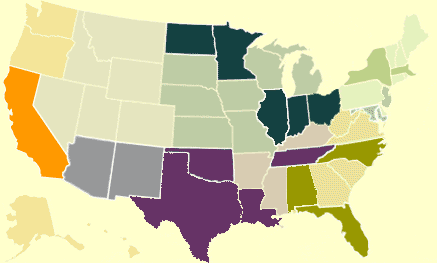
Here is the list by State [from the 2006 NCSHA Annual Survey Results] and the % of the units targeted <30% of the AMI:      

List by State and the % of the units targeted <30% of the AMI:
Alabama........................0%   
Illinois (Chicago)............10
 Missouri....................N/AV 
Pennsylvania...................6       
Alaska ........................0%   
Illinois (non-Chic)............0
Montana....................... 2 
Rhode Island.................. 3 
Arizona .......................0% 
Indiana........................8   
Nebraska...................... 0 
South Carolina................ 0   
Arkansas.......................7% 
Iowa...........................0 
Nevada........................ 1        
South Dakota.................. 0   
California................... 10% 
Kansas........................ 0 
New Hampshire..................0
Tennessee..................... 0 
Colorado...................... 3% 
Kentucky....................   7               
New Jersey....................31
Texas......................... 6       
Connecticut................... 9 
Louisiana....................  0
New Mexico.................... 2             
Utah...........................6  
Delaware...................... 4 
Maine......................... 0                 
New York ..................... 6        
Vermont...................... 41            
D. C........................ N/AV 
Maryland....................  15 
North Carolina................26       
Virginia...................... 0 
Florida....................... 2 
Massachus.................. . 14 
North Dakota.................. 3    
Washington ..................  9         
Georgia....................... 2           
Michigan.....................  7   
Ohio....................... N/AV   
West Virginia................  0 
Hawaii.........................2 
Minnesota................... .30            
Oklahoma...................... 0      
Wisconsin ...................  2                
Idaho.........................10
Mississippi.................. .0 
Oregon........................ 6 
Wyoming ......................10

Steve Gold, The Disability Odyssey continues

Back issues of other Information Bulletins are available online at http://www.stevegoldada.com with a searchable Archive at this site divided into different subjects.  To contact Steve Gold directly, write to stevegoldada@cs.com or call 215-627-7100.  

May National Conversation on Advising Self-Advocacy Groups

This is a reminder that you are invited to join us in a National Conversation on Advising Self-Advocacy Groups! Time is running out to register for our May teleconference. The registration deadline is April 28, 2008.

Important Note: If you have previously registered, there is no need to register again. You will be sent an update of the call-in numbers 3-4 days before the teleconference.

The self-advocacy movement has grown stronger over the years and is here to stay. Success, though, often depends on self-advocates getting the support they need. This support is offered by individuals called “advisors.” We understand that advising a self-advocacy group is not always easy. Advisors want to be helpful.  But sometimes advisors give too much help, or too little. And sometimes advisors don’t give the right kind of help at all. Anybody who advises a self-advocacy group understands how rewarding it can be…and how hard!

So let’s talk about it! We have hosted one teleconference and have just two left on advising self-advocacy groups: May 5, 2008 and June 2, 2008. Both will begin at 3pm ET and run for approximately 90 minutes each.

Each teleconference will include a 60 minute panel presentation and a 30 minute Question and Answer discussion. The panel participants will include advisors and self-advocates. We will learn a lot from these participants. Scroll down to read about the topics that will be discussed during each session.

The registration fee will be $25 per teleconference for ONE phone line. If you use a speaker phone you can gather people around and listen together! Additional lines will be $25 each.

To register for these teleconferences you can go to our website at www.theriotrocks.org and follow the link.

Or you can download the registration form directly here:  http://www.hsri.org/leaders/theriot/riot-teleconf-registration.pdf

For each session, the registration deadline is one week prior to the scheduled teleconference.  Don’t miss the cut-off!

Come join us for the National Conversation on Advising Self-Advocacy Groups!  Register Now!!

The topics we will cover during each session are described below:

Teleconference #2:  The Advisor – Coach, Guide or Doer? - May 5, 2008 – 90 minutes (3pm ET) - Registration Deadline:  April 28, 2008

1.      What task are advisors asked to do?  Styles, functions, stage of group evolution.
2.      What are the biggest lessons we have learned?
3.      What are the biggest challenges you have experienced?
4.      What do you worry about when you think about things?
5.      Relationship between person’s role as an advisor and their real life roles – conflicts?

Teleconference #3: Growing with the Self-Advocacy Movement June 2, 2008 – 90 minutes (3pm ET) Registration Deadline: May 26, 2008

1.      The evolving relationship between self-advocates and their advisors.
2.      What support do advisors need to do their job well?
3.      Indicators of a good advisor – what are they?

Warm regards, The Riot! Staff

New product published on the Quality Mall web site:

"The Frst-time Manager (5th ed)" - http://www.qualitymall.org/products/prod1.asp?prodid=4287

"The future of the human services workforce in Massachusetts" - http://www.qualitymall.org/products/prod1.asp?prodid=4264

"Wages, health benefits, and workers' health" - http://www.qualitymall.org/products/prod1.asp?prodid=4279

"Wage and benefits for Wisconsin Direct Support Workers: Findings of a Statewide Study" - http://www.qualitymall.org/products/prod1.asp?prodid=4280

"Teamwork in human services: Models and applications acoss the life span" - http://www.qualitymall.org/products/prod1.asp?prodid=4286

SIS VANTAGE - Perspectives on the Supports Intensity Scale - Volume 3, Issue 2, April 2008

http://www.siswebsite.org/cs/Newsletter

[nectac-enotes]
NECTAC eNotes - April 25, 2008

Current and past issues of eNotes can be viewed online at http://www.nectac.org/enotes/enotes.asp

In this Issue

  1. Trends in Infancy/Early Childhood and Middle Childhood Well-Being, 1994-2006
    Source: Foundation for Child Development - April 25, 2008
  2. Grant Notice - Head Start Innovation and Improvement Projects
    Source: Administration for Children and Families, Office of Head Start - April 21, 2008

[nectac-enotes]
NEILS Database Training Workshop

WHEN: June 16th-18th, 2008
APPLICATION DEADLINE: May 2nd, 2008
ONLINE APPLICATION

The University of Maryland in collaboration with SRI International and the Office of Special Education Programs (OSEP), U.S. Department of Education, will sponsor a two and half day advanced training workshop on the use of the National Early Intervention Longitudinal Study (NEILS) <http://www.sri.com/neils/> database. NEILS provides data on more than 3,338 children with disabilities or at risk for disabilities and their families through their experiences in early intervention and into early elementary school. Data on the characteristics of children and families, the services received, and the outcomes experienced can be analyzed through the NEILS dataset. The workshop will cover descriptions and applications of the NEILS database for research and policy studies.

For complete information go to http://largescaledb.umd.edu/workshops.php.
If you have questions, please contact: Ming-yi Cho, Project Coordinator of LSDB, Department of Special Education, University of Maryland, College Park, 301-405-6504, mingyi+AEA-umd.edu

Understanding Asperger Syndrome: A Professor's Guide

The Organization for Autism Research (OAR) released Understanding Asperger Syndrome: A Professor's Guide, a 12-minute video for use by college students with Asperger Syndrome as a tool to educate their professors, teaching assistants, and others about the disorder.  OAR produced the DVD in cooperation with the Global Regional Asperger Syndrome Project (GRASP) and Pace University in New York thanks to a grant from the Schwallie Family Foundation. The video is available now for viewing and download at no cost on OAR's Web site, www.researchautism.org/resources/AspergerDVDSeries.asp .

"The idea behind this series," said Peter Gerhardt, Ed.D., OAR's president, "is to have adults with Asperger Syndrome in effect teach what it means to be an adult with the disorder."

To that end, the video features two people with Asperger Syndrome, Michael John Carley from GRASP and Kiriana Cownesage, a doctoral student at NYU. Dr. Gerhardt also appears, providing information on "reasonable accommodations" in the college classroom. In addition to being posted on OAR's Web site, OAR will post it on YouTube.com and produce DVDs to be available upon request via the Web site by early June.

NIDRR Announces New Document - Emergency Management Research and People With Disabilities: A Resource Guide

The National Institute on Disability and Rehabilitation Research is pleased to announce the release of a new online publication: Emergency Management Research and People With Disabilities: A Resource Guide. This resource guide is the culmination of cooperative efforts by NIDRR, the Department of Education, the Research Subcommittee of the Interagency Coordinating Council on Emergency Preparedness and Individuals with Disabilities (ICC), and the New Freedom Initiative Subcommittee of the Interagency Committee on Disability Research. 

The guide provides a listing and description of research projects funded by the federal government and nonfederal entities, research
recommendations that have come out of conferences on emergency management and disability, and a bibliography of relevant research
publications.  It is our hope that this guide will facilitate the development and implementation of a nationwide research agenda on
emergency management and people with disabilities, so that we can develop a strong evidence base about the best ways to ensure the safety and security of people with disabilities in emergency and disaster situations. 

This report is available on the U.S. Department of Education's Web site at: http://www.ed.gov/rschstat/research/pubs, the National Center for the Dissemination of Disability Research Web site at http://www.ncddr.org/new/announcements.html the National Rehabilitation Information Center (NARIC) Web site at http://www.naric.com/public/pubs.cfm, and the Interagency Committee on
Disability Research Web site at http://www.icdr.us/.

Until Next week

The Arc of the United States,1010 Wayne Avenue, Ste. 650,Silver Spring, MD 20910, Phone: 301-565-3842, Fax: 301-565-3843, Email: mmwdc@info.thearc.org, Web: www.thearc.org

Disclaimer: MMWDC publishes information about issues and events that we believe to be important and likely to be of interest to advocates and others interested in inclusion of persons with disabilities in all parts of society.  However, MMWDC and The Arc of the United States and TheArcLink Incorporated do not necessarily endorse all events, sponsoring organizations and reports which appear.