Banner for Monday Morning in Washington, DC


Volume 08 Issue 14 April 7, 2008

Welcome to Monday Morning in Washington, D.C., published weekly by The Arc of the United States. We will bring to you news of interest to self advocates and their families, volunteers, professionals, and supporters of the disability movement. Please send any comments to mmwdc@thearc.org. You are welcome to reproduce and distribute items from Monday Morning in Washington, D.C., but please credit Monday Morning in Washington, D.C. (The Arc of the United States, 2007).

The Arc of the United States advocates for the rights and full participation of all children and adults with intellectual and developmental disabilities. Together with our network of members and affiliated chapters, we improve systems of supports and services; connect families; inspire communities; and influence public policy.

[NOTE: Having trouble reading this newsletter? Read it online.] [Past Issues]

IN THIS ISSUE:

[nectac-enotes] NECTAC eNotes - April 4, 2008

Current and past issues of eNotes can be viewed online at http://www.nectac.org/enotes/enotes.asp

April 4, 2008 - In this Issue:
  1. 2007 State Preschool Yearbook
    Source: National Institute for Early Education Research - March 28, 2008
  2. Designing Quality Rating Systems Inclusive of Infants and Toddlers
    Source: National Infant and Toddler Child Care Initiative
  3. New Report on the Long-Term Effects of Childhood Stress
    Source: Centers for Disease Control and Prevention - Retrieved March 31, 2008
  4. New Research Findings on Nonfatal Maltreatment of Infants in the United States
    Source: Centers for Disease Control and Prevention - April 4, 2008
  5. Children's Bureau Express - Special Section on Child Abuse and Neglect
    Source: Child Welfare Information Gateway - April 3, 2008
  6. Newly Awarded Autism Centers of Excellence to Further Autism Research
    Source: National Institutes of Health - April 1, 2008
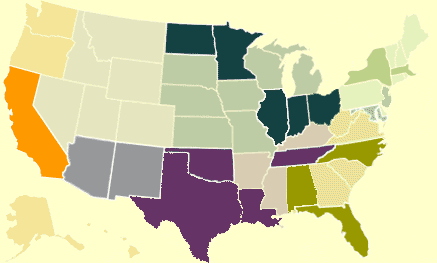
  7. Geography Matters: Child Well-Being in the States
    Source: Every Child Matters Education Fund - April 2, 2008

DisabilityInfo.gov 
Health News & Events  Update:  Learn the Signs--Act Early

April is National Autism Awareness Month. The Learn the Signs, Act Early campaign is issuing a challenge to help spread the word to people in communities across the country about the importance of monitoring development early in a child's life-the first step toward detecting a developmental delay and helping a child reach his or her full potential.

This information has recently been updated, and can be accessed by visiting this link: http://www.disabilityinfo.gov/digov-public/public/DisplayPage.do?parentFolderId=138.

DisabilityInfo.gov
Quality Health Care  Update:  Hospital Compare

This new tool provides information on how well hospitals care for all their adult patients relating to certain conditions or procedures. This information will help you compare the quality of care hospitals provide.

This information has recently been updated, and can be accessed by visiting this link:  http://www.disabilityinfo.gov/digov-public/public/DisplayPage.do?parentFolderId=148.

DisabilityInfo.gov
Aging  Update:  Recently Updated Resources for Seniors

Includes recently updated information on emergency preparedness and state contacts from the National Association of State Units on Aging.

You are subscribed to Aging for DisabilityInfo.gov. This information has recently been updated, and can be accessed by visiting this link:  http://www.disabilityinfo.gov/digov-public/public/DisplayPage.do?parentFolderId=5125.

REFERENCE POINTS:
Career Academies, Lessons Learned

A recent issue brief from MDRC focuses on lessons learned from research on Career Academies. Career Academies were first developed some 35 years ago with the aim of restructuring large high schools into small learning communities and creating pathways between high school and further education and the workplace. Since then, the Career Academy approach has taken root in more than 2,000 high schools across the country. The MDRC Career Academies study, which tracked students for four years after high school, suggests the following lessons:

Earnings impacts for young men in Career Academies appear to be linked to career awareness activities and work internships during high school. 

The potential benefits of partnerships between high schools and employers can be more fully realized when these partnerships are more structured and when schools can designate a full-time, non-teaching staff person to serve as a liaison with employers.

It may be necessary to improve the academic component of Career Academies in order to raise students' achievement on standardized tests and help them secure admission to college. More information is available online at http://www.mdrc.org/area_issue_20.html

REFERENCE POINTS:

Social Security Administration Extends Youth Transition Demonstration

In the March 13 Federal Register, the Social Security Administration (SSA) published notice that it intends to extend and alter the Youth Transition Demonstration (YTD). The YTD began in 2003 with seven sites in six states. The project intended to demonstrate and evaluate the effectiveness of altering Supplemental Security Income Rules (SSI) and providing employment services to youth who were receiving SSA benefits or were at risk of receiving benefits. SSA published notice that three of the original seven sites will be extended and that three additional sites will be included in the study until 2012. The final evaluation will include the seven original sites and the three additional sites. The notice is available online at http://a257.g.akamaitech.net/7/257/2422/01jan20081800/edocket.access.gpo.gov/2008/pdf/E8-5036.pdf.
From: Working for Tomorrow, a publication of CWD

REFERENCE POINTS:
Resources on Self-Employment

START-UP/USA - SELF-EMPLOYMENT, TECHNICAL ASSISTANCE RESOURCES, AND TRAINING
START-UP/USA provides technical assistance to support self-employment and small business ownership among people with disabilities. It includes a series of webcasts on using SSA's Plan for Achieving Self Support (PASS) to support small business ownership, developing a business plan, as well as information for veterans with disabilities. http://www.start-up-usa.biz/

SELF-EMPLOYMENT Q AND A: SUCCESSFUL ENTREPRENEURS WITH DISABILITIES SPEAK OUT!
This fact sheet from START-UP / USA highlights the experiences of several entrepreneurs with disabilities. Several individuals were asked the same set of questions. Their answers provide insights, encouragement, and cautions for other individuals with disabilities who might want to consider business ownership. Interestingly, these business owners' answers were not any different from other typical business owners without disabilities  http://www.start-up-usa.biz/resources/factsheets/speak_out.cfm

THE SMALL BUSINESS ADMINISTRATION
The SBA offers brief (30-minute) courses on how to start a business, develop a business plan, find start-up funding, assess financial needs, manage cash flow, conduct a marketing analysis, build your brand, build a website for e-commerce, ensure computer security, do business internationally, plan for retirement, and more. Some courses require online registration. For more information go to http://www.sba.gov/services/training/onlinecourses/index.html

ENTREPRENEURSHIP: A FLEXIBLE ROUTE TO ECONOMIC INDEPENDENCE FOR PEOPLE WITH DISABILITIES FACT SHEET
Entrepreneurship an increasingly popular and practical option for people with disabilities. Small business ownership and other self-employment options have the power to lower the traditionally high unemployment rate among people with disabilities. This ODEP fact sheet lists both the benefits of and barriers to self employment and highlights creative partnerships that are advancing entrepreneurship as an effective route to economic independence. The fact sheet can be found at http://www.dol.gov/odep/pubs/misc/entrepre.htm

ARCHIVED WEBCAST ON SELF-EMPLOYMENT AVAILABLE ON LINE
The National Research and Training Center recently held a web cast discussing self-employment, "Put Yourself in the Driver's Seat: Getting on the Road to Self-Employment or a Job that's Right for You". Highlights of the web cast include using the Internet as an employment resource, finding the right job, getting help for starting a business venture, and developing a business plan. Emphasis is on people with mental health disabilities, but anyone interested in work and entrepreneurship will find useful information in these three sessions. To access the recorded webcasts and the handouts, use the following link:
http://www.psych.uic.edu/UICNRTC/webcast_11_16_04.htm

NEW CD - SELF EMPLOYMENT FOR INDIVIDUALS WITH DISABILITIES
This CD, developed by T-TAP, provides the viewer with information on self-employment for individuals with disabilities. The CD contains audio and video presentations, fact sheets, related web links, and important contact information. Topics include Self-Employment for Individuals with Disabilities, Using Work Incentives to Fund Micro Enterprises, Developing a Business Plan, and Self-Employment as a Customized Employment Outcome. To purchase the CD, go to http://www.worksupport.com/store/index.cfm

FVND Share the Wealth Week of March 31
The Thinking Guide to Inclusive Childcare
:

http://www.disabilityrightswi.org/wp-content/uploads/2008/02/thinking-gu
ide-to-inclusive-child-care.pdf   Other documents-are
available to anyone at the Publications section of our website: http://www.disabilityrightswi.org

Medicaid Financing: Long-standing Concerns about Inappropriate State Arrangements Support Need for Improved Federal Oversight.

GAO-08-650T, April 3 http://www.gao.gov/cgi-bin/getrpt?GAO-08-650T Highlights - http://www.gao.gov/highlights/d08650thigh.pdf

The Governors Highway Safety Association (GHSA) has published a new best practices manual on occupant protection for children (OPC).

The new publication follows previously developed comprehensive guidelines and an assessment tool for state highway safety offices to examine their OPC programs and focus their resources where they are most needed.  The Occupant Protect for Children: Best Practices Manual is available as a PDF document online at www.ghsa.org

Ten Key Findings from Responsible Fatherhood Initiatives

focuses on fatherhood programs that were developed and implemented during the 1990s and early 2000s and assesses what has been learned and how to build on the early programs' successes. The brief is available at: http://www.urban.org/UploadedPDF/411623_fatherhood_initiatives.pdf.

New Internet Course: "Ready, Willing, and Able, Assisting People with Disabilities During Disasters",

Offered by TRAIN, a Project of the Public Health Foundation-Ready, Willing & Able is a free, professional, 2 hour, introductory, online training course offered for independent study and for continuing education.  It is designed for public health and hospital staff, health professionals, disaster preparedness managers, emergency response workers, and personnel working with people with disabilities. This course is offered through TRAIN, a project of the Public Health Foundation, funded by a grant from the Robert Wood Johnson Foundation, participating states, and the Centers for Disease Control and prevention. Information about this training can be found at https://www.train.org/DesktopShell.aspx The course name Ready, Willing, & Able and course number 1010882 are necessary to get to the course to register. The Office of Evaluation, and Policy Development has published proposed amendments to the regulations governing education records maintained by educational agencies and institutions under section 444 of the General Education Provisions Act, which is also known as the Family Educational Rights and Privacy Act of 1974, as amended (FERPA). Comments must be received on or before May 8, 2008. For complete information see the Federal Register Notice at http://www.ed.gov/legislation/FedRegister/proprule/2008-1/032408a.html

Fourth Quarter 2007 Letters of Clarification from Office of Special Education Programs (OSEP) Source:

U.S. Department of Education, Office of Special Education Programs - Retrieved March 28, 2008
Policy documents from the Office of Special Education Programs (OSEP) dated October 1, 2007 through December 31, 2007 related to the education of infants, toddlers, children, and youth with disabilities are now available online at http://www.ed.gov/policy/speced/guid/idea/letters/2007-4/index.html

Two new reports look at recent changes in the regulations and administration of government health insurance programs for children.

These changes include a requirement that states prove that they have enrolled at least 95 percent of all uninsured children eligible for the State Children's Health Insurance Program (SCHIP) or Medicaid before they can expand coverage to other children, and prohibiting the use of schools to administer Medicaid. The summaries offer clear explanations of the new rules. New Report Indicates Medicaid Rules Would Hurt Special Needs Children (First Focus) - http://firstfocus.net/pages/3377/ and Children Are the Real Victims of the CMS August Directive (Shriver Center) - http://www.povertylaw.org/news-and-events/poverty-action-report/march-2008/Children%20Are%20the%20Real%20Victims%20of%20the%20CMS%20August%20Directive.html

A new report from the National Early Childhood Transition Center (NECTC)

entitled Transition Issues and Barriers for Children with Significant Disabilities and from Culturally and Linguistically Diverse Backgrounds by Beth Rous, Carol Schroeder, Sarintha Stricklin, Ann Hains, and Megan Cox provides findings from a national study to identify issues and barriers encountered during transitions for young children with disabilities and their families. Transitions for two specific groups were targeted; (a) children with significant disabilities and their families, and (b) children with disabilities from culturally and linguistically diverse backgrounds and their families.  A short summary of the report is available at: http://www.ihdi.uky.edu/nectc/TRANSITIONALERTS/Delphi%20Findings.pdf The full technical report is available at http://www.ihdi.uky.edu/nectc/Documents/technicalreport/DelphiTechnical%20Report.pdf

New Rules from CMS take a bite out of the institutional bias

This proposed rule allows states -- which apply-- much greater flexibility to provide and focus on community long term services and
supports; but states must apply and be approved. The proposed rule makes important changes however it doesn't end the insitutional bias as it is for people with incomes at or below 150% of poverty, less than the 3X SSI of most nursing home rules, and allows States to put caps on the service covered. It is however a good step in the right direction...

The proposed rule will be published in the Federal Register on April 4, 2008, and will have a public comment period through June 3, 2008. Go to http://www.cms.hhs.gov/MedicaidGenInfo/Downloads/CMS2249P.pdf to view the complete proposed rule.

Build your Own Care Notebook Available Now

Dr. Charles Onufer, Director, Division of Specialized Care for Children at the University of Illinois at Chicago and his Title V CSHCN staff, created a web site called “Build Your Own Care Notebook”.  They are working with staff from the National Center of Medical Home Initiatives for Children with Special Needs. This web site is designed to assist families to build their own care notebooks for their own children with special needs. The web site allows parents to select different versions of care notebooks and put them together to build their own customized care notebook.

Dr. Onufer took 20 complete care notebooks and developed a template consisting of 6 major sections with their corresponding subsections.   For each of these subsections, up to 20 versions of that subsection was created in MS Word and Adobe PDF formats.  A parent then has the capability to review these different versions of the subsections that they would like to include in their child’s care notebook, and download those Word or PDF files to their computer.  

The next step was creating an online tutorial for parents to guide them in  "how to" use the online care notebook for their child or patient.  A field test of the tutorial was held for parents and health care professionals on February 5, 2008 at the Illinois Center for Rehab and Education.    Dr. Onufer and his staff are revising the tutorial based on comments from the field test and will work with National Center Staff on uploading the tutorial.   Currently, the care notebook web site is live and is located at: http://www.medicalhomeinfo.org/tools/care_notebook.html.  At the website you can download and print off pages that you prefer and are relevant to your child’s care, and create your own care notebook.    

Carmen KirkpatrickACT Team CoordinatorThe Fifth Freedom Network227 E. Washington Blvd., Suite 304Fort Wayne, IN  46802(260) 426-8789(866) 441-2577 carmen@fifthfreedom.orgwww.fifthfreedom.org

Informational Alert Forwarded by The Fifth Freedom Network
Courtesy of Center on Aging and Community

SELF ADVOCATE APPLICANTS NEEDED

The Building Leadership Series project has begun recruitment for 20 new participants for the Fall 2008 Series. Self-Advocates are encouraged to apply.

The 2008 Series consists of three two-day workshops over a three-month period at the Convention Center in Bloomington, Indiana.

Selected participants will receive:

Support staff, when needed, also receives compensation, meals and lodging.

The workshop topics are:

The workshops are co-trained with staff from IIDC and persons with disabilities. There is a good mix of interactive activities, video, discussion, role play and lecture. Workbooks accompany each topical area. Past participants have commented on how much they learned and committed to personal action steps upon arriving back home. New friendships developed, and personal growth was evident for all participants.

Help us spread the word to potential participants and provider agencies for the 2008 Series.For more information and applications, contact Jennie Todd via email - jeptodd@indiana.edu - or by phone: 812-855-6508.

Carmen Kirkpatrick, ACT Team Coordinator, The Fifth Freedom Network, 227 E. Washington Blvd., Suite 304, Fort Wayne, IN, 46802, (260) 426-8789, (866) 441-2577, carmen@fifthfreedom.org, www.fifthfreedom.org

AAIDD F.Y.I.--April 2008

April 2008, Vol.8, No.4

Visit www.aaidd.org/FYI/ to access current and past issues of this monthly newsletter. Topics discussed in this issue:

The New Professional: Leadership in Science, Practice, Policy, and Advocacy Graphic

AAIDD 132nd Annual Meeting, May 28 - 30, 2008, L'Enfant Plaza Hotel, Washington, DC, Register Now! <http://www.aaidd.org/Events/DC/registration.shtml>

New product on the Quality Mall web site:

"Mozart and the Whale" - http://www.qualitymall.org/products/prod1.asp?prodid=4748

Center for Personal Assistance Services Bulletin

April 2008--Volume 5, Issue 2
A pdf version of this newsletter can be found at http://www.pascenter.org/newsletter/CenterforPASBulletinApr08.pdf
Previous newsletters can be found at http://www.pascenter.org/newsletter

The Center for Personal Assistance Services provides research, training, dissemination and technical assistance on issues of personal assistance services (PAS) in the United States. Personal assistance services (PAS) refer to help provided to people with disabilities to assist them with tasks essential for daily living. These tasks include bathing, dressing, getting around, toileting, eating, shopping, remembering things, and other activities. PAS, along with assistive technology such as wheelchairs, text readers, and hearing aides, help people with disabilities to participate in activities at home, at work, and in the community.

The purpose of this newsletter is to provide the latest news on issues relating to formal and informal PAS, home & community-based services, the PAS workforce, and workplace PAS within and outside of the Center.

Great news from Inclusion International.

Inclusion International has been actively involved in the development and negotiations of the UNConvention on the Rights of Persons
with Disabilities, which began in 2001. Today we are very please to announce that the UN Convention has been ratified by 20 countries. The full list of countries that have ratified is available at http://www.inclusion-international.org/en/ii_priority_areas/undc/index.html

The Convention will enter into force 30 days after the 20th ratification.The countries that have ratified the Convention are now obliged to establish national arrangements for coordinating Convention implementation. The Conference of States Parties will convene not later than six months after the 20th ratification. They will appoint a Committee on the Rights of Persons with Disabilities at the time of their first meeting. The Committee will have the job of monitoring national progress, further interpreting the Convention Articles and dealing with complaints from within countries which have signed and ratified the Optional Protocol.

Today is a day for celebration. However, our work doesn't finish here.  *Only* the the countries that ratify the CRPD will be legally bound by it after it takes full legal force. Therefore it is important to encourage the other countries to ratify it so that their citizens, too, can enjoy the rights protected in the CRPD.

Updates will be posted on the Inclusion International website www.inclusion-international.org

Best regards - Raquel Gonzalez, Coordinator, Inclusion International, http://www.inclusion-international.org/ , http://www.inclusion-international.blogspot.com/

hcbs.org > Clearinghouse CLIPS: April 3, 2008
Real Choice Systems Change Grants: Compendium Seventh Edition


Summary: The Compendium contains basic information about each of the Real Choice Systems Change Grantees receiving awards in FY 2004. It includes information for the Family-to-Family and Systems Transformation Grantees who received awards in FY 2005 and FY 2006 plus the Person-Centered Planning Implementation awards in FY 2007. It is divided into sections corresponding to the different types of grants and year of award; the report helps Grantees identify others with similar goals and activities.
Topic(s): Accessibility, Aging Issues, Children and Family Services, Consumer Direction, Deficit Reduction Act, Developmental/Psychiatric Disabilities, Employment, Financing HCBS, Housing, Long-Term Care, Mental Health, Money Follows the Person, Peer Supports, Physical Disabilities, Quality, Resource Center, Single Point of Entry/No Wrong Door, State/Agency Information, Sustainability, Transition/Diversion from Institutions, Waiver, Workforce
Source: RTI - Systems Change Evaluation
More Info: http://www.hcbs.org/moreInfo.php/nb/doc/2191

Consumer Direction of Personal Assistance Services in Medicaid: A Review of Four State Programs

Summary: Consumer direction of personal assistance services (CD-PAS) is one model of service delivery that gives Medicaid beneficiaries varying degrees of control over hiring, scheduling, training, and paying personal care attendants. Program administrators, experienced with the programmatic features of CD-PAS in their state, were interviewed. Eligibility criteria, participant support services, and method of financial management used by Medicaid beneficiaries to pay direct care workers are discussed.
Topic(s): Children and Family Services, Consumer Direction, Long-Term Care, Quality, State/Agency Information
Source: Kaiser Commission on Medicaid and the Uninsured
More Info: http://www.hcbs.org/moreInfo.php/nb/doc/2197

Consumer Direction of Personal Assistance Services Programs in Medicaid: Insights from Enrollees in Four States

Summary: The Kaiser Commission on Medicaid and the Uninsured supported this focus group project of adults with disabilities in 4 states, who are enrolled in Medicaid Consumer Directed Personal Assistance Services programs. This research was undertaken to learn about Medicaid enrollees’ experiences in the program and their opinions about key features of the program including recruitment issues and degree of responsibility over services. Ways to improve upon the programs were also identified.
Topic(s): Children and Family Services, Consumer Direction, Long-Term Care, State/Agency Information
Source: Kaiser Commission on Medicaid and the Uninsured
More Info: http://www.hcbs.org/moreInfo.php/nb/doc/2198

Discussion Brief: Advancing Medicaid HCBS Policy: From Capped Consumer to Consumer-Directed

Summary: Over the last eight years, federal, state, and local governments have re-envisioned how to deliver and pay for an ever-growing caseload of elderly individuals and persons with disabilities who need services at home, in the workplace, or in more costly nursing facilities. This discussion provides a vision and a context for HCBS reform consistent with CMS’ vision for reforming post-acute care that focuses on addressing system barriers and informing and empowering health care consumers.
Topic(s): Accessibility, Aging Issues, Consumer Direction, Deficit Reduction Act, Financing HCBS, Long-Term Care
Source: Rutgers/NASHP
More Info: http://www.hcbs.org/moreInfo.php/nb/doc/2200

Discussion Paper: Redefining Quality: Participant-Directed Services

Summary: This paper explores the various participant-direction models, existing quality management strategies, and the potential for change that allows participant-directed quality management systems to remain true to the core values they were founded upon. Participant-directed programs face unique challenges in meeting federal requirements while remaining faithful to the principles of participant-direction. Well-defined roles and responsibilities are essential and will directly influence the design.
Topic(s): Accessibility, Aging Issues, Consumer Direction, Physical Disabilities
Source: Rutgers/NASHP
More Info: http://www.hcbs.org/moreInfo.php/nb/doc/2199

Medicaid Demonstration Waivers: Recent HHS Approvals Continue to Raise Cost and Oversight Concerns

Summary: This report by the GAO reviewed the extent to which HHS ensured that Section 1115 Waiver demonstrations will be budget neutral to the federal government and maintain Medicaid’s fiscal integrity. Specifically, the report examined the projected spending associated with two waivers granted to Florida and Vermont. Review the shortcomings in these specific approvals as well as recommendations for further congressional oversight and HHS procedural reform.
Topic(s): State/Agency Information, Waiver
Source: Government Accountability Office (GAO)
More Info: http://www.hcbs.org/moreInfo.php/nb/doc/2202

Medicaid Infrastructure Grant Announcement 2008

Summary: CMS was soliciting proposals to develop the infrastructure to support competitive employment opportunities for people with disabilities. Funding is intended to facilitate enhancements to state Medicaid programs and services, to promote linkages between Medicaid and other employment-related service agencies, and to develop a comprehensive system of employment supports. The demonstration period runs Jan–Dec 2008. This prior solicitation acts as a resource for terms, conditions and guidance.
Topic(s): Developmental/Psychiatric Disabilities, Medicaid Infrastructure Grant, Physical Disabilities, Workforce
Source: CMS
More Info: http://www.hcbs.org/moreInfo.php/nb/doc/2188

Profile of the 2008 Medicaid Infrastructure Grantees - 2008

Summary: Which states received MIG grants in 2008? You can review this list of 40 states that were awarded basic, comprehensive and conditional grants. The list also contains the contact information for each state's project as well as links to their website.
Topic(s): Medicaid Infrastructure Grant, State/Agency Information
Source: Ascellon Corporation
More Info: http://www.hcbs.org/moreInfo.php/nb/doc/2187

Promising Practices in HCBS: Maryland - Encouraging Evidence-Based Practices in Supported Employment

Summary: Maryland's vocational rehabilitation and mental health agencies jointly promote supported employment evidence-based practices (EBP) for people with mental illness. The state provides a payment for EBP services and monitors fidelity to EBP. Training, technical assistance, and small, time-limited grants have assisted providers transitioning to EBP. More than two-thirds of Maryland’s supported employment providers either have adopted EBP or are implementing these practices.
Topic(s): Employment, Mental Health
Source: Thomson Healthcare (formerly Medstat)
More Info: http://www.hcbs.org/moreInfo.php/nb/doc/2196

The Administration’s Medicaid Regulations: State-By-State Impacts

Summary: This report details the state-by-state impacts of seven regulations issued by the CMS that would make major wide-ranging changes. Areas affected include cost limits for public providers, graduate medical education, outpatient hospital services, provider taxes, rehabilitative services, school administration and transportation services, and case management services. The website offers an interactive map showing how proposed regulations would impact each state.
Topic(s): Financing HCBS, State/Agency Information
Source: House Committee on Oversight and Government Reform
More Info: http://www.hcbs.org/moreInfo.php/nb/doc/2201

One-Stop Toolkit Resources of the Week Technical Assistance Project - www.onestoptoolkit.org
ACTION:  Funding Opportunity—U.S. Department of Education

Office of Special Education and Rehabilitative Services: Overview Information; Projects With Industry (PWI) Program; Notice Inviting Applications for New Awards for Fiscal Year (FY) 2008

[Federal Register: March 28, 2008 (Volume 73, Number 61)] - http://edocket.access.gpo.gov/2008/E8-6453.htm
DATES:

SUMMARY.  Purpose of Program: The PWI program creates and expands job and career opportunities for individuals with disabilities in the competitive labor market by engaging the talent and leadership of private industry as partners in the rehabilitation process. Projects identify competitive job and career opportunities and the skills needed to perform those jobs, create practical settings for job readiness and training programs, and provide training, job placements, and career advancement services.

Each grantee must establish a Business Advisory Council which must "identify job and career availability within the community, consistent with the current and projected local employment opportunities identified by the local workforce investment board for the community under section 118(b)(1)(B) of the Workforce Investment Act of 1998; (2) identify the skills necessary to perform the jobs and careers identified; and (3) prescribe training programs designed to develop appropriate job and career skills, or job placement programs designed to identify and develop job placement and career advancement  opportunities, for individuals with disabilities (see 29 U.S.C. 795(a)(2)(A))."

ELIGIBLE APPLICANTS.  Eligible applicants include employers, nonprofit agencies or organizations, designated State units, labor unions, community rehabilitation program providers, trade associations, Indian tribes, tribal organizations, and other agencies or organizations, including faith-based and community organizations, with the capacity to create and expand job and career opportunities for individuals with disabilities.

Access the URL to read the full notice, which includes full background, describes the statutory requirements for program operation, enumerates the competitive priorities, summarizes the application requirements and  Federal review criteria, and lists the relevant contact information and web resources.

DOL News Release:  U.S. Labor Department and Social Security Administration share technology to provide more efficient access to online benefits information

April 2, 2008 - http://www.dol.gov/opa/media/press/oasam/oasam20080437.htm

A newly designed version of the U.S. Social Security Administration's (SSA) online Benefit Eligibility Screening Tool (BEST) application, powered by the U.S. Department of Labor-managed GovBenefits.gov, has been launched to make it easier for individuals to determine their eligibility for 17 different Social Security programs.

GovBenefits.gov is the federal government's official source for information about more than 1,000 benefit programs available through 16 agencies. BEST is SSA's Web-based tool for information about benefits administered by that agency.

Visitors can access the new screening tool at http://best.ssa.gov. GovBenefits.govwww.GovBenefits.gov is a Bush Administration e-gov initiative designed to make government more accessible to citizens. The Web site has attracted more than 26 million visitors since it went online in April 2002.

How Do Medicaid Buy-In Participants Who Collect Social Security Disability Insurance Benefits Use SSA Work Incentive Programs?

Mathematica Policy Research, Inc.
- http://www.mathematicampr.com/publications/pdfs/WWDsocialsecurity.pdf

[The following is excerpted from a press release on the publication of this brief.]

Medicaid Buy-In participants who receive Social Security Disability Insurance (SSDI) benefits may not be taking full advantage of the available work incentive programs that can improve their prospects of finding employment and attaining economic self-sufficiency. The seventh policy brief in a new series on working with disability from Mathematica Policy Research, Inc., reveals that only 23 percent of Medicaid Buy-In participants who received SSDI benefits between 2000 and 2005 took part in a work incentive program. The brief summarizes Mathematica's study of participation rates for four specific SSDI work incentive programs: Trial Work Period, Extended Period of Eligibility, Impairment-Related Work Expenses, and Ticket to Work.

Many SSDI beneficiaries may avoid working or earning above the substantial gainful activity level for fear of losing their benefits. To encourage working-age adults with disabilities to seek employment or earn more income, the Social Security Administration offers work incentive programs that provide various benefits, from continuation of benefits while working to free employment services that include job training and placement.

As the brief explains, the Trial Work Period program was the most utilized among Buy-In participants who receive SSDI benefits, with approximately 16 percent of beneficiaries participating. The Extended Period of Eligibility program had the second highest participation rate, 7 percent, with Ticket to Work running a close third with 6 percent of beneficiaries participating. Less than one percent utilized the Impairment-Related Work Expenses incentive.

A state-by-state comparison of participation rates gives greater insight into how some state-designed programs can be more effective than others. Nebraska, for example, had the highest share of participants (58 percent) in any program. This trend may have been influenced by the design of the state's Buy-In program, which waives the unearned income limit for all SSDI beneficiaries who participate in the Trial Work Period or Extended Period of Eligibility programs. With the largest participation rate for the Ticket to Work program (25 percent), Vermont offers another example of an effective Buy-In design feature. The state provides centralized benefits counseling services and Buy-In outreach at state vocational rehabilitation agencies, thus educating beneficiaries about available incentive programs and increasing their likelihood of participation.

Until Next week

The Arc of the United States,1010 Wayne Avenue, Ste. 650,Silver Spring, MD 20910, Phone: 301-565-3842, Fax: 301-565-3843, Email: mmwdc@info.thearc.org, Web: www.thearc.org

Disclaimer: MMWDC publishes information about issues and events that we believe to be important and likely to be of interest to advocates and others interested in inclusion of persons with disabilities in all parts of society.  However, MMWDC and The Arc of the United States and TheArcLink Incorporated do not necessarily endorse all events, sponsoring organizations and reports which appear.