Banner for Monday Morning in Washington DC with The Arc logo and a yellow-gold sun rising over a green earth


Volume 07                                                                     Issue 7                                                            February 19, 2007              


Welcome to Monday Morning in Washington, D.C., published weekly by The Arc of the United States. We will bring to you news of interest to self advocates and their families, volunteers, professionals, and supporters of the disability movement. Please send any comments to mmwdc@thearc.org. You are welcome to reproduce and distribute items from Monday Morning in Washington, D.C., but please credit "Monday Morning in Washington, D.C. (The Arc of the United States, 2007)."


The Arc of the United States advocates for the rights and full participation of all children and adults with intellectual and developmental disabilities. Together with our network of members and affiliated chapters, we improve systems of supports and services; connect families; inspire communities; and influence public policy.


[NOTE: Having trouble reading this newsletter?  Read it online.]

  IN THIS ISSUE: 


 Klinefelter Syndrome: A Review of Genetics, Clinical Presentations, and Treatments  


47,XXY/Klinefelter Syndrome is believed to be the most common genetic disorder, affecting approximately 1 in 600 males.   Despite the condition's high prevalence, and the high rate of psychological disorders, social difficulties, physical and psychological manifestations of hypogonadism and infertility, only 35 percent of all males with the condition are ever diagnosed. 


The University of Tennessee College of Medicine at Chattanooga and the EP Foundation for Education, Inc. proudly invite interested families and friends to attend a free on line interactive live TV quality educational seminar, delivered by EP LiveOnLine in cooperation with EP Global Communications Inc (a/k/a Exceptional Parent), and Vemics Inc on February 21, 2007 from 6:30 PM to 9:30 p.m. ET


The program purpose is to increase professionals' awareness of 47,XXY Klinefelter Syndrome in the diagnosis and treatment of children with developmental delays.  Seminar participants will discuss the features and variable presentations of XXY syndrome in children


Participants include:  Moderator Rick Rader, M.D. and Virginia Cover MSW, MBA

Director, Morton J. Kent Habilitation Center, Cody Center for Autism and Developmental Disabilities Orange Grove Inc., Chattanooga, TN Stonybrook, NY; and faculty members:  Andrew R. Zinn MD, PhD Associate Professor of Internal Medicine, Nicole Tartaglia MD University of Texas Southwestern Medical School, Fellow in Developmental and Behavioral Pediatrics McDermott Center for Human Growth and Development, M.I.N.D. Institute Sacramento, California Dallas, Texas


Grantor Support: Solvay Pharmaceuticals through an unrestricted educational grant


Registration: There is no registration fee to participate in this program.  It is free to all parents and friends who register to attend.  For complete program details please go to www.epliveonline.com  and click on upcoming events.


CME Credits: Provided at no cost to participants who qualify


Center for Children and Families

States Affected by Proposals to Reduce SCHIP Coverage Options


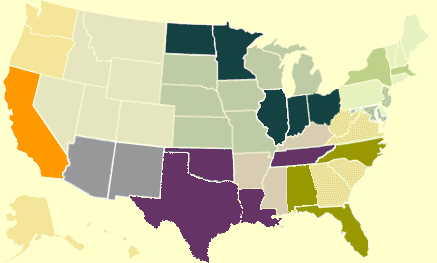
With reauthorization of the State Children's Health Insurance Program (SCHIP) on the congressional horizon, some policymakers have suggested that Congress should impose new limits on who can be covered with SCHIP funds. In President Bush's fiscal year 2008 budget proposal, he called on Congress to " refocus the program on children at or below 200 percent of the poverty levels." If this Bush administration proposal is adopted, it could result in the loss of coverage for children and low-income adults (mostly parents). Overall, more than half of states (26 states) could be potentially affected by this proposal, according to CCF researchers. (See attached or go to < http://ccf.georgetown.edu >)


[nectac-enotes] NECTAC eNotes - February 16, 2007

NAEYC's Recommendations to the 110th U.S. Congress


Source: NAEYC - Retrieved February 15, 2007

The National Association for the Education of Young Children (NAEYC) recently published its Recommendations to the 110th U.S. Congress online at http://www.naeyc.org/policy/federal/pdf/CALLtoACTION107Combo.pdf


CDC Releases New Data on Autism Spectrum Disorders


Source: Centers for Disease Control and Prevention - February 8, 2007

On February 8, 2007 the Centers for Disease Control and Prevention (CDC) reported findings from the first and largest summary of prevalence data from multiple U.S. communities participating in an autism spectrum disorder (ASD) surveillance project. The results showed an average of 6.7 children out of 1,000 had an ASD in the six communities assessed in 2000, and an average of 6.6 children out of 1,000 having an ASD in the 14 communities included in the 2002 study. This equals approximately 1 in 150 children in these communities. For more information go to http://www.cdc.gov/od/oc/media/pressrel/2007/f070208.htm


Impact: Feature Issue on Supporting Success in School and Beyond for Students with Autism Spectrum Disorders


http://ici.umn.edu/products/impact/193/default.html


Study Examines the Feasibility of Expanding Mental Health Services for Young Children


Source: Journal of the American Academy of Child and Adolescent Psychiatry - Retrieved February 12, 2007


The findings of a study published in the February 2007 issue of the Journal of the American Academy of Child and Adolescent Psychiatry concludes that training mental health staff to provide treatment to infants and preschool children and families in public mental health settings is feasible and leads to an increase in numbers of children served. An abstract of the article is available at http://www.jaacap.com/pt/re/jaacap/abstract.00004583-200702000-00003.htm


The full citation for the article is: Knapp PK, Ammen S, Arstein-Kerslake C, et al. 2007. Feasibility of expanding services for very young children in the public mental health setting. Journal of the American Academy of Child and Adolescent Psychiatry 46(2):152-161.


[WRIGHTSLAW] Transition Services, Transition Plans, a Great Transition Case - Special Ed Advocate (02/13/07)


Download the printer-friendly version of this issue: http://www.wrightslaw.com/nltr/07/nl.0213.htm

Disabled People and Poverty in 2007, Information Bulletin # 197 A

After I sent out #197, I was provided the data for 2007, so I've redone it with current data.

People with disabilities between 18-64, who have never been able to work or who can no longer work, receive either Supplemental Security Income (SSI) and/or Social Security Disability Insurance (SSDI).  Based on the following data, our national government and elected officials seem to have forgotten to address disability and poverty. Maybe the same can be said for disability advocates in many states.

Nationally, there are about 10 million people between 18 and 64 who are disabled and received either SSDI and/or SSI.  It's important to break down these numbers to understand the extent of poverty these people face.

First, let's look at the nearly 6 million people with disabilities in this age category who received SSDI only.  These 6 million received an average of about $950 a month in SSDI - only 10 % above the 2007 federal poverty level. The federal poverty level for a single person is $10,210 a year or $851 a month and $13,690 or $1,141 a month for a couple.  As with all "averages," there are many folks below the $950 a month.

Second, there are 3 million disabled people between 18 and 64 who received SSI only.  The monthly SSI federal payment averaged $469 a month -- 55% BELOW the 2007 federal poverty level.  If a person were lucky enough to live in one of the 30 states that provide both the SSI federal payment and a state optional and mandatory supplementation to the federal SSI payment, then their total monthly benefits are about $623 a month - still 27% BELOW the 2007 poverty level.

Third, there are about 1 million people who received a combination of SSDI and SSI. These people receive a combination of SSDI and SSI because their SSDI benefits fell well below their State's SSI payment.  They are then eligible for a SSI payment up to the SSI benefit level. (Obviously, these are the poor SSDI recipients who have no other source of household income.)

These 1 million people received in 2006 an average SSI payment of $189 a month to supplement their SSDI.  This means these 1 million were, before they became disabled, low-income workers and/or were sporadically employed and did not earn enough from wages to receive an SSDI benefit that exceeded the minimum SSI benefits. Since their SSI benefits with their SSDI benefits equaled only the minimum SSI level, their total monthly combined benefits will total about $623 a month.

When viewing people with disabilities and poverty, we should look at those 4 million SSI recipients with disabilities between 18-64 who receive SSI only or a combination of SSI and SSDI all of whose incomes fall at least 27% BELOW the 2007 federal poverty level.

If these figures were not discouraging enough, then there are the resource limitations and exclusions that must be satisfied to qualify for SSI: countable income cannot exceed $2,000 for an individual and $3,000 for a couple.  This has not changed since the SSI law was enacted more than 30 years ago!

We all know that of the 6 million people with disabilities receiving SSDI only, there are many people who would qualify for a SSI payment, because their monthly SSDI benefits are low, but they do not apply for SSI because the resource limitations. They are discouraged from applying for the measly SSI monthly income solely because they have saved more than $2,000 and are afraid to part with it in order to qualify for SSI.

If you want to know whether or not your State pays an optional state supplementation to SSI, the number of disabled who receive it, and the amount, if any, you can find it at http://www.socialsecurity.gov/policy/docs/progdesc/ssi_st_asst/2006/index.html click on your state and look at Tables 1 and 2.

Disability Advocates -

1.    Why should any person with a disability have to survive on less than the poverty level?  Isn't it time for a state campaign to raise SSI levels to the poverty level?

2.    If your State does not provide State Supplementation to federal SSI payments, how can any elected official expect a person with disability to survive on $469 or even $603 a month?  Why doesn't your State provide it?  Why haven't the disability advocates taken up this issue?

3.    What about national legislation to increase the minimum federal SSI and to significantly increase or eliminate altogether the resource limitations? What are our national inside the beltway advocates doing to address this issue? With the recent talk of a national minimum age, what about a national SSI payment at least at the poverty level?


Steve Gold, The Disability Odyssey continues


NIDRR Announces New Grant Opportunities in Emergency Management and Disability


The National Institute on Disability and Rehabilitation Research (NIDRR) in the U.S. Department of Education is pleased to announce notices inviting applications for two new research grants in the areas of: "Emergency Evacuation and Individuals with Disabilities" and "Emergency Management Technologies." 


"Emergency Evacuation and Individuals with Disabilities" is a three-year Disability and Rehabilitation Research Project (DRRP) with projected funding at $450,000 per year.  "Emergency Management Technologies" is a five-year Rehabilitation Research and Engineering Center (RERC) with projected funding at $950,000 per year.


NIDRR will hold pre-application meetings (by teleconference) for anyone interested in applying for the grants.  Please see the notices inviting applications for the dates and times of the pre-application meetings.  We also will conduct peer-reviewed competitions to evaluate the applications we receive. 


Notices inviting applications for these (and other) NIDRR grants were published in the Federal Register on February 14, 2007 and are available at http://a257.g.akamaitech.net/7/257/2422/01jan20071800/edocket.access.gpo.gov/2007/E7-2349.htm or on the Department of Education website at http://www.ed.gov/news/fedregister/index.html


Applicants:  Complete grant application packages for both competitions are available at both http://www.ed.gov/fund/grant/apply/grantapps/index.html and www.grants.gov.  Please note: When downloading the application package via Grants.gov you are given three boxes to fill in -- the FON; the CDFA and the ID -- you should only fill in one of these boxes in order to open the application package.  If submitting electronically via Grants.gov you will have to read the instructions very carefully. Please log onto www.grants.gov   <http://www.grants.gov/> early to register - this is a 3-5 day process. Institutes of Higher ED - Please check with your grants/sponsored programs office to see who there will be submitting them for you. Do not wait to the last hour on the closing date to apply. Electronic applications received at the Department via grants.gov must be received/logged in, on the due date, by 4:30 p.m. Washington, DC time in order to be considered.


Applications are due on or before MONDAY, April 16, 2007.  


Peer Reviewers:  Persons interested in being a peer reviewer for either of these competitions should send a detailed resume to OSERSPRS@ed.gov, with copies to bonnie.gracer@ed.gov   and thomas.corfman@ed.gov.   Please include a cover letter describing your areas of expertise.  You must include your academic credentials, complete contact information and a description of your experience in relevant areas (e.g., research, engineering, emergency management, disability).  If you already sent your resume to Bonnie Gracer you do not need to resend it.   Federal employees are not eligible to be peer reviewers for these competitions.


Please feel free to forward this message to interested parties.


Children's Health Insurance: States' SCHIP Enrollment and Spending Experiences and Considerations for Reauthorization.


http://www.gao.gov/cgi-bin/getrpt?GAO-07-501T Highlights - http://www.gao.gov/highlights/d07501thigh.pdf


NEW ONLINE REPORT EXAMINES IMPLICATION OF BASING ELIGIBILITY FOR SUBSIDIZED HEALTH COVERAGE ON THE FEDERAL POVERTY LEVEL

CONTACTS: Craig Palosky, (202) 347-5270 or cpalosky@kff.org ; Tiffany Ford Fields, (202) 347-5270 or tford@kff.org

Federal and state health care programs often base income eligibility for subsidies for health insurance coverage on how an individual's or family's income compares to the federal poverty level (FPL).  Rather than a set income limit, this measure provides annual updates for cost of living and is adjusted for family size.  However, a new paper from the Kaiser Family Foundation illustrates how linking income-related eligibility requirements for subsidized health coverage this way may not provide a consistent level of financial protection over time because health insurance costs are increasing more rapidly than poverty levels. The paper can be found online at: http://www.kff.org/insurance/snapshot/chcm021507oth.cfm

In general, the federal poverty level (in 2007, $17,170 for a family of three) serves as the benchmark for determining when low-income people can obtain many government-subsidized health benefits. For example, children in families with incomes less than twice FPL are eligible for subsidized coverage through Medicaid or the State Children's Health Insurance Program in most states.  Also, under the new Massachusetts law that requires residents to purchase health insurance, free coverage is available to people in families with incomes under FPL; people in families with incomes up to three times FPL can receive assistance covering a portion of premiums (a declining share as income rises); and those with incomes above three times FPL are expected to pay the full cost of health insurance.

However, in recent years, the cost of health insurance has risen much faster than the federal poverty level on which eligibility is based.  Between 1996 and 2004, premiums for family health insurance more than doubled and premiums for individual coverage rose 86 percent, while the FPL increased only about 20 percent.  For a family whose income was just over an eligibility threshold based on FPL at the beginning of this period, the share of family income required to purchase health insurance would rise over the period by about 55% for single coverage and by about 68% for family coverage.

This dynamic has important implications for policymakers.  As long as health insurance premiums continue to rise more quickly than the costs of other goods and services, eligibility thresholds tied to FPL (or a multiple of FPL) will not maintain a consistent level of financial protection against rising health insurance costs.  Protecting low and moderate income families from spending too high a percentage of their income on health insurance would require subsidy structures that reach an expanding income range over time.  Options might include increasing income thresholds for subsidies at the same rate as the cost of health insurance or making periodic adjustments in thresholds to account for the rapid growth in health insurance premiums relative to incomes and other costs. 

The paper, “Effect of Tying Eligibility for Health Insurance Subsidies to the Federal Poverty Level,” is the latest in the Foundation's online Snapshots: Health Care Costs series.  Each of the Snapshots are written by Kaiser Family Foundation staff and uses charts, data and analysis to provide insight into key.disabilityinfo.gov/digov-public/public/DisplayPage.do?parentFolderId=13

 < governments and businesses people, for care health of costs rising the curbing strategies weigh country across Washington in policymakers as discussion fact-based well-informed a encourage addressed, be can how understanding increase help to intended are Snapshots The States. United cost affecting issues>


DisabilityInfo.gov 

Youth, Families & Seniors  Update:  Federal Interagency Coordinating Council on Access and Mobility Celebrates 3rd Anniversary of United We Ride


One of the many functions of the Council is to simplify access to transportation services for persons with disabilities, persons with low incomes and older adults. This information has recently been updated, and is now available. http://www.disabilityinfo.gov/digov-public/public/DisplayPage.do?parentFolderId=133


Employing People with Disabilities  Update: Workforce Innovations 2007


This year's Workforce Innovations conference will take place July 17-19, 2007 in Kansas City, MO. The conference explores how businesses, education and workforce systems and others can collaborate to break down boundaries and create a competitive advantage. This information has recently been updated, and is now available. http://wwwan>

Vocational Rehabilitation in Employment Update: Self-Employment as a Customized Employment Outcome


Some people with disabilities will consider self-employment as a career option due to a lack of available employment opportunities in the community. However, difficulty finding a job should not be the only reason that a person decides to start a business. Self-employment should be viewed as another approach to customizing employment for someone who happens to have a disability. This information has recently been updated, and is now available - http://www.disabilityinfo.gov/digov-public/public/DisplayPage.do?parentFolderId=5094 & http://www.disabilityinfo.gov/digov-public/public/DisplayPage.do?parentFolderId=41


Employment News & Events Update:  Call for Nominations for the 2007 New Freedom Initiative Award


U. S. Secretary of Labor Elaine L. Chao invites nominations for the 2007 Secretary of Labor's New Freedom Initiative Awards. This marks the sixth year that Secretary Chao will be presenting awards to businesses, non-profit organizations and individuals who have demonstrated exemplary and innovative efforts in enhancing employment opportunities for workers with disabilities. This information has recently been updated, and is now available. http://www.disabilityinfo.gov/digov-public/public/DisplayPage.do?parentFolderId=10


School to Work Update:  Work and Benefits Calculators


Disability Benefits 101 (DB101) helps workers, job seekers, students and service providers understand the connections between work and benefits. In addition to the Benefits-to-Work Calculator and the Job-to-Job Calculator, a new calculator called School and Work is now available for youth with disabilities. This information has recently been updated, and is now available. http://www.disabilityinfo.gov/digov-public/public/DisplayPage.do?parentFolderId=5147


Minority Populations  Update:  National Minorities with Disabilities Coalition (NMDC)


The National Minorities with Disabilities Coalition (NMDC) addresses disability issues relating to all communities of color.  This information has recently been updated, and is now available. http://www.disabilityinfo.gov/digov-public/public/DisplayPage.do?parentFolderId=158  


2007 Bridges to Employment Conference:  Exploring Career Opportunities for Latinos with Disabilities 

Radisson Miami Hotel - Miami, FL - June 13-15, 2007

http://www.proyectovision.net/english/bridges/index.html 

The Bridges to Employment Conference is a national event that brings employers, jobseekers and Latino and disability service providers together to help connect Latinos with disabilities to employment opportunities.  The program features a unique mix of informative workshops and roundtables that address topics including the effects of recent legislation on jobseekers, employers and service providers; assistive technology in the workplace; disability employment rights; employer narratives about how to recruit/employ people with disabilities; financial literacy and asset-building for jobseekers, and more. 

The conference registration fee is $150. Scholarships are available to cover the registration fee for low-income/unemployed Latinos. 

Program and speaker details will be available shortly. 

The conference is put on by Proyecto Visión, national technical assistance center on employment funded by the Department of Education's Rehabilitation Services Administration based at the World Institute on Disability, in partnership with Best Buddies and Presenting Sponsor AT&T.  

Access the URL for more information including registration. 

Latinos with Disabilities in the United States: Understanding & Addressing Barriers to Employment - Proyecto Vision 

http://www.proyectovision.net/english/news/31/report.html

Proyecto Visión, the National Technical Assistance Center on Employment for Latinos with Disabilities, released a report that examines the low employment status of disabled Latinos and recommends ways to improve their job and other opportunities. Latinos with Disabilities in the United States: Understanding & Addressing Barriers to Employment presents a snapshot of this growing population. It outlines factors affecting the extent of participation, and degree of success, of disabled Latinos in the service delivery system; highlights innovative research and employment projects that are working to reduce barriers; and presents profiles of individuals and families who have attained success and others who have fallen between the cracks.  

The report combines information gathered from reviewing scores of studies and research papers with the first-hand knowledge that Proyecto Visión and its regional partners gleaned from five years of providing localized technical assistance to disabled Latinos across the U.S. in diverse communities including Chicago, Los Angeles, Miami, New York City and Salinas, California.  It summarizes innovative job preparation and placement programs providing culturally responsive services that address the multiple dimensions of jobseekers' identities, including disability, race/ethnicity, language and gender. In addition to featuring successful project models, the paper outlines four priorities for improving the success of vocational programs at including and serving disabled Latinos:


REFERENCE POINTS:  National Council On Disability Report Identifies Six Strategies To Make American Communities More Livable For People With Disabilities

Third in the series of reports by the National Council on Disability (NCD) on how to make American communities more livable for people with disabilities, Creating Livable Communities presents six strategies that can be implemented at the federal and local levels in the U.S. to promote
community living for people with disabilities. Each strategy is illustrated by actual initiatives being practiced at federal and state levels. The report also contains eight recommendations for the legislative and executive branches of the federal government and states, so that they can proactively
adopt strategies and policies that invest in livable community outcomes. The report can be found at http://www.ncd.gov/newsroom/publications/2006/livable_communities.htm#executive


The two previous NCD reports include Livable Communities for Adults with Disabilities (2004) and The State of 21st Century Long-Term Services and Supports: Financing and Systems Reform for Americans with Disabilities (2005).
 

NCWD/A News 6(1): February Events and Opportunities

WIA's next stage-- are you informed?


Important changes may be in the works for the Workforce Investment Act. A new policy document by expert Bobby Silverstein lays out the information so you can become knowledgeable about upcoming issues. Analysis of Proposed WIA Rulemaking - http://www.onestops.info/website.php?page=policy_silverstein#wia07


Internship and Employment Opportunities

We know some of you may be waiting for the right time and the right job to make an employment transition. Others of you may be anticipating a move due to a spouse's work transfer, and you haven't quite figured out where you might work once in your new location.

For students, spring break is around the corner as are the makings of summer plans. Some of you will be graduating and looking for full-time employment. Others of you will be looking for a great internship experience.

Below, you'll find one new internship opportunity and one new employment opportunity both with unique disability focus. Both are in the D.C. area.

However, we know our JFA readers hail from all across the country, so be reminded that you can also view an extensive listing of nationwide employment and internship opportunities on the AAPD website: http://www.aapd.com/employment/indexemploy.php  http://www.aapd.com/employment/internships.php
 

New Reports on the Web from Families USA


We've collected information on several new reports and other resources available on the Web that we hope you'll find interesting and useful. Descriptions and links appear below. You can also view these resources on our Web site - http://www.familiesusa.org/resources/tools-for-advocates/new-on-web/new-on-the-web-35.html


State of Mine Goes National, and Needs Your Stories

State of Mine, a Youth Run Mental Health Advocacy Organization started in Albuquerque, New Mexico, is opening up to a national level. 

State of Mine was started three years ago in Albuquerque, New Mexico by teenagers who wanted to make a difference in the community's perceptions of individuals with psychiatric disabilities. Over the next three years, the organization grew to work with students in high schools and colleges directing awareness campaigns and competitions, creating community awareness initiatives, producing documentaries, and holding local events to promote awareness and decrease stigma.

Curricula and training have been developed for youth advocacy and legislative advocacy trainings. These trainings help youth to become community advocates and assist individuals in working within a legislative session to achieve a desired outcome.

The newest project developed by the leaders at State of Mine is the creation of a book of recovery stories, or success stories, which will tell of the lives of amazing individuals who have struggled with psychiatric disabilities and mental illness and how they have gone on to live successful lives.

In order to complete this project, State of Mine needs your help. If you are interested in sharing your story or being interviewed for this book, please email stateofmine2007@yahoo.com for more information.

Source: Anisha Imhoff-Kerr is the executive director of State of Mine and is one of AAPD's 2006 Paul G. Hearne recipients.

For more news issues, see: http://www.aapd.com/docs/news.php


[News from ADA-Ohio]

ADA Basics Course online
 

Visit http://www.adabasics.org to register for the ADA Basics Course developed for you by your regional Disability and Business Technical Assistance Centers. The course is designed to provide you with the basic principles and core concepts of the Americans with Disabilities Act of 1990 (ADA). The 12-topic course may be accessed at any time using a computer or mobile device with an Internet connection. Each topic contains relative information and real-life examples to help increase your understanding of the ADA.! The comprehensive course includes:  

CEU and CRC credits are available.


Questions on the Americans with Disabilities Act?
Contact the regional DBTAC serving your state via the national toll-free ADA hotline at 1-800-949-4232 (v/tty) or visit DBTAC - ADA & IT Technical Assistance Centers at http://www.dbtac.vcu.edu /

ADA-OHIO (The Americans with Disabilities Act), 700 Morse Road, Suite 101, Columbus, OH 43214, 800-ADA-OHIO (800-232-6446), 800-ADA-ADA1, (800-232-2321) TTY, 614-844-5537 FAX, adaohio@aol.com, http://www.ada-ohio.org - ADA-OHIO is a nonprofit 501(c)(3) organization.


State Policy in Practice: Challenges Posed by Waiver Waiting Lists


Summary: More states are using money follows the person and institutional transition programs to rebalance their long-term care systems. One major challenge they face is the decision to give certain individuals priority access to services when there are home and community-based services (HCBS) waiver waiting lists. This State Policy in Practice brief describes how selected states develop and maintain waiting lists and whether they are giving service priority to certain groups of people on a waiting list.

Topic(s): Financing HCBS, Long-Term Care, Money Follows the Person, Single Point of Entry/No Wrong Door, Waiver
Source: Rutgers/NASHP

More Info: http://www.hcbs.org/moreInfo.php/nb/doc/1786


The Impact of Medicare Special Needs Plans on State Procurement Strategies for Dually Eligible Beneficiaries in Long-Term Care


Summary: Special Needs Plans (SNPs), authorized by the Medicare Modernization Act, offer state Medicaid programs a new potential vehicle for coordinating Medicare and Medicaid benefits for dual eligibles. This report investigates the degree to which states (and plans) are using this option to develop more fully integrated Medicare-Medicaid models for dual eligibles needing long-term care services.

Topic(s): Aging Issues, Financing HCBS, Long-Term Care, Money Follows the Person, Physical Disabilities
Source: Medstat

More Info: http://www.hcbs.org/moreInfo.php/nb/doc/1785


[Want to read previous issues of the Monday Morning in Washington, DC?  View them online.]


Until Next week


The Arc of the United States, 1010 Wayne Avenue, Ste. 650, Silver Spring, MD 20910, Phone: 3015653842, Fax: 3015653843, Email: mmwdc@info.thearc.org, Web: www.thearc.org

 Disclaimer: MMWDC publishes information about issues and events that we believe to be important and likely to be of interest to advocates and others interested in inclusion of persons with disabilities in all parts of society.  However, MMWDC and The Arc of the United States do not necessarily endorse all events, sponsoring organizations and reports which appear.