Banner for Monday Morning in Washington, DC


Volume 07 Issue 50 December 17, 2007

Welcome to Monday Morning in Washington, D.C., published weekly by The Arc of the United States. We will bring to you news of interest to self advocates and their families, volunteers, professionals, and supporters of the disability movement. Please send any comments to mmwdc@thearc.org. You are welcome to reproduce and distribute items from Monday Morning in Washington, D.C., but please credit Monday Morning in Washington, D.C. (The Arc of the United States, 2007).

The Arc of the United States advocates for the rights and full participation of all children and adults with intellectual and developmental disabilities. Together with our network of members and affiliated chapters, we improve systems of supports and services; connect families; inspire communities; and influence public policy.

[NOTE: Having trouble reading this newsletter? Read it online.] [Past Issues]

IN THIS ISSUE:

Family Voices of North Dakota e-News
Resource Guide for Serving Refugees with Disabilities/U.S. Committee for Refugees and Immigrants

The Resource Guide for Serving Refugees with Disabilities is written as a how-to for caseworkers and advocates who serve refugees with disabilities. It was developed in an effort to improve access to services for newly arrived refugees with disabilities. With an increasing number of refugees with disabilities resettled in the U.S., there is a greater need for effective and coordinated care. This resource guide includes a section on benefits for refugees with disabilities, housing, citizenship and disabilities, laws related to disabilities, other sections on disability-related topics as well as additional resources of interest. http://www.refugees.org/article.aspx?id=1965

Institute on Community Integration

What does it take to break down social barriers between people with disabilities and those without? According to the Yes I Can! program, not much. Managed by the Institute on Community Integration, this program is a perfect manifestation of the ICI’s goal to make persons with disabilities feel like valued members of the local community. The Yes I Can! program focuses on the importance of recreation and leisure activities in the lives of youth with disabilities. Students from surrounding communities are taught to break down social barriers with youth with disabilities by regularly participating in extracurricular activities with them. In the process, valuable relationships are often established that lead to a growing experience for everyone involved. To learn more about this program that is opening the eyes of youth all over the nation, visit the Yes I Can! website at:  http://ici.umn.edu/yesican/

Role of the Medical Home in Family-Centered Early Intervention Services

Council on Children With Disabilities

There is growing evidence that early intervention services have a positive influence on the developmental outcome of children with established disabilities as well as those who are considered to be "at risk" of disabilities. Various federal and state laws now mandate the establishment of community-based, coordinated, multidisciplinary, family-centered programs that are accessible to children and families. The medical home, in close collaboration with the family and the early intervention team, can play a critical role in ensuring that at-risk children receive appropriate clinical and developmental early intervention services. The purpose of this statement is to assist the pediatric health care professional in assuming a proactive role with the interdisciplinary team that provides early intervention services. For the full text click here > http://pediatrics.aappublications.org/cgi/content/full/120/5/1153

"Benefits For Employees with Children with Special Needs

Findings from the Collaborative Employee Benefit Study" Betsy Anderson and Nora Wells of the Federation for Children with Special Health Care Needs published a paper in the July/August 2007 issue of Health Affairs. To read this article visit, "Benefits For Employees with Children with Special Needs: Findings from the Collaborative Employee Benefit Study," - http://content.healthaffairs.org/cgi/content/abstract/26/4/1096 It describes various employer efforts to support employees with children with special health care needs.

Progress Since Olmstead - How Is Your State Doing? Information Bulletin # 231 (12/07).

In 1999, the U.S. Supreme Court held in the Olmstead decision that"unjustified isolation is properly regarded as discrimination based on disability."  The U.S. Attorney General concluded, as the Court noted, that unnecessary "retention of persons in institutions, severely limited their exposure to the outside community [and] constitutes a form of discrimination."

The Court wrote that "institutional placement of persons who can handle and benefit from community settings perpetuates unwarranted assumptions that persons so isolated are incapable or unworthy of participating in community life." In the decision, the Court noted that a State's efforts should "not be controlled by the State's endeavors to keep its institutions fully populated."

Okay.  So how much progress has been made in your state between the 1999 Olmstead decision and FY 2006 (the last year for which we have data) regarding people in nursing homes?

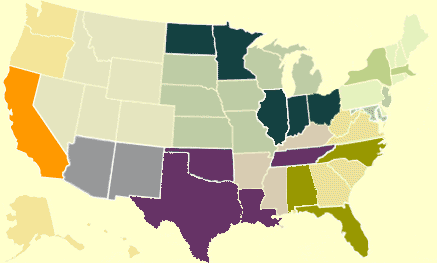
Here is what we found using Medicaid's long-term care expenditures in both 1999 and 2006 for the nursing facility institution versus the comparable Medicaid LTC community services - those Medicaid waivers for persons eligible for nursing facilities (i.e., waivers CMS classified only for aged, aged/ disabled, and physically disabled), the personal care option, and home health expenditures.

1999 - Olmstead decision - the benchmark:

FY 2006 - Seven years later - how much progress has been made:

First the worst states in 2006:

And now, the best states in 2006:

So what's up with the rest of the States:

16 states had a "drop" of less than 5 percentage points from 1999 (AL, CN, FL, GA, IN, MD, MI, MN, NH, NJ, ND, RI, TN, UT, WI and WY).

Some questions.

Why are the disability and older American advocates in the "worst states" not outraged that seven years after Olmstead their states are doing so badly?

What are their state Protection and Advocacy lawyers doing?

What are the advocates doing in the "worst states?"  Where is the next generation of lawsuits?  Other strategies?

What about the 16 states where the "improvement" was so small - less than 5 percentage points?  Aren't there disability and older American advocates in those states who are upset with the extremely slow Olmstead progress.

Steve Gold, The Disability Odyssey continues

Back issues of other Information Bulletins are available online at http://www.stevegoldada.com with a searchable Archive at this site divided into different subjects.  To contact Steve Gold directly, write to stevegoldada@cs.com or call 215-627-7100.

Kaiser Family Foundation and Alliance for Health Reform
Nursing Home Reforms: Twenty Years After OBRA '87

http://www.kaisernetwork.org/healthcast/alliance/07dec07
This event featured a panel of experts discussing the Nursing Home Reform Law, which was part of the Omnibus Reconciliation Act of 1987 (OBRA '87). Panelists examined current issues facing nursing homes and the progress since OBRA was passed. A podcast is also available.

DisabilityInfo.gov 
Grants & Funding in Education Update: Steppingstones of Technology Innovation for Children with Disabilities

Grants to improve results for children with disabilities by promoting the development, demonstration and use of technology; supporting educational media services activities designed to be of educational value for children with disabilities; and providing support for captioning and video description for use in the classroom setting. Application deadline is January 9, 2008.

This information has recently been updated, and can be accessed by visiting the following link:  http://www.disabilityinfo.gov/digov-public/public/DisplayPage.do?parentFolderId=5097

REFERENCE POINTS: 
Conference and Workshop Updates Added to the PACER Website


REFERENCE POINTS Conference and workshop updates feature NEW additions to the listing of transition related national and regional conferences maintained on PACER Center's TATRA Project web site. To see our complete calendar of events, please visit us at http://www.pacer.org/tatra/calendar.asp.

Proposed Center on Postsecondary Education for Students with Intellectual Disabilities

To improve postsecondary education and other outcomes for individuals with intellectual disabilities and focus attention on an area of national need, the Assistant Secretary for Special Education and Rehabilitative Services, the Assistant Secretary for Vocational and Adult Education, and the Assistant Secretary for Postsecondary Education have jointly proposed a priority and definitions for a center on postsecondary education for students with intellectual disabilities. The Assistant Secretary for Special Education and Rehabilitative Services may use this priority for competitions in fiscal year (FY) 2008 and later years.  The public is invited  to submit comments regarding the proposed priority. Comments must be received on or before January 10, 2008. For more information, please see the notice published in the December 11, 2007 Federal Register:  http://a257.g.akamaitech.net/7/257/2422/01jan20071800/edocket.access.gpo.gov/2007/E7-23975.htm

Opportunities for Youth

NATIONAL YOUTH LEADERSHIP NETWORK
National Youth Leadership Network (NYLN) is looking for new leaders! And we want you to apply to serve on our Governing Board! NYLN is a non-profit organization run by young people with disabilities. We empower all young people to reach their maximum potential. read more: http://www.heath.gwu.edu/node/552

KASA'S WEBSITE IS LOOKING FOR YOUTH WHO WANT TO EXPRESS THEMSELVES.
Do you write poetry, have a success at getting an accommodation at school or a job? Learn something about Voc. Rehab or a summer camp you like? Or do you have some advice to offer the rest of us on dating and relationships? KASA is always accepting written contributions to the website if you are an "expert" on or have had an experience with one of these subjects: school, work, civil rights, prevention &recovery, health, sports, leisure & recreation, dating & relationships, technology, or transportation. Write to ortizn@fvkasa.org and explain your interest.

UNDERGRADUATE RESEARCH PLACEMENTS:
Paid Summer 2008 Undergrad Research Placements!!!
The National Science Foundation is currently seeking students to apply for
their Research Placements. Over 600 programs -Undergraduate REU and OtherSummer Research Opportunities: See  http://www.agep.us/summer.asp  or http://www.igert.org/summer.asp

AAPD'S SUMMER INTERNSHIP PROGRAMS
These PAID internships in our nation's capital are incredible opportunities for college students with disabilities to further their educations and careers with invaluable experience and contacts in politics, law, technology, and employment in D.C. All applicants must be college or university students with disabilities, enrolled in an associate's or bachelor's degree program, when they begin the internship program.  More information can be found at http://www.aapd.com/internships/internship08/internInfo08.htm
DEADLINE: December 14, 2007

CAPTAIN PLANET FOUNDATION ENVIRONMENTAL GRANTS
The Captain Planet Foundation funds hands-on environmental projects to encourage youth around the world to work individually and collectively to solve environmental problems in their neighborhoods and communities. Maximum Award: $2,500. For more information go to http://www.captainplanetfdn.org/grants.html
DEADLINE:December 31, 2007.

C-SPAN StudentCam
C-SPAN StudentCam is an annual documentary competition that encourages students to think seriously about issues that affect our communities and our nation. C-SPAN StudentCam invites students to identify a current political topic of interest and produce a short (up to ten minute) video documentary which creatively explores an issue while integrating C-SPAN programming. The competition is open to students in grades 6 - 12. For more information go to http://www.studentcam.org 
DEADLINE: Dec 31, 2007

SMART KIDS WITH LEARNING DISABILITIES YOUTH ACHIEVEMENT AWARD
Nominations for the fourth annual Smart Kids with Learning Disabilities Youth Achievement Award are due January 31, 2008. This year's $1,000.00 award recognizes the great strengths of young people with LD and/or ADHD. The award will be given to a student (high school or younger) with documented learning disabilities and/or ADHD who has demonstrated initiative, talent and determination resulting in a notable accomplishment in any field-including art, science, math athletics, or community service. Honorable mentions will also be awarded. More information can be found at http://www.smartkidswithld.org/award.html
DEADLINE: January 31, 2008

INTERNATIONAL YOUNG ECO-HERO AWARDS
The Action for Nature International Young Eco-Hero Awards recognize the individual accomplishments of young people whose personal actions significantly improve the environment. Maximum Award: $500. Eligibility: youths aged 8-16. http://www.actionfornature.org/eco-hero/ecoheroawards.html
DEADLINE: February 28, 2008

STUDENT POSTER COMPETITION
The Eighth Annual Multiple Perspectives on Access, Inclusion & Disability conference is seeking undergraduate and graduate student research; performance, writing, visual art; or applied and community service projects for a poster session and reception on Tuesday April 22, 2008. Please visit: http://ada.osu.edu/conferences for more information on the conference. Posters that relate to this year's conference themes "looking back and thinking ahead" will be given preference in the review process.
DEADLINE FOR APPLICATION: March 21, 2008:

LEMELSON-MIT INVENTEAMS GRANTS
Lemelson-MIT InvenTeams Grants foster inventiveness among high school students. InvenTeams composed of high school students, teachers and mentors are asked to collaboratively identify a problem that they want to solve, research the problem and develop a prototype invention as an in-class or extracurricular project. Maximum Award: $10,000  For more information go to http://web.mit.edu/inventeams/about.html
DEADLINE: April 25, 2008.

Direct Service Workforce (DSW) Symposium - Save the Date!

DSW Resource Center - Centers for Medicare and Medicaid Services

The National Direct Service Workforce Resource Center is pleased to announce that the U.S. Departments of Labor and Health and Human Services, with other federal partner agencies, are jointly convening a National Symposium on Strengthening the Home and Community-Based Direct Service Workforce on May 8-9, 2008 in Baltimore, MD. This event will provide a forum for showcasing best practices in home and
community-based direct service workforce development, highlight Federal and state workforce initiatives, and disseminate research findings and best practices. A primary theme of the event will be the importance of addressing workforce issues across age and disability consumer populations.

Information about the symposium agenda and registration will be forthcoming. Please check back at
http://www.dswresourcecenter.org/index.php/dsw/dsw_symposium for more details.

The DSW Resource Center was created by the Centers for Medicare and Medicaid Services in 2006 to respond to the growing shortage of workers who provide direct care and personal assistance to individuals who need long term supports and services in the United States.

email: info@dswresourcecenter.org; phone: 1-877-822-2647; web: http://www.dswresourcecenter.org

Digest of Federal Grants with Faith-Based and Community Organization Eligibility
Abuse, Neglect, and Exploitation of Elderly Individuals and Residents of Residential Care Facilities grant

Faith-based and other qualified applicants are encouraged to apply for the Research and Evaluation on the Abuse, Neglect, and Exploitation of Elderly Individuals and Residents of Residential Care Facilities grant.  NIJ is soliciting applications for funding of research and evaluation in the area of abuse, neglect, and exploitation of individuals over the age of 65  (including individuals who reside either in the community or in residential care facilities) and individuals of any age who reside in residential care facilities.

For the purpose of this solicitation, the term "abuse" includes physical abuse, sexual abuse, psychological abuse, abandonment and isolation, neglect, or financial or fiduciary abuse. The term "residential care facility" includes nursing homes; assisted living facilities; adult family care homes; adult care facilities for people with developmental, cognitive, or physical disabilities; and other residential facilities that provide services to persons who are elderly, have disabilities, or have long-term chronic care needs.

Funding under this competitive grant announcement is contingent on the availability of appropriated funds and amount of FY 2008 funding available. The full application is due February 5, 2008. A link to the full announcement can be found here http://www.ncjrs.gov/pdffiles1/nij/sl000817.pdf

hcbs.org > Clearinghouse CLIPS: December 13, 2007
Cash & Counseling: Improving the Lives of Medicaid Beneficiaries Who Need Personal Care or Home and Community-Based Services


Summary:This final report summarizes the findings from five years of research on how each of the three demonstration states implemented its program, and on how the programs have affected the consumers who participated, the consumers’ paid and unpaid caregivers, and the costs to Medicaid. The analysis is based on an experimental design to ensure that the estimates of program effects are unbiased, and has sample sizes that are adequate to detect program effects of policy-relevant magnitudes.

Topic(s): Consumer Direction
Source: Mathematica

More Info: http://www.hcbs.org/moreInfo.php/nb/doc/2108

Evaluation of the Ticket to Work Program: Assessment of Post-Rollout Implementation and Early Impacts, Volume 1

Summary: This report examines experiences of Beneficiaries, State Vocational Rehabilitation Agencies (VR), Employment Networks (ENs), and the Social Security Administration (SSA) during the TTW rollout period from 2002–2004. Overall, Mathematica found that the Ticket to Work Program did not have a significant impact on the way VR does business or on the practices of ENs in the community. TTW did, however, begin a fundamental shift within SSA toward focusing on improving the earnings of beneficiaries.
Topic(s): Developmental/Psychiatric Disabilities, Medicaid Infrastructure Grant, Physical Disabilities, Workforce
Source: Mathematica
More Info: http://www.hcbs.org/moreInfo.php/nb/doc/2109

Family Caregiver Support: State Facts at a Glance

Summary:
This report provides information about family caregivers of older Americans and the state-level programs serving them. The profiles provide information on state demographics and programs related to caregiving. They offer a snapshot of each state's caregiver support programs, services offered, funding sources, eligibility criteria, and options for consumer direction. Also, information is included about locating grandparent support programs, along with highlights of recent state legislation.
Topic(s): Aging Issues, Consumer Direction, Long-Term Care, State/Agency Information, Waiver
Source: Grantee produced, U.S. Department on Aging, Department of Health and Human Services
More Info: http://www.hcbs.org/moreInfo.php/nb/doc/2101


Family Caregivers – What They Spend, What They Sacrifice: Findings from a National Survey

Summary:
The out-of-pocket cost of caring for an aging parent or spouse averages $5,531 a year, according to the nation's first in-depth study of such expenses, a sum that is more than double previous estimates and more than the average American household spends each year on health care and entertainment combined. This Evercare/NAC study found that as many as 17 million people care for a loved one 50 years or older and are spending more than 10 percent of their annual income on caregiving expenses.
Topic(s): Aging Issues, Long-Term Care
Source: Evercare, National Alliance for Caregiving
More Info: http://www.hcbs.org/moreInfo.php/nb/doc/2107

Georgia Aging and Disability Resource Connection Expansion Evaluation

Summary:
This report describes the process evaluation findings related to ADRC implementation approaches in three expansion sites, presents an initial evaluation of the role and functioning of the ADRC Coalition, and describes the formation of the collaboration between the AAA and the Regional Offices of MHDDAD. A framework includes benchmarks for successful collaboration development, and program logic modeling is discussed as an evaluation framework to guide future process and outcome evaluations.
Topic(s): Aging Issues, Developmental/Psychiatric Disabilities, Physical Disabilities, Resource Center, State/Agency Information
Source: Grantee produced, Georgia
More Info: http://www.hcbs.org/moreInfo.php/nb/doc/2102

Increasing Opportunities for Workers with Disabilities in Maine

Summary:
The CHOICES CEO (Comprehensive Employment Opportunities) online newsletter, Working Together, focuses on Maine’s efforts to increase work opportunities for people with disabilities. Additionally, a brochure on MaineCare, a health insurance program for people with disabilities in Maine, includes information on benefits, qualifications, and local resources for the MaineCare option.
Topic(s): Accessibility, Developmental/Psychiatric Disabilities, Employment, Medicaid Infrastructure Grant, Physical Disabilities, State/Agency Information, Transition/Diversion from Institutions, Workforce
Source: Grantee produced, Maine Department of Health and Human Services and Maine Department of Labor
More Info: http://www.hcbs.org/moreInfo.php/nb/doc/2097

It Doesn’t Take a Rocket Scientist to Understand & Use Social Security Work Incentives: A Manual for Social Security Work Incentives Training

Summary:
This training manual provides a basic overview of Work Incentives and their parent programs. Title II Work Incentive Programs, such as Trail Work Period and Extended Period Eligibility, are discussed. Additionally, Title XVI Work Incentives, such as Blind Work Incentives and Plans for Achieving Self Support, are explained.
Topic(s): Developmental/Psychiatric Disabilities, Employment, Medicaid Infrastructure Grant, Physical Disabilities, Workforce
Source: The Rural Institute, Adult Community Services and Supports Department at the Univeristy of Montana
More Info: http://www.hcbs.org/moreInfo.php/nb/doc/2099

Medicare Part D Survey of MaineCare Workers with Disabilities Dual Eligibles: Experience Before and During Transition

Summary:
In 2006, Maine’s Medicaid Infrastructure Grant was awarded funds to provide outreach about Medicare’s new prescription drug coverage to MaineCare Workers with Disabilities Option dual eligible members. Methods for raising awareness and education about the transition to Medicare Part D were implemented. To identify the usefulness of outreach efforts and to learn about experiences with transitioning prescription drug coverage, a telephone survey was conducted. A report highlights the findings.
Topic(s): Developmental/Psychiatric Disabilities, Employment, Medicaid Infrastructure Grant, Physical Disabilities, State/Agency Information, Workforce
Source: Grantee produced, Maine
More Info: http://www.hcbs.org/moreInfo.php/nb/doc/2098

Michigan Freedom to Work Outreach Materials

Summary:
See a variety of resources on assistance to people with disabilities in Michigan. Included are the Freedom to Work brochure, a Persons with Disabilities and Prescription Drug Coverage fact sheet, the Work Incentives Planning and Assistance brochure, Outreach Materials contact information, an on-line resources sheet, and a copy of the Michigan Freedom to Work for Individuals with Disabilities Law. A link to the Freedom to Work Website is provided.
Topic(s): Developmental/Psychiatric Disabilities, Medicaid Infrastructure Grant, Physical Disabilities, Resource Center, State/Agency Information, Workforce
Source: Grantee produced, Michigan
More Info: http://www.hcbs.org/moreInfo.php/nb/doc/2100

Quality Management Under Money Follows the Person: Summary Notes - July 29-31, 2007, Portland, Maine

Summary:
In July 2007, NASHP convened grantees from 10 states and CMS to share their experiences in promoting positive outcomes under Money Follows the Person. To aid in this discussion, the Muskie School of Public Service was invited to facilitate the conversation and to provide a framework for discussing the role of quality management under the MFP initiatives. For the past three years, the Muskie School served as technical resource to states in the implementation of CMS quality improvement grants.
Topic(s): Long-Term Care, Money Follows the Person, Quality, Transition/Diversion from Institutions
Source: Rutgers/NASHP
More Info: http://www.hcbs.org/moreInfo.php/nb/doc/2104

Strategic Plan to Maximize Employment for People with Disabilities - Maine

Summary:
The Maine Department of Health and Human Services and Department of Labor worked with a coalition from public and private sectors to recommend steps to support people with disabilities who work, or who wish to work. The full and abridged reports identify information on resources, opportunities, and short- and long-term activities to increase the number of workers with disabilities. Additionally, key findings for the MaineCare Workers with Disabilities Option are available in the Reader’s Guide.
Topic(s): Accessibility, Developmental/Psychiatric Disabilities, Employment, Medicaid Infrastructure Grant, Physical Disabilities, State/Agency Information, Transition/Diversion from Institutions, Workforce
Source: Grantee produced, Maine
More Info: http://www.hcbs.org/moreInfo.php/nb/doc/2096

The Indicator: NCI’s Bimonthly Newsletter – October 2007

Summary:
The latest newsletter of the National Core Indicators (NCI) program, this publication is designed to keep you abreast of developments and best practices in performance and outcome measurement as exemplified in initiatives among NCI participants. Volume 2, Issue 2 explores the birth of this national collaboration at the 10th Anniversary. The newsletter highlights the pioneer states and founding members and explains how NCI data is utilized and the future ideas as NCI enters their second decade.
Topic(s): Quality
Source: HSRI
More Info: http://www.hcbs.org/moreInfo.php/nb/doc/2103

NICHCY, the National Dissemination Center for Children with Disabilities
Evidence for Education brief, Assessment and Accommodations

We are pleased to send you our latest Evidence for Education brief, Assessment and Accommodations. If you are involved in teaching or assessing students with disabilities, then this publication is for you!

Assessment and Accommodations examines what the research has to say about providing students with disabilities with accommodations that support learning as well as their ability to show what they know and can do. We have included multiple examples of accommodations, guidelines to help IEP teams decide what accommodations a student needs, connections to Federal guidance and requirements on this important topic, and links that will help you identify what accommodation policies your state has adopted to guide participation of children with disabilities in large-scale assessments.

Assessment and Accommodations is available online at:
http://research.nichcy.org/accommodations1.asp

One-Stop Toolkit Resources of the Week Technical Assistance Project
National ADA Symposium


Hosted by the Network of DBTAC-ADA Centers
America's Center - St. Louis, MO
May 12-14, 2008
http://www.adasymposium.org/

The National ADA Symposium is the most comprehensive conference available on the Americans with Disabilities Act and related disability laws. This premiere event offers: a session schedule offering a wide range of topics. Customize your schedule to meet your individual needs and interests.  Presenters who are key representatives from the agencies involved with the ADA including the U.S. Dept of Justice, EEOC, U.S. Access Board, U.S. Dept. of Labor and the U.S. Dept. of Education.

Registration:  On-line registration will begin January 7, 2008.  Fees: $400.00 prior to April 15, 2008 and $475.00 after April 15, 2008

Fact Sheet: Augmenting Workplace Personal Assistance Services (PAS) Through the Use of Assistive Technology Vol. 4

RRTC on Workplace Supports and Job Retention
Many employees with significant disabilities know the importance of balancing Assistive Technology (AT) and Workplace Personal Assistance Services (WPAS) when needed as an employment accommodation.  Unfortunately, employees who need both accommodations are fearful that potential employers will consider the request for both accommodations unreasonable.  Employers who do not fully understand the need for these employees to have both accommodations would probably agree.  It is important for the employee to explain why both supports are needed to maximize their efficiency.   In order to justify the need for both accommodations, the employee should become very knowledgeable about workplace AT and workplace PAS.

Access the URL to view/download this fact sheet, which provides guidance on understanding and using AT and WPAS in the workplace including scenarios on how to request both as employment accommodations http://www.worksupport.com/research/viewContent.cfm/627.

Fact Sheet:  Individualized Support Needs and Traumatic Brain Injury

CRP-RCEP
The Brain Injury Association of America (BIAA) reports that annually 1.5 million people will sustain a traumatic brain injury (TBI) with 80,000 people experiencing the onset of long-term disabilities. Currently, an estimated 5.3 million Americans live with disabilities resulting from a TBI. Every 23 seconds one person in America will sustain a traumatic brain injury (BIAA, 2007).

Traumatic brain injury is caused by trauma to the brain, which might occur when the head strikes a hard surface such as a windshield during an automobile during an automobile accident.  This type of "closed" head injury typically results in damage to the entire brain. Trauma also may result from a penetrating injury such as a gunshot wound.  This type of injury is called an "open" head injury and may only damage a specific area of the brain.  After an injury, the person may be in a prolonged period of unconsciousness or coma, which may result in severe damage to the brain.

Not very long ago, many people who sustained a TBI died. Today, due to advances in medical care, the vast majority of individuals live.  Because some degree of healing does occur to the brain post injury, a person may recover various skills and abilities during the first six months to two years post injury.  However, many individuals with TBI will experience life-long difficulties as noted in the statistics from the BIAA.

How well the person does post injury will depend on a number of factors. Some of these factors are related to the individual's skills, abilities, and age before the injury.  Other factors are related to the severity of the injury; personal, emotional, and social adjustment after the injury; and the level of support received from family members and others.

Access the URL to read the full fact sheet.http://www.crp-rcep.org/resources/viewContent.cfm/621

Creature Discomforts

Leonard Cheshire Disability (UK) has launched a new advertising campaign to change the way people think about, and respond to, disability.  The campaign entitled, “Creature Discomforts,” modeled after Aardman Animation’s “Creature Comfort” series, features six animated characters, each of whom has a disability.  All of the six characters are voiced by a person with a disability.  The ads debuted on the radio, in newspapers, and magazine, and on bus stops on November 15.
http://www.creaturediscomforts.org/

Employer Innovations Online

Partnership for Workplace Mental Health

Employer Innovations Online, facilitating practical applications at the workplace, helps employers take action to address mental health at the workplace by providing case examples of successful corporate approaches.  The website includes a search engine, which allows users to search for actual practices of leading employers in key areas, such as screening and education, Employee Assistance Programs, and disability management.

The Partnership for Workplace Mental Health advances effective employer approaches to mental health by combining the knowledge and experience of the American Psychiatric Association and its employer partners.  The partnership delivers educational materials and provides a forum to explore mental health issues and share innovative solutions. It promotes the business case for quality mental health care, including early recognition, access to care and effective treatment. http://www.workplacementalhealth.org/search.aspx

Send ADAPT a 25th Anniversary Message for the Commemorative Program

The ADAPT Community will be celebrating its 25th year of disability rights activism in Washington, DC, April 26th - May 2nd.  www.adapt25.org

You can be part of this celebration by writing a 25th Anniversary message that will be included in the "ADAPT 25th Anniversary Commemorative Program".

Please be a part of our celebration of activism, either in person or by filling out the form below, sending your advocate's message supporting disability rights.

For an Institution and Barrier Free America, The members of the ADAPT Community

Until Next week

The Arc of the United States,1010 Wayne Avenue, Ste. 650,Silver Spring, MD 20910, Phone: 301-565-3842, Fax: 301-565-3843, Email: mmwdc@info.thearc.org, Web: www.thearc.org

Disclaimer: MMWDC publishes information about issues and events that we believe to be important and likely to be of interest to advocates and others interested in inclusion of persons with disabilities in all parts of society.  However, MMWDC and The Arc of the United States and TheArcLink Incorporated do not necessarily endorse all events, sponsoring organizations and reports which appear.