Banner for Monday Morning in Washington, DC


Volume 07 Issue 49 December 10, 2007

Welcome to Monday Morning in Washington, D.C., published weekly by The Arc of the United States. We will bring to you news of interest to self advocates and their families, volunteers, professionals, and supporters of the disability movement. Please send any comments to mmwdc@thearc.org. You are welcome to reproduce and distribute items from Monday Morning in Washington, D.C., but please credit Monday Morning in Washington, D.C. (The Arc of the United States, 2007).

The Arc of the United States advocates for the rights and full participation of all children and adults with intellectual and developmental disabilities. Together with our network of members and affiliated chapters, we improve systems of supports and services; connect families; inspire communities; and influence public policy.

[NOTE: Having trouble reading this newsletter? Read it online.] [Past Issues]

IN THIS ISSUE:

2006 Data for ILCs and Relocating People From Nursing Homes.  Information Bulletin # 230 (12/07)

Earlier this year, we provided a breakdown by Independent Living Centers of the number of persons in 2005 that each center successfully relocated from nursing homes.  We also provided national data for 2004.

Some ILCs questioned the accuracy of the data and RSA's reporting process. Some were upset that we published the name of their ILC with the low numbers. Some thought that the ILC movement should not publicly provide the data.  Please be very assured that my purpose of providing such data is to push a debate - not editorialize nor imply opinions - regarding the role of ICLs, and to move beyond whether we should be getting people out of nursing homes.

To recap, in 2004, there were 2,864 people ILCs reported to RSA, the federal funding agency, who were "successfully relocated" from a nursing facility to the community.  In 2005, there were 2,867.

Pursuant to the Freedom of Information Act, we obtained RSA data for 2006. Even though we have this information by state and by ILC, we decided to summarize the data, instead of providing it by ILC.

These results are for only federally-funded ILCs as they reported the information to RSA.

The national total for 2006 was 2,631 people whom federally-funded ILCs relocated from nursing homes.

RSA had requested each ILC to set a goal of the number of people the ILC hoped/planned/set as a goal to relocate from the nursing homes.  It also requested the actual number that the ILC relocated.

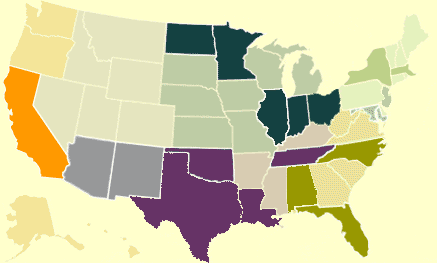
These 2,631 people represent 54% of the total number (i.e., 4,894) that the 354 federally-funded ILCs had hoped to relocate and had set as their goal.  Here are the results.

If these goals had been met, then the ILCs would have relocated 4,894 people from nursing homes.

The actual accomplishments show that:

The ILCs in 2006 relocated a total of 2,631 people from nursing facilities.

These percentages present a number of questions:

  1. Is there a correlation between the size of the ILCs and either the goals or their actual accomplishments?  A correlation between amount of ILCs budgets and accomplishments?
  2. Are ILCs who relocate more people making this a budget priority regardless of size of budget? Making this a primary service and providing the "core"  required service to this population?
  3. What is the relationship between a State's Medicaid "targeted case management" funds and the ILCs?  Do ILCs contract with the Medicaid office who receive and use these funds relocate more people than ILCs that do not?
  4. Is "success" even related to the numbers?  Is it fair to use data? Is it fair or reasonable to presume that ILCs should be relocating persons from nursing homes?
  5. What assistance would an ILC in your State need or want in order to increase their outreach to nursing home residents? Assistance in working with their Medicaid offices?  Increasing affordable, accessible housing in existing federally funded programs?
  6. Is it unfair to focus on this issue without also providing data for ILCs regarding, e.g., assistance in finding employment or housing, or in diverting people from going into the institutions and staying out?
  7. What would it take to increase the numbers substantially?
  8. What practices are the ILCs which relocated ten or more people doing that they can share with other ILCs? What barriers have they faced? What successes did they have?  What is the forum for this dialogue to take place?
  9. Why isn't there a national focus on this? What has happened to the Rehabilitation Act making this a "core" service?

Steve Gold, The Disability Odyssey continues

Back issues of other Information Bulletins are available online at http://www.stevegoldada.com with a searchable Archive at this site divided into different subjects.  To contact Steve Gold directly, write to stevegoldada@cs.com or call 215-627-7100.  

One-Stop Toolkit Resources of the Week Technical Assistance Project
Tax Benefits for Businesses Accommodating Persons with Disabilities

U.S. Department of Treasury Internal Revenue Service

http://www.irs.gov/businesses/small/article/0,,id=175291,00.html

Webinar Archive:  Promising Practices: A Look at Jobs Corps and YouthBuild

Workforce3one (Aired on November 30th) - http://www.workforce3one.org/

The U.S. Department of Labor Employment and Training Administration hosted a Webinar on November 30th, featuring two educational programs that link disconnected youth to education and the workforce through applied learning: Job Corps and Youth Build. Representatives from Job Corps and Year One YouthBuild provided an overview of their programs, described potential opportunities for partnerships, and highlighted promising practices that communities could incorporate into their programs and initiatives.  You must be a registered user of Workforce3One to listen to and view Webinars. Access the URL to register to view the archive Webinar.

Real Economic Impact Tour:  2006-2007 Annual Progress Report

National Disability Institute - http://www.reitour.org/docs/annualreports/REI_2006-07_report.pdf

[The following is excerpted from the Executive Summary.]

The roadmap out of poverty for millions of working Americans with disabilities is being paved by a grassroots movement of community-based organizations nationwide called the Real Economic Impact Tour (REI Tour). The 54 city Tour in 2007 built on the existing work being led by the Annie E. Casey Foundation, United Way of America, the National Community Tax Coalition and other national organizations in providing EITC outreach to an underserved population of taxpayers with disabilities.  Through an array of new partnerships both nationally and locally, the movement is building knowledge and workgroups that are identifying issues specific to taxpayers with disabilities. The Tour in three years has spurred the publication of national research, Congressional reports and ad hoc committees identifying the specific challenges facing thousands of taxpayers with disabilities.

The REI Tour is a public-private partnership of federal, state, local, and national organizations designed to improve the economic well-being of working Americans with disabilities through asset building strategies. In 2008, the REI Tour will expand to 62 cities nationwide and will be expected to benefit over 50,000 low income wage earners with disabilities, with financial education classes, and new savings and asset building opportunities.

Atlas: Global Resources for Persons with Intellectual Disabilities, 2007

World Health Organization (WHO) - http://bangkok-id-conference.org/pdf/atlas-report/view

[The following is excerpted from the Atlas Foreword.]

Persons with intellectual disabilities (ID) are frequently the most vulnerable group and, on many occasions, are exposed to human rights violations and deprived of minimum services and dignity. These persons are also the most likely to be secluded in large institutions, unable to access basic health and educational services, and excluded from ordinary social relations.  Although it is well known that intellectual disability is a neglected area, essential information about the presence or absence of resources and services for this population does not even exist in most of the countries of the world.

The World Health Organization (WHO) and the Montreal PAHO/WHO Collaborating Centre for Research and Training in Mental Health have worked together to develop the first ‘Atlas: Global Resources for Persons with Intellectual Disabilities’ (Atlas-ID). The main aim of Atlas-ID is to improve evidence-based knowledge and awareness on the global and regional disparities through essential and needed information on resources and services for persons with ID at country level. This global report includes information from 147 countries, representing 95% of the world population. The information is specifically related to terms and classification systems used for this population, policy and legislation, financing and benefits, prevention, health and social care services, human resources and training, research and information systems and roles of NGOs and international organizations. In addition, the Atlas-ID includes a complete glossary of terms with definitions of basic concepts related to the intellectual disabilities field and the questionnaire used to collect the quantitative and qualitative information.

Atlas-ID findings reveal a lack of adequate policy and legislative response and a serious deficiency of services and resources allocated to the care of persons with ID globally. The situation is especially worrisome in most low and middle income countries. The lack of consensus on basic terms and classification criteria related to the ID field do not help to improve the situation. The evidence provided by this report is likely to be useful to professionals, NGOs, development agencies, public health and social services sector organizations, service planners, policy makers, health and social researchers, family members of people with ID, and especially to people with intellectual disabilities. This report constitutes a call for mobilization of resources and the respect of the basic individual rights of persons with ID at the international level.

DisabilityInfo.gov
Minority Populations  Update:  Webcast on Research & Dissemination in Indian Country

This three-part presentation focuses on false assumptions and cultural differences that prevent effective research and dissemination on Indian reservations. The third part of the presentation summarizes research on the means by which individuals with disabilities and their families obtain information. The webcast is scheduled for December 14, 2007 at 2:00 p.m. CST.

This information has recently been updated, and can be accessed by visiting the following link:  http://www.disabilityinfo.gov/digov-public/public/DisplayPage.do?parentFolderId=158

The HEATH Resource Center
Wheelchair Help For Disabled Infants

Video: Researchers have discovered that infants as young as four months old can actually drive a robotic vehicle. A mini car called UD1 is computer driven with sensors and wheels.

It could be a major improvement for disabled kids who have to wait till they're three or five for mobilized wheelchairs.

Researchers have found the best drivers are babies who can't even crawl yet because they quickly discover this vehicle can get them around. http://www.wifr.com/news/headlines/11950381.html

Family Voices of North Dakota e-News
JOIN THE all-YOUTH TASK FORCE for the YOUTH INFORMATION, TRAINING AND RESOURCE
CENTER, KASA 

We want YOU! We are looking for teens, between the ages of 13 and 18, who have disabilities*, to serve on the KASA Task Force. Be part of this really cool opportunity! To check out the details, please read on!  What Does The KASA Task Force Do?  The KASA Youth Information, Training and Resource Center Task Force give advice and opinions to the KASA Advisory Board and staff about what information and training youth with disabilities need. We review documents to make sure young people can understand them and to make sure they are helpful. The Task Force learns new skills on monthly calls from community members, and from each other. We help KASA educate society about issues that affect young people with disabilities.  If you have any questions, or would like more information please contact Naomi at 520-881-4672, or email at: naomiortiz01@msn.com.

National Youth Leadership Network (NYLN)

NYLN is looking for young people with disabilities as leaders!  November 2007 The National Youth Leadership Network (NYLN) is looking for new leaders! And we want you to apply to serve on our Governing Board! NYLN is a non-profit organization run by young people with disabilities. We empower all young people to reach their maximum potential. read more: http://www.heath.gwu.edu/node/552

DB101 Launches Upgraded Benefits to Work Calculator

Oakland, CA
Disability Benefits 101 (www.db101.org) at the World Institute on Disability has upgraded and launched a new 2.0 version of its Benefits to Work Calculator. The Benefits-to-Work Calculator shows how your benefits might change when taking a job, changing jobs or starting a business. The improved online calculator tool allows workers and job seekers to plan ahead with new features for more personal and real-life planning. Users can now compare new job offers and their impact on benefits and health coverage.

DB101 also launched a newsletter Employment Matters, news and views from DB101, to share related information on changing times, topics, programs and resources. DB101 visitors can use the subscription link to subscribe directly to the email newsletter.

The revamped website revised its sections on the Earned Income Tax Credit, Individual Development Accounts, and the Work Opportunity Tax Credit. Important to many, all these new features are in English and Spanish.

Recently DB101 launched the Plan for Achieving Self Support (PASS) Calculator. Social Security’s PASS program can help you set aside money to fund a career goal. DB101’s PASS Calculator provides estimates on how setting up a PASS might affect your finances, and can help you decide if the PASS program is something you want to explore further.

Other calculators include the Medi-Cal for the Working Disabled Calculator, which estimates whether you can access health coverage through Medi-Cal’s 250% Working Disabled Program. DB101’s School and Work Calculator helps youth aged 14 to 18 navigate and plan for important benefit changes that may occur at age 18.

If you are leaving a job or have left one recently, and expect to start your next one within a year, DB101’s Job-to-Job Calculator can show you what might happen to your income and health coverage during the gap.

Work and Benefits Calculators are easy to use, screen reader accessible and in plain language (English and Spanish). They are completely confidential. The DB101 team designed these calculator tools for and with people with disabilities and their families, as well as service providers and the employers who work with them. In developing the new tools, the design team received and used input from benefits planners and beneficiaries using public and private benefits.

A contract with the Social Security Administration allowed DB101 to complete the calculator tools by the end of this year. The calculators are the result of pioneering design and development support since 2002 from the California Department of Rehabilitation, the Employment Development Department, the California Health Incentives Improvement Project, the Community Technology Foundation of California, and The California Endowment. Key design partners are Eightfold Way Consultants, Berkeley, California, and ECONorthwest, Portland, Oregon.

Contact: Bryon MacDonald, Phone 510-251-4304, TTY 510-208-9496,bryon@wid.org

Disability and Special Needs Technical Assistance Conference

The Disability and Special Needs Technical Assistance Conference taking place Jan. 8th-9th in Washington, DC will provide technical assistance on aspects of emergency management planning and response for people with disabilities and special needs. Recent disasters have made us aware of plans and operational procedures related to response and recovery to these populations in any natural or non-natural disaster. This conference will bring together Federal, State, and local experts to discuss day-to-day challenges in planning for their vulnerable populations. You will learn new concepts currently used or being developed to address disability and special needs planning in their jurisdictions. Register on-line at www.governmenthorizons.com or www.governmenthorizons.org/emergency-preparedness-and-response08.htm or call Katie Smith at (703) 807-2758.

2008 Conference on Inclusive Education - Designing Classrooms for Success!

February 14-16, 2008, Hyatt Regency Denver Tech Center, Denver, CO

Click here to get more information about this conference > http://peakparent.org/conferences.asp

ADA Disability Law and Policy, Present and Future - A National Audio-Conference

Tuesday December 18 - 2 - 3:30 pm EST

Speaker: Peter Blanck, JD, Ph.D, Chair, Burton Blatt Institute, Syracuse University

Reviewing previous research efforts, this session sets out a blueprint for the role of research, policy, and law in advancing the civic, economic and social participation of persons with disabilities in a global society. It reviews past public policy efforts and research findings regarding workers with disabilities. It discusses current and future research initiatives on the cutting edge of promoting successful employment outcomes for people with disabilities. The discussion presents promising research methodologies in multidisciplinary field disability and employment research. Finally, our presenter will put forth challenges and opportunities for research, policy, and legal initiatives, framing a blueprint for the next quarter century.

Cost per site (regardless of the number of participants at each site)
$25 for nonprofits, individuals and government agencies
$40 for businesses

Sessions are 90 minutes and delivered by telephone (call in to a toll free phone number that you can access after you register). Participants are in a "listen-only" mode until the question and answer period. The sessions are offered real-time captioned on the web.

Audio conferences are a great way to get information without traveling. You sit in your office or home or at any telephone and call in. If you have a speaker phone invite your colleagues to participate.

Registration at www.ada-audio.org

If you have problems/questions with registration: the Great Lakes ADA Center at 312-413-1407 voice/tty or email gldbtac@uic.edu.

CEU Credits: CRC

You are welcome to come to our office at 200 Portland Street in Boston to participate at no cost, we’ve already registered. Please call or send us an email.

Want to join us at the office? Need more info? ADAinfo@NewEnglandADA.org or 1-800-949-4232 voice/tty.

REFERENCE POINTS:
Clearinghouse for Sustaining and Expanding Youth Programs and Policies

This online clearinghouse is a joint project of The Finance Project and the Forum for Youth Investment. The clearinghouse contains information and resources for supporting and sustaining youth programs and initiatives. It is designed to help individuals learn about data, tools, policies, practices, financing strategies, coordination efforts and technical assistance resources developed by organizations in the field that aim to improve the lives of youth. The clearinghouse was also designed to meet the needs of program developers and managers, intermediaries, funders and policymakers. To view the clearinghouse, visit: http://forumfyi.org/_catdisp_page.cfm?LID=8544E0E1-5B79-4415-BFD1F498FD4330AB.

The Finance Project, www.financeproject.org , has developed a series of publications that focus on tools, strategies, and resources to support and sustain effective youth programs and policies:

"A Guide to Successful Public-Private Partnerships for Youth Programs" provides practical information on creating and maintaining public-private partnerships to improve and expand youth programs in states and communities nationwide. http://www.financeproject.org/publications/PublicPrivate_PM.pdf.

"Creating Dedicated Local Revenue Sources for Youth Programs" outlines strategies to create dedicated local and state revenue sources for youth programs and profiles these strategies at work in different states and communities. http://www.financeproject.org/publications/DLR_PM.pdf.

"Thinking Broadly Financing Strategies for Youth Programs" presents a typology of approaches for financing youth programs and suggests general principles to guide the selection of financing strategies based on variable aspects of youth programs. It also provides considerations to help state and local leaders develop financing plans that closely align with their program goals, available resources, and the political and economic environments in which they work. http://www.financeproject.org/publications/Thinkingbroadly_PM.pdf.

REFERENCE POINTS: 
Facts from NLTS2: Secondary School Experiences of Students with Autism

This fact sheet provides a national picture of the secondary school experiences of students with autism using data from the National Longitudinal Transition Study-2 (NLTS2). Approximately 1,000 youth with autism are included in NLTS2's nationally representative sample of more than 11,000 students with disabilities. The fact sheet provides information on the courses taken by, instructional settings of, curriculum and instruction for, and teacher perceptions of students with autism, as well as types of accommodations and supports provided to them. Available in PDF (16 pages, 692 KB).
http://ies.ed.gov/ncser/pdf/20073005.pdf

REFERENCE POINTS: 
Conference and Workshop Updates Added to the PACER Website

REFERENCE POINTS Conference and workshop updates feature NEW additions to the listing of transition related national and regional conferences maintained on PACER Center's TATRA Project web site. To see our complete calendar of events, please visit us at http://www.pacer.org/tatra/calendar.asp.

Worksupport.com e-Newsletter

Information, resources and research about work and disability issues http://www.worksupport.com/news/ws_120307.html

ability expo 2008

http://www.abilitiesexpo.com/IAEBrandManager/v42/index.cvn

[LGT-National]
changing the way people see disability

http://www.creaturediscomforts.org/

International Conference Exhibit Information

Hello Supporters of Self-Determination,

The opportunity for individuals and organizations to pursue exhibitor and demonstration time and a booth at International Conference on Self-Determination - http://www.communitydrive.org/Conference.html is now available. Click here - http://www.communitydrive.org/Exhibitors_Demonstrations.html for more specific exhibitor and demonstration information.

This event is going to be one of a kind!

Pat Carver, International Conference on Self-Determination, May 27-29, 2008, Detroit, Michigan, self.determination.com , 810-231-6364.

New Resources and Briefing Explore Nursing Home Reform Twenty Years After Passage of Landmark Law

To mark the 20th anniversary of the passage of the Omnibus Budget Reconciliation Act of 1987 (known as OBRA 87), the Kaiser Family Foundation released new resources and cosponsored a Washington, D.C. briefing to examine the effects of this landmark legislation to improve the quality of nursing home care.  Among the resources released were new opinion poll results on the public’s views about the quality of long-term care services in the United States; the short film, "Nursing Home Reform: Then and Now," that examines the history surrounding the landmark law; the new report, Nursing Home Care Quality: Twenty Years After the Omnibus Budget Reconciliation Act of 1987, which explains the key provisions of OBRA ’87 related to nursing home care and examines the progress and problems in quality assurance in nursing homes over the past twenty years and an updated fact sheet, Medicaid and Long-Term Care Services, by the Foundation’s Kaiser Commission on Medicaid and the Uninsured.  The briefing was a moderated panel discussion with ten experts led by Ed Howard of the Alliance for Health Reform and Diane Rowland of the Foundation.  The materials, including the online video of the film, and a link to the webcast of the briefing are available at http://www.kff.org/obra87reforms.cfm.

~~~~~~~~~~~~~~~~~~~~~~~~~~~~~~~~~~~~~~~~~~~~~~~~~~~~~~~~~~~~~~~~~~~~~~~~~~~~

Please take a moment and make a year-end contribution to The Arc of the United States.

Simply click here - https://www.thearc.org/NetCommunity/SSLPage.aspx?&pid=349&srcid=183 to make your gift at our secure donation site.  We are grateful for your support.

Until Next week

The Arc of the United States,1010 Wayne Avenue, Ste. 650,Silver Spring, MD 20910, Phone: 301-565-3842, Fax: 301-565-3843, Email: mmwdc@info.thearc.org, Web: www.thearc.org

Disclaimer: MMWDC publishes information about issues and events that we believe to be important and likely to be of interest to advocates and others interested in inclusion of persons with disabilities in all parts of society.  However, MMWDC and The Arc of the United States and TheArcLink Incorporated do not necessarily endorse all events, sponsoring organizations and reports which appear.