| Volume 07 | Issue 43 | October 29, 2007 |
Welcome to Monday Morning in Washington, D.C., published weekly by The Arc of the United States. We will bring to you news of interest to self advocates and their families, volunteers, professionals, and supporters of the disability movement. Please send any comments to mmwdc@thearc.org. You are welcome to reproduce and distribute items from Monday Morning in Washington, D.C., but please credit Monday Morning in Washington, D.C. (The Arc of the United States, 2007).
The Arc of the United States advocates for the rights and full participation of all children and adults with intellectual and developmental disabilities. Together with our network of members and affiliated chapters, we improve systems of supports and services; connect families; inspire communities; and influence public policy.
[NOTE: Having trouble reading this newsletter? Read it online.] [Past Issues]
Toys"R"Us Differently Abled Children Toy Guide
http://www.toysrus.com/category/index.jsp?categoryId=2257808
Resources and information for children with disabilities and their families - http://www.pacer.org/newsletters/enews/current.asp
The Disability is Natural E-Newsletter
view online at www.disabilityisnatural.com/email/2007-10.htm - www.disabilityisnatural.com, © October 2007 by Kathie Snow
Quality Mall
New products
"Body & Soul: Diana & Kathy" -
http://www.qualitymall.org/products/prod1.asp?prodid=4172
New funding opportunities
UCP Research and Educational Foundation Grant - http://www.qualitymall.org/funding/fundingdetail.asp?postingid=443
Center for Self-Determination E-Newsletter
http://www.self-determination.com/newsletters/oct2007.html
[LGT-National]
Chamber of Commerce
The Chamber’s mission is to help persons with disabilities and their direct
caregivers to form and grow businesses. http://disabilitychamber.org/
CMS Moves to Pull Services for People with Mental Illness, Others
The Center on Budget and Policy Priorities reports that in August, the Centers for Medicaid and Medicare Services (CMS) issued a proposed regulation that would eliminate federal funding through Medicaid for states to provide community-based and school-based rehabilitative services intended to enable individuals with disabilities to improve their mental and physical well-being outside of an institutional setting.
The National Governor's Association (NGA) recently called on CMS to withdraw the proposed regulation, calling it a significant departure from states' authority to provide health-related services to Medicaid beneficiaries.
Read the report http://www.cbpp.org/9-25-07health.pdf or http://www.cbpp.org/9-25-07health.htm
National Women's Law Center - http://www.nwlc.org/
Making the Grade on Women’s Health: A National and State-by-State Report Card
Making the Grade on Women’s Health: A National and State-by-State Report Card, recently released by the National Women’s Law Center and Oregon Health & Science University, is now available online at http://hrc.nwlc.org/.
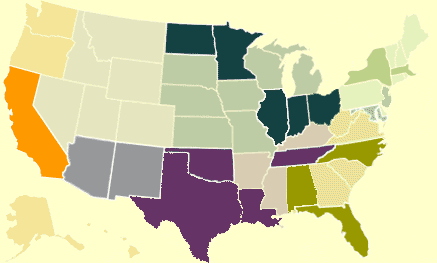
The 2007 Report Card illustrates that:
The 2007 Report Card compares the nation and individual states to the national goals primarily set by the U.S. Department of Health and Human Services’ Healthy People 2010 agenda. The health status of women across the country needs significant improvement, and far too many states fail to meet national goals for satisfactory health indicators and have failed to enact policies that would improve women’s health.
We hope the 2007 Report Card will serve as a wake-up call, encouraging policy makers to step up efforts to improve women’s health. To learn more about how your state and the nation fared on critical health status indicators and policies, go to: http://hrc.nwlc.org/.
DisabilityInfo.gov
Housing News & Events Update: HUD Awards More
Than $18 Million in Grants to Fight Housing Discrimination
The Department of Housing and Urban Development (HUD) has awarded 88 grants
totaling $17.1 million to recipients in 37 states and the District of
Columbia to help fight housing discrimination. One of the grant recipients, Access
Living of metropolitan Chicago, is part of the Department's national effort to
reduce discrimination against persons with disabilities. Access Living will
use the grant to conduct fair housing enforcement activities.
You are subscribed to Housing News & Events for DisabilityInfo.gov. This
information has recently been updated, and can be accessed by clicking on this
link:
http://www.disabilityinfo.gov/digov-public/public/DisplayPage.do?parentFolderId=5041
REFERENCE POINTS:
Social Security Announces 2.3 Percent Benefit Increase for 2008
The Social Security Administration has announced that monthly Social Security and Supplemental Security Income benefits for more than 54 million Americans will increase 2.3 percent in 2008. The 2.3 percent Cost-of-Living Adjustment (COLA) will begin with benefits that nearly 50 million Social Security beneficiaries receive in January 2008. Increased payments to more than 7 million Supplemental Security Income beneficiaries will begin on December 31.
Information about Medicare changes for 2008 can be found at www.cms.hhs.gov. The press release can be found at http://www.socialsecurity.gov/pressoffice/pr/2008cola-pr.htm
What Works Clearinghouse Releases Topic Report for Dropout Prevention Interventions
The What Works Clearinghouse (WWC), an initiative of the U.S. Department of Education's Institute of Education Sciences, announces the release of a Dropout Prevention topic report in which 59 studies of 16 dropout prevention programs were identified. It is available on the web at http://ies.ed.gov/ncee/wwc/reports/dropout/topic/
The What Works Clearinghouse (WWC) was established in 2002 by the U.S. Department of Education's Institute of Education Sciences (IES) to provide educators, policymakers, researchers, and the public with a central and trusted source of scientific evidence of what works in education. It is administered by the Department through a contract to a joint venture of the American Institutes for Research and the Campbell Collaboration. WWC also provides an e-mail-based alert service designed to inform you about all new content posted to the IES website including news from its four Centers and programs within the Centers. To subscribe, go to http://ies.ed.gov/newsflash/
ECSE Overseas Early Intervention Services Program to support infants/toddlers of U.S. Military Families
Sterling Medical is one of the two largest providers of direct healthcare services to government agencies, including Military Treatment
Facilities both Stateside and Overseas for the Department of Defense. As such, we extend social services to our clients, including care for
psychological and developmental needs of families in the areas of early intervention and social work.
We continually seek qualified full-time Early Childhood Special Educators for Department of Defense-sponsored Overseas Early
Intervention Program to support the Active Duty Military Families in Europe and Asia. We have two current openings for Early Childhood
Special Educator in Germany and anticipate future opportunity throughout Europe and parts of Asia.
Primary requirements for this two-year Overseas EIS assignment - renewable upon the ECSE provider's satisfaction, include:
Manageable caseloads, flexible scheduling, and a sufficient Paid Time Off program enhance the opportunity to travel and assimilate culture.
Our attractive compensation package also includes tax benefits for earned income tax exclusion, extensive insurance coverage, four weeks
Paid Time Off annually, paid relocation, education reimbursement, and retirement planning.
For additional information on this intrinsically rewarding and culturally expanding experience that assists Military Families stationed
overseas, please visit our website (www.sterlingoverseas.com) or contact Tom Thaman, EIS Overseas Recruiter, by phone between 8:00 a.m. and 5:00
p.m. (EST), Monday thru Friday. Of course, you are welcome to email at your convenience.
Tom Thaman,
Sterling/Magnum Medical Overseas, JV,
411 Oak Street,
Cincinnati, OH 45219,
(1-800) 852-5678 ext. 158,
(513) 984-1800 ext. 158,
Fax: (513) 984-4909,
E-mail: tthaman@sterlingmedcorp.com
NIH is soliciting ideas on Priorities in Basic Behavioral and Social Sciences Research
Request for Information (RFI):
To Solicit Input and Ideas on Priorities in Basic Behavioral and Social Sciences Research
Notice Number: NOT-OD-08-008
Key Dates:
Release Date: October 22, 2007 -
Response Date: November 26, 2007
Issued by
National Institutes of Health, Office of the Director, Office of Portfolio Analysis and Strategic Initiatives (OPASI), http://opasi.nih.gov; and the Office of Behavioral and Social Sciences Research (OBSSR), http://obssr.od.nih.gov/.
The NIH is seeking input from the scientific community, health professionals, patient advocates, and the general public about current and emerging priorities in basic Behavioral and Social Sciences Research (bBSSR) that may offer potential for improving and accelerating health research and its impact on the health of the Nation. This information will aid OPASI, working with OBSSR expertise, in developing a congressionally-requested strategic plan for bBSSR at the NIH. Relevant text from the House Appropriations Committee request is available at http://www.bBSSRresponse.com/
Background
The National Institutes of Health (NIH) is the world leader in funding biomedical and behavioral research to improve health. It consists of 27 Institutes and Centers (ICs) and the Office of the Director, which includes several programmatic Offices, each of which coordinates NIH activities in cross-cutting areas that are important to the missions of all the ICs.
The Office of Portfolio Analysis and Strategic Initiatives (OPASI) provides NIH and its ICs with the methods and information necessary to manage their large and complex scientific portfolios, identifies - in concert with multiple other inputs - important areas of emerging scientific opportunities or rising public health challenges, and assists in the acceleration of investments in these areas, focusing on those involving multiple ICs. The Office currently has three divisions tasked with coordination, resource development, and evaluation.
The Office of Behavioral and Social Sciences Research (OBSSR) serves as the NIH focal point for research on behavioral, social, and lifestyle factors in the causation, treatment, and prevention of diseases. As such, the Office advises and consults on these topics with NIH scientists and others within and outside the federal government, and plays a key role in promoting and enhancing basic and applied behavioral and social sciences research across all of NIH.
Basic research in the behavioral and social sciences is designed to further our understanding of fundamental mechanisms and patterns of behavioral and social functioning relevant to the Nation's health and well-being, and as they interact with each other, with biology and the environment. As is the case with basic biomedical research, basic behavioral and social sciences research is designed to elucidate knowledge about underlying mechanisms and processes, knowledge that is fundamental to improving the understanding, explanation, observation, prediction, prevention, and management of illnesses, as well as the promotion of optimal health and well being. The range of focus includes different "granularity" or levels of complexity. Basic behavioral and social sciences research involves both human and animal studies and spans the full range of scientific inquiry, from processes within the intra-individual level ("under the skin"), to mechanisms "outside the skin" that explain inter-individual, group, organizational, community, population, macroeconomic and other systems level patterns of collective behavior. While the primary focus of basic BSSR must ultimately be directly relevant to behavioral and social factors, the domains and units of analysis can include intra-organismic as well as inter-organismic factors ("cells to society"), over varying units of time from nanoseconds to centuries, and including lifespan developmental phases and phenomena that may occur within and across generations. An expanded definition of bBSSR can be found here: http://www.bBSSRresponse.com/.
The current request for information supplements previous efforts to identify bBSSR priorities, including reports from the Institute of Medicine and National Research Council of the National Academies of Sciences, and most notably, a report from the Working Group of the NIH Advisory Committee to the Director on Research Opportunities in the Basic Behavioral and Social Sciences (2004), which includes descriptions of ICs' portfolios in bBSSR and identifies future bBSSR opportunities for NIH. These sources and a summary of the Working Group's identified priorities can be viewed at http://www.bBSSRresponse.com/.
Information Requested
This RFI invites the scientific community, health professionals, patient advocates, and the general public to respond to the following questions:
We welcome identification of priority areas that cut across the missions of multiple NIH Institutes and Centers (e.g. understanding fundamental mechanisms in human motivation and goal directed behaviors), as well as specific examples of basic research that fit the mission of a particular IC.
Responses
Responses will be accepted through November 26, 2007 and can be entered at the following web site:
http://www.bBSSRresponse.com/. Formal acknowledgement of receipt of responses will not be made beyond that provided by the survey utility. This RFI shall not be construed as a solicitation for applications or as an obligation on the part of the government. The government will not pay for the preparation of any information submitted. Responders should be aware that the information provided will be analyzed and may appear in various reports. Additionally, the government cannot guarantee the confidentiality of the information provided.
Inquiries -
Questions about this request for information may be directed to:
Deborah H. Olster, Ph.D.,
Deputy Director,
Office of Behavioral and Social Sciences Research,
National Institutes of Health,
Building 31, Room B1C19,
31 Center Drive,
Bethesda, MD 20892-2027,
Tel: 301-402-1147
FAX: 301-402-1150,
E-mail: OlsterD@od.nih.gov
James P. Stansbury, Ph.D., M.P.H.,
AAAS Fellow,
Office of Behavioral and Social Sciences Research,
National Institutes of Health,
Building 31, Room B1C19,
31 Center Drive,
Bethesda, MD 20892-2027
Tel: 301-402-3930,
FAX: 301-402-1150,
E-mail: stansburyj@od.nih.gov
Social Security, Medicare and Medicaid accounted for more than $1 trillion of the $2.3 trillion the federal government spent in 2005, according to the U.S. Census Bureau, which publishes the only consolidated source of data on the geographic distribution of federal expenditures.
The Consolidated Federal Funds Report for Fiscal Year 2005 (www.census.gov/prod/2005pubs/cffr-04.pdf) is a presentation of data on most domestic spending by the federal government for state and county areas of the United States, including the District of Columbia and U.S. outlying areas. The data include expenditures for the Defense Department and the Department of Homeland Security.
The report covers direct payments, grants, procurement awards, and salaries and wages by federal agency and program. The report does not include expenditures for selected intelligence agencies, international payments, foreign aid and interest on the federal debt.
A companion report, Federal Aid to States for Fiscal Year 2005 (www.census.gov/prod/2007pubs/fas-05.pdf), contains federal agency and program-level data on grants to state and local governments.
Consolidated Federal Funds Report highlights:
The data in these reports are not subject to sampling variability, but are subject to nonsampling errors, which include errors of response and processing.
Editor’s note: These reports present data for the states and counties only. They do not support the application of federal spending data directly for other areas such as places and congressional districts.
Factsheet: Finding a Workplace Personal Assistant
RRTC on Workplace Supports and Job Retention
http://www.worksupport.com/research/viewContent.cfm/619
People with disabilities believe Personal Assistance Services (PAS) are services that are only used in the home to assist individuals to remain independent. Over the past 20 years people with severe disabilities have discovered they can use PAS services in the workplace as a reasonable job accommodation and consider a workplace PAS a necessary to perform the essential job functions.
It is important for employees with disabilities to understand what workplace PAS is and is not. A workplace PA does not mean that someone will be performing the job duties or that they will be expected to take care of daily personal needs, it is not the employer’s responsibility to provide this type of service. A workplace PA is used only to provide assistance with the actual job tasks to increase the efficiency and productivity of employees with disabilities. Employers are responsible to provide this accommodation under Title I of the Americans with Disabilities Act. Employees need to work with their employer to find the right individual to provide this valuable on the job support.
Opportunities for Collaboration Across Human Services Programs
The Finance Project Welfare Information Network - June 2003
http://www.financeproject.org/Publications/EBO_collaborationprograms.pdf
[The following is excerpted from the Introduction.]
Purpose of this Paper
The importance of collaboration and cooperation in the development and implementation of human service programs at the state and local level is increasing dramatically both from the perspective of effective services to families and that of efficiently stewarding resources in a time of fiscal pressure.
This paper provides agency and program leaders, governors’ staff, and legislative staff with a concise overview of some of the major human service programs administered at the state and local level. It also discusses the interdependence of those programs, their common goals, and the way in which those programs might work together. While directed largely at individuals new to these responsibilities it can also prove of value to more experienced staff as well.
Background
The leaders of state human services agencies and programs face an extraordinary series of challenges in the years ahead. These challenges are exacerbated by a combination of factors, including a slower than expected economic recovery, the extremely tight fiscal situation of government at all levels, and a continuing change in the underlying structure of federal programs as they go through the reauthorization process.
Increasingly, political leaders, advocates, researchers and public administrators are recognizing that social problems cannot always be solved within the constraints of individual programs and funding silos. Many families and individuals face multiple problems. And, many problems cannot be solved within the confines of a single program. As a result, there is a growing recognition that success will, in many cases, depend upon the ability of government to work with nonprofits and the private sector to create ready access to the comprehensive services needed.
While there are, and will be, many attempts to achieve comprehensive services through statutory changes and formal requirements for the integration of services, these efforts will probably fall short of the mark. As a result, both short- and long-term improvements will probably depend on efforts at the state and local levels to improve cooperation and coordination among existing programs and organizations.
Such efforts are difficult at best and are often hampered by a lack of information on the roles and responsibilities of other program and agencies. Efforts often fail because they begin with a demand for what one agency needs, rather than with the recognition of common goals and objectives or with a willingness to bring a resource to the table that can be shared with others.
In an effort to encourage greater dialogue at the national level, The Finance Project’s Welfare Information Network invited leadership from ten organizations that represent state officials that administer fourteen human service programs to come together to discuss their individual organizations and to examine areas where they might work together. At its first meeting, this group identified the importance of collaboration at the service delivery level. It also noted the lack of information and tools that could assist their members in exploring opportunities for collaboration. Following an intensive discussion, the organizations agreed to explore a number of joint activities. This publication represents the first of those activities.
Until Next week
The Arc of the United States,1010 Wayne Avenue, Ste. 650,Silver Spring, MD 20910, Phone: 301-565-3842, Fax: 301-565-3843, Email: mmwdc@info.thearc.org, Web: www.thearc.org
Disclaimer: MMWDC publishes information about issues and events that we believe to be important and likely to be of interest to advocates and others interested in inclusion of persons with disabilities in all parts of society. However, MMWDC and The Arc of the United States and TheArcLink Incorporated do not necessarily endorse all events, sponsoring organizations and reports which appear.