Banner for Monday Morning in Washington, DC


Volume 07 Issue 37 September 17, 2007

Welcome to Monday Morning in Washington, D.C., published weekly by The Arc of the United States. We will bring to you news of interest to self advocates and their families, volunteers, professionals, and supporters of the disability movement. Please send any comments to mmwdc@thearc.org. You are welcome to reproduce and distribute items from Monday Morning in Washington, D.C., but please credit Monday Morning in Washington, D.C. (The Arc of the United States, 2007).

The Arc of the United States advocates for the rights and full participation of all children and adults with intellectual and developmental disabilities. Together with our network of members and affiliated chapters, we improve systems of supports and services; connect families; inspire communities; and influence public policy.

[NOTE: Having trouble reading this newsletter? Read it online.] [Past Issues]

IN THIS ISSUE:

Social Security Administration
September 20 Ticket Panel teleconference accepting public comment

On September 20, 2007, the Ticket to Work and Work Incentives Advisory Panel (the "Panel") will hold a teleconference. The public is invited to listen to the teleconference by calling the phone number listed above. Public testimony will be taken from 3:30 p.m. until 4 p.m. Eastern Daylight Savings Time. You just be registered to give public comment. To register for the public comment portion of the meeting, please contact Debra Tidwell-Peters by calling (202) 358-6126, or by e-mail to debra.tidwell- peters@ssa.gov.

The full agenda for the meeting will be posted on the Internet at http://www.ssa.gov/work/panel at least one week before the starting date or can be received, in advance, electronically or by fax upon request.

The Ticket Panel was established to advise the President, the Congress, and the Commissioner of the Social Security Administration on issues related to work incentives programs, planning, and assistance for individuals with disabilities.

DATES: September 20, 2007 (2 to 4 p.m. EST)
Time Ticket to Work and Work Incentives Advisory Panel Conference Call
Call-in number: 1-888-790-4158
Pass code: PANEL TELECONFERENCE
Leader/Host: Berthy De la Rosa-Aponte

Announcing - TASH Webinar Series on Engaging and Serving People of Color with Disabilities

Register Online at http://www.tash.org/dev/tashstore/ONSCategory.aspx?catid=4, or by mailing/faxing the attached to: 202-637-0138
Get a detailed Session Descriptions and Pricing by visiting our website's homepage at www.tash.org.


Engaging and Serving People of Color with Disabilities

Disability research shows high rates of disabilities for communities of color. The Center for Disease Control and Prevention (CDC) reports high rates of intellectual disabilities for individuals of color. Down Syndrome is nearly doubled in Latino communities in comparison to whites and Intellectual Disabilities and Developmental Disability (ID/DD) is nearly doubled in black communities in comparison to whites. A literature review and discussions with consumers, families, and experts in the field suggests that Blacks and other people of color:

While policy-makers, providers, and advocacy organizations have noted the need to enhance services and supports to these communities, the opportunities for review of best practices and effective strategies have been limited. The voices of self-advocates and families have frequently been isolated and provider inquiries for guidance and "research to practice" operational strategies have been unanswered. This frequently results in assumptions of "benign neglect", incompetence, or even racism.

Webinar objectives are:

1. Raise awareness on the compounding interplay of race/ethnicity and disability;
2. Provide information and tools for developing cultural competency in organizations; and
3. Support "creating a voice" for individuals and families of color with disabilities.

The presenters include family members, educators, researchers, community leaders, executive directors of national disability organizations, and other individuals dedicated to enhancing the life experiences of individuals of color with disabilities.

What can you expect? Participants in the TASH webinar will

New Guide for Parents: Learning Opportunities for Your Child Through Alternate Assessments: Alternate Assessments Based on Modified Academic Achievement Standards

The National Center on Educational Outcomes has produced a new guide to help parents of students with disabilities understand a new state alternate assessment allowable under No Child Left Behind. While few states are currently offering this assessment option, some will be developing it in the coming years. Parents will need to understand what it is and how to decide if it is the right option for their child. The
guide is available for download free of charge at www.NCEO.info/OnlinePUbs/AAMASParentGuide.pdf

Wrightslaw Newsletter - Are Parents Protected from Discrimination in the Workplace?

http://www.wrightslaw.com/nltr/07/nl.0912.htm

DisabilityInfo.gov
Employment News & Events Update: NCD to Make Employment Recommendations

The National Council on Disability (NCD) will highlight National Disability Employment Awareness Month by releasing its latest report, Empowerment for Americans with Disabilities: Breaking Barriers to Careers and Full Employment, at a news conference and panel discussion on October 1st from 1:00 p.m. until 3:00 p.m.

This information has recently been updated, and can be accessed by clicking on this link: http://www.disabilityinfo.gov/digov-public/public/DisplayPage.do?parentFolderId=10

Mental Health Update: New Research to Help Youth with Mental Disorders Transition to Adulthood

As young people with mental health disorders transition from adolescence to adulthood, they frequently face new and difficult challenges. Several new grants will examine these issues, and work toward developing better ways to help young people with mental disorders successfully enter adulthood.

This information has recently been updated, and can be accessed by clicking on this link: http://www.disabilityinfo.gov/digov-public/public/DisplayPage.do?parentFolderId=151

Grants & Funding in Education Update: Grants to Strengthen Rehabilitation Counseling

Funding opportunity to increase the knowledge of students of the role and responsibilities of the VR counselor and of the benefits of counseling in State VR agencies. This priority focuses attention on and intends to strengthen the unique role of rehabilitation educators and State VR agencies in the preparation of qualified VR counselors by increasing or creating ongoing collaboration between institutions of higher education and State VR agencies. Application deadline is October 29, 2007.

This information has recently been updated and can be accessed by clicking on this link: http://www.disabilityinfo.gov/digov-public/public/DisplayPage.do?parentFolderId=5097.

One-Stop Toolkit Resources of the Week Technical Assistance Project

To subscribe and/or view past resources of the week archives, access: www.onestoptoolkit.org and click on the link to "Resources of the Week" on the right hand side of the home page.

To view an indexed list of the resources of the week by subject matter, visit the Law, Health Policy & Disability Center website at http://disability.law.uiowa.edu/lhpdc/resources/wig/default.asp. It currently includes 20 categories, covering over 300 annotated references. Each category opens to a new window with each Resource of the Week which covered material in that area

October is National Disability Employment Awareness Month and October 17th is Disability Mentoring Day

October is National Disability Employment Awareness Month (http://www.dol.gov/odep/faqs/ndeam.htm) and Disability Mentoring Day (http://www.dmd-aapd.org/). It is not too early to start planning an event or activity that you can launch in October to add to the collective efforts that will take place across the country. Particularly consider how you can participate in National Disability Mentoring Day (DMD) on October 17!

Utilizing Low Income Housing Tax Credits (LIHTC) to Create Affordable, Accessible Rental Housing for People with Disabilities.

World Institute on Disability: EQUITY e-newsletters Summer 2007
http://www.wid.org/programs/access-to-assets/equity/equity-e-newsletter-summer-2007

Ann O'Hara, Technical Assistance Collaborative, explains Low Income Housing Tax Credits and provides examples of collaboratives working to make housing developments affordable for very low income people with disabilities.

AARP Policy and Research: Sources of Income of People Age 50 to 64 with Work Disabilities

Ke Bin Wu, AARP Public Policy Institute
Laurel Beedon, AARP Public Policy Institute
May 2007

http://www.aarp.org/research/work/employment/dd157_income.html

[The following is excerpted from the website. Access the URL to link to the PDF version of the data report.]

People with disabilities are disproportionately poor. When a 2004 Harris survey asked people with and without disabilities to pick the income category best describing their total 2003 household income, their responses revealed that 26 percent of those with disabilities were likely to have household incomes of $15,000 or less, compared to 9 percent of other Americans.

This AARP Public Policy Institute Data Digest analyzes income sources for people age 50 to 64 with work disabilities, highlighting the distribution of these individuals and the distribution of their major income sources by gender and race/ethnic group.

The four most important sources of income for the midlife work-disabled population are:

Data used in the report are based on the U. S. Census Bureau's March 2005 Current Population Survey.

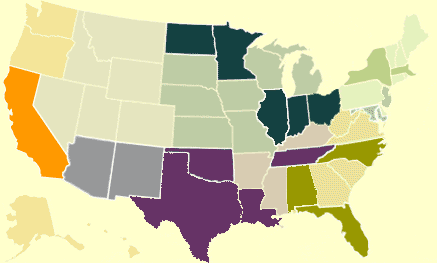
Disability Maps

http://www.disabilitymaps.org/

The National Center on Workforce and Disability/Adult has developed a website that users can use to locate projects across the US that have received grants to test new strategies to improve employment outcomes for people with disabilities.

Annual Report on the Federal Work Force: Fiscal Year 2006

U.S. Equal Employment Opportunity Commission
http://www.eeoc.gov/federal/fsp2006/index.html

This report covers the period from October 1, 2005 through September 30, 2006 and contains selected measures of agencies' progress toward model equal employment opportunity programs, including workforce profiles of 59 federal agencies. The report finds that the federal workforce participation rate for individuals with targeted disabilities (such as deafness, blindness, paralysis, intellectual disabilities, and mental illness) continues to fall. Findings include the following:

The Department of Labor's Observations and Vision in Practice: Examples from Around the Country

Released July 2007
http://www.doleta.gov/youth_services/pdf/DOLObsandVis0412051.pdf

A paper prepared by Jobs For The Future for the U.S. Department of Labor's Employment and Training Administration (ETA) profiles programs and partnerships that demonstrate ETA's strategic vision for serving the neediest youth. The profiles highlight examples of cross-sector collaboration, pathways to credentials for out-of-school youth, increasing out-of-school youth's numeracy and literacy skills, and using data for program improvement. The paper also incorporates field-based observations that emerged from developing the profiles, including that state and local policies play a key role in advancing quality alternative education and supporting cross-sector collaboration.

FVND Share the Wealth Week of Sept. 10
The Office on Disability (OD) of the U.S. Department of Health and Human Services

The OD has a number of actions and programs underway that are important for children with disabilities, their families, and their physicians. One program is the implementation of the strategic plan of the Surgeon General's Call to Action to Improve the Health and Wellness of Persons with Disabilities. Through the implementation of this document, the OD is working to improve healthcare access and health behaviors for persons with disabilities, including children, and make sure that all Americans know that good health means the same thing to everyone.

A second Office on Disability program, I Can Do It, You Can Do It!, is a physical fitness and nutrition mentoring program for youth with disabilities. The program is run through organizations in each community who match youth with disabilities with physically fit men tors. Together, the children and their individual mentors develop weekly physical fitness plans that are fun for the mentees and are tailored to their interests and abilities. The mentor then supports the mentee throughout the 6 week program in meeting physical activity and nutritional goals.

The Office on Disability encourages you to identify opportunities to promote these efforts. Your networks of colleagues, patient family members, and advocates can make a huge impact in getting knowledge of these programs to children who can really benefit. Also, if you know of any other forums for these messages, such as conferences and organizational newsletters, please contact the Office on Disability.

Please visit the Office on Disability (OD), Call to Action www.surgeongeneral.gov/library/disabilities, and "I Can Do It, You Can Do It!" (www.hhs.gov/od/physicalfitness.html) websites to learn more about these programs and others. If you would like more information on what you can do to support or take part in these initiatives, please do not hesitate to contact the OD!

Addressing the Needs of Young Children in Child Welfare: Part C - Early Intervention Services

This bulletin from the Child Welfare Information Gateway provides examples of State efforts to implement the new Part C referral provisions in the Child Abuse Prevention and Treatment Act (CAPTA) and the Individuals with Disabilities Education Improvement Act of 2004 (IDEA). It explains the overall importance to child welfare of the Part C Early Intervention Program and offers potential strategies to address barriers. For more information go to http://www.childwelfare.gov/pubs/partc/index.cfm

The Youth Center

Across the country, young people with disabilities are waking up to disability pride and culture. They want equal rights and equal lives. What they need is information that will empower them to advocate for the lives they want. That's why Access Living created this website. Most of the time, those of us with disabilities are the only ones in our families who have a disability. It's hard to explain what that's like to people without disabilities. However, at this website you can find information by and about people who know what it's like living life with a disability. We've got REAL information for your REAL life with a disability: stuff about dating, activism, getting news, disability pride, participating in Chicago events. The Youth Center can be found at http://www.alyouthinfo.org/

Medicaid's Rehabilitation Services Option: Overview and Current Policy Issues

The Kaiser Commission on Medicaid and the Uninsured released a report on the Medicaid rehabilitative services option which can be viewed at http://kff.org/medicaid/upload/7682.pdf. The report was finalized just prior to publication by the Centers for Medicare and Medicaid Services (CMS) of a notice of proposed rulemaking (NPRM) in the Federal Register on August 13 that, among other things, would amend the definition of Medicaid rehabilitation services to prohibit payment for habilitation services. The Kaiser document should provide useful background for development of comments in response to the proposed new regulation.

Announcement- The Centers for Medicare and Medicaid Services on Friday surprised enrollees, patient advocates and state government officials with new, tougher guidelines on how states may use State Children's Health Insurance Program (SCHIP) money to pay for health (and dental) benefits for children in families with incomes greater than 250 percent of the federal poverty level. The new guidelines are part of the Bush Administration's efforts to refocus SCHIP on lower-income people. Some state officials believe the new regulation sets requirements that are unattainable and would force at least 12 states to modify their state plans to revoke coverage and in the process lower the amount of overall federal dollars those states have received in the past.

NECTAC eNotes - September 14, 2007
Notice of Proposed Rule Making - Elimination of Reimbursement Under Medicaid for School Administration Expenditures and Costs Related to Transportation of School-Age Children Between Home and School

Source: U.S. Department of Health and Human Services, Centers for Medicare & Medicaid Services - September 7, 2007

On September 7, 2007, the Centers for Medicare & Medicaid Services issued a Notice of Proposed Rule Making that would eliminate federal Medicaid payments for administrative activities performed by school employees or contractors, or anyone under the control of a public or private educational institution. The proposed regulations would also eliminate Medicaid reimbursements for transportation from home to school and back for school-aged children with an Individualized Education Program (IEP) or an Individualized Family Services Plan (IFSP) established pursuant to the Individuals with Disabilities Education Act (IDEA). Public comments are due by November 6, 2007. For complete information go to http://a257.g.akamaitech.net/7/257/2422/01jan20071800/edocket.access.gpo.gov/2007/pdf/07-4356.pdf

The Disability Rights Section of the Civil Rights Division of the U.S. Department of Justice

They has recently posted the 18th Edition of Disability Rights On-Line News, which gives readers some of the latest information surrounding efforts to uphold the rights of people with disabilities across the country. The text is available in HTML and PDF formats, and you may also read back issues of the publication. Visit: http://www.usdoj.gov/crt/ada/disabilitynews.htm

NEW (FREE) INTERNATIONAL HANDBOOK PROVIDES BASIC INFORMATION FOR WOMEN WITH DISABILITIES ON HOW TO STAY HEALTHY AND LIVE WELL

A new handbook with examples and illustrations drawn from across the world, serves as a basic guide to health and wellness for women living with a physical or mental disability. Women with disabilities across the world often find it difficult to get the health care they need, when they need it. A Health Handbook for Women With Disabilities by the Hesperian Foundation provides basic and essential information on issues such as understanding your body, sexuality, pregnancy, preventing abuse, taking care of assistive devices, information on common medications, and more. To download the book by chapter, visit http://www.hesperian.org/publications_download_wwd.php.

JOIN A TELECONFERENCE HOSTED BY THE U.S. DEPARTMENT OF HEALTH AND HUMAN SERVICES ON FEDERAL PROGRAMS AND SERVICES AVAILABLE FOR SUPPORTING CAREGIVERS ACROSS THE LIFESPAN

On September 19, 2007, from 1 pm-3 pm U.S. Eastern Time, the New Freedom Initiative Subcommittee on Caregiving will present a broadcast designed to bring awareness to the range of programs and services offered by the Department of Health and Human Services offers that support caregivers across the lifespan. To learn more, download a flyer at http://www.cms.hhs.gov/partnerships/downloads/NFIflyer.pdf.

PASS Plan Form with Help Keys

Attached is the new "PASS Plan with Help Keys." It will also be available for download from the Transition Projects Web site located at: http://ruralinstitute.umt.edu/transition/.

This document allows a user to easily tab through the PASS Plan application and to access numerous "help" boxes that will guide her/him through the questions and provide examples of responses. For more information about PASS Plans (Social Security Plans for Achieving Self-Support), a valuable and vastly underutilized resource for certain SSI-eligible youth and adults, please visit the following Web sites:

http://ruralinstitute.umt.edu/transition/SSAworkincent.asp

http://www.passplan.org/

http://www.socialsecurity.gov/disabilityresearch/wi/pass.htm

Kim Brown, Transition Project Coordinator, Rural Institute, CHC 030, The University of Montana, Missoula, MT 59812, (406) 243-4852, brown@ruralinstitute.umt.edu

Donna Martinez, Director, The HEATH Resource Center, The George Washington University, 2134 G Street, N.W., Washington, DC 20052-0001, Voice: 202-973-0904, FAX: 202-994-3365, Email: askheath@gwu.edu, www.HEATH.gwu.edu

REFERENCE POINTS: GAO Report: Federal Disability Programs "Poorly Positioned" to Help People Go to Work

A recent report by the watchdog US Government Accountability Office (GAO) stated ".social and legal changes have promoted the goal of greater inclusion of persons with disabilities in the mainstream of society, including adults at work. For example, the Americans with Disabilities Act (ADA) supports the full participation of persons with disabilities in society and fosters the expectation that persons with disabilities can work and have the right to work. However, GAO's reviews of the largest federal disability programs indicate that such programs have not evolved in line with these larger societal changes and, therefore, are poorly positioned to provide meaningful and timely support for persons with disabilities." The report further cites the looming crises in the slowdown in the nation's labor force and the low rate of return of return to work for individuals with disabilities receiving cash and medical benefits. The report can be found at http://www.gao.gov/new.items/d07934sp.pdf

REFERENCE POINTS: New Issue Brief on Role of CTE in Secondary-Postsecondary Transitions

The Association for Career and Technical Education (ACTE) has released a new issue brief on the role of career and technical education (CTE) in secondary-postsecondary transition. As states and national organizations are implementing new initiatives designed to improve the secondary and postsecondary education outcomes of our nation's youth, numerous reform strategies that involve a strong focus on CTE have emerged. To read the report, go to http://www.acteonline.org/resource_center/upload/Transitions.pdf

REFERENCE POINTS: Perceptions and Expectations of Youth With Disabilities. A Special Topic Report of Findings From the National Longitudinal Transition Study-2 (NLTS2)

This report from NCSER provides a picture of the self-representations and expectations of youth with disabilities, how they differ across disability categories and demographic groups, and how they compare with youth in the general population. The National Longitudinal Transition Study-2 (NLTS2), funded by IES, was initiated in 2001 and has a nationally representative sample of more than 11,000 students with disabilities. This report presents findings drawn primarily from telephone interviews or self-administered mail surveys collected from youth when they were ages 15 through 19. The report addresses questions such as how youth with disabilities describe their feelings about themselves and their lives, their secondary school experiences, their personal relationships, and their expectations for the future. To download, view and print the publication as a PDF file, please visit:
http://ies.ed.gov/ncser/pubs/index.asp#NLTS2perceptions

REFERENCE POINTS: Conference and Workshop Updates Added to the PACER Website

REFERENCE POINTS Conference and workshop updates feature NEW additios tothe listing of transition related national and regional conferences maintained on PACER Center's TATRA Project web site. To see our complete calendar of events, please visit us at http://www.pacer.org/tatra/calendar.asp.

The ADAPT Community
MDS Active Resident Information Report - Age of Residents in Nursing Homes

MDS Data Second Quarter 2007 = CMS website
Total Residents Surveyed - 1,394,781
http://www.cms.hhs.gov/MDSPubQIandResRep/04_activeresreport.asp?isSubmitted=res3&var=RSaGE&date=19
Age of Residents - National figures - Approximate because of rounding

 
AGE # OF RESIDENTS   AGE # OF RESIDENTS
1-30
8,369
  under 31
8,369
31-64
184,111
  under 65
192,479
65-74
182,716
  under75
375,195
75-84
430,987
  under 85
806,182
85-95
517,464
  85+
587,203
95+
69,739
     

Physical & Mental Wellness: Promising Practices - Intellectual Disability/Mental Health (ID/MH)

NADD 24th Annual Conference and Exhibit Show

Don't be late to receive the Early Bird Registration Rate!
Register on or before 9/21 & Save $$$!
You won't want to miss this opportunity!

October 24-26, 2007
Renaissance Atlanta Hotel Downtown, Atlanta, GA - Hotel reservation cut-off for NADD rate is October 1, based on availability. Make reservations soon! Scholarships Available FULL CONFERENCE BROCHURE & REGISTRATION NOW AVAILABLE AT WWW.THENADD.ORG

For more information click here - http://www.thenadd.org/pages/conferences/24th/index.shtml

National Council on Disability Urges Congress to Support Americans with Disabilities Act Restoration

WASHINGTON - The National Council on Disability (NCD) today urged Congress to support legislation that will "right" the course of the Americans with Disabilities Act (ADA) and protect the civil rights of people with disabilities.

ADA restoration bills were introduced in the House (H.R. 3195) and the Senate (S.1881) on July 26, 2007. NCD proposed the original ADA legislation, and is charged with gathering information about the implementation, effectiveness, and impact of the ADA. In keeping with this requirement, NCD undertook a two-year study to analyze 19 Supreme Court cases interpreting the ADA and, in December 2004, released a comprehensive report entitled Righting the ADA(http://www.ncd.gov/newsroom/publications/2004/righting_ADA.htm).

According to NCD chairperson John R. Vaughn, "NCD's study revealed that the majority of the Supreme Court's rulings involving the ADA depart substantially from the core principles and objectives of the ADA, resulting in unfair outcomes that sanction, rather than remedy, even the most egregious employment discrimination against people with disabilities."

"Countless federal court cases have followed, in which an employer refuses to hire or accommodate an individual with a disability because of the disability, but then is allowed to argue that the person does not have a disability. Rarely are the individual's qualifications for the job evaluated, nor is the alleged discrimination examined.

The purpose of the ADA is 'to provide a clear and comprehensive national mandate for the elimination of discrimination against individuals with disabilities.' While the provisions of the ADA addressing architectural, transportation, and communication accessibility have been implemented with notable success, the employment provisions of the ADA essentially have been rewritten by the Supreme Court, such that these provisions no longer provide the opportunities and protections expressly intended by those involved in the creation and passage of the ADA.

NCD's two recent ADA reports, Implementation of the Americans with Disabilities Act: Challenges, Best Practices, and New Opportunities for Success (http://www.ncd.gov/newsroom/publications/2007/implementation_07-26-07.htm) and The Impact of the Americans with Disabilities Act: Assessing the Progress Toward Achieving the Goals of the ADA (http://www.ncd.gov/newsroom/publications/2007/ada_impact_07-26-07.htm) both confirm that legislation is urgently needed to restore the ADA to ensure equality of opportunity, full participation, independent living, and economic self-sufficiency for all Americans with disabilities," Vaughn concluded.

NCD is an independent federal agency and is composed of 15 members appointed by the President, by and with the advice and consent of the Senate. It provides advice to the President, Congress, and executive branch agencies to promote policies, programs, practices, and procedures that guarantee equal opportunity for all individuals with disabilities, regardless of the nature or severity of the disability, and to empower individuals with disabilities to achieve economic self-sufficiency, independent living, and inclusion and integration into all aspects of society.

For additional information, please contact Mark S. Quigley at 202-272-272-2004

Career Development for People with disabilites Web Course October 3 -16, 2007

TRN, Inc. is offering its popular 2-week, 20-hour web training covering key principles and hands-on tools for innovative vocational assessment, career development skills, and vocational profiling for youth and adults with disabilities. (Course highlights below.)

Registration is $149 US. Participants can log on at any time during the course period and participate in the training.

The course is taught by Rob Hoffman. Rob is the Director of Community and Employer Development for Region 7 CRP-RCEP and is responsible for the development and delivery of training and technical assistance on employment services and business partnership strategies.

Registration is limited, and previous courses have filled to capacity. To learn more about the training and to register, go to: http://www.trninc.com/entry/welcome2.asp

Course Outline

Mother Jones article about Judge Rotenberg Center

SCHOOL OF SHOCK
Eight states are sending autistic, mentally retarded, and emotionally troubled kids to a facility that punishes them with painful electric shocks. How many times do you have to zap a child before it's torture? In this eye-opening article in Mother Jones, Jennifer Gonnerman details a year-long investigation of the Judge Rotenberg Educational Center, located in Canton, Mass., 20 miles outside Boston. The facility, which calls itself a "special needs school," takes in all kinds of troubled kids -- severely autistic, mentally retarded, schizophrenic, bipolar, emotionally disturbed -- and attempts to change their behavior with a complex system of rewards and punishments, including painful electric shocks to the torso and limbs. Of the 234 current residents, about half are wired to receive shocks, including some as young as nine or ten. Nearly 60 percent come from New York, a quarter from Massachusetts, the rest from six other states and Washington, D.C. The Rotenberg Center, which has 900 employees and annual revenues exceeding $56 million, charges $220,000 a year for each student. States and school districts pick up the tab. The Rotenberg Center is the only facility in the country that disciplines students by shocking them, a form of punishment not inflicted on serial killers or child molesters or any of the 2.2 million inmates now incarcerated in U.S. jails and prisons. Over its 36-year history, six children have died in its care, prompting numerous lawsuits and government investigations. Last year, New York state investigators filed a blistering report that made the place sound like a high school version of Abu Ghraib. Yet the program continues to thrive -- in large part because no one except desperate parents, and a few state legislators, seems to care about what happens to the hundreds of kids who pass through its gates.
To read the whole story click - http://www.motherjones.com/news/feature/2007/09/school_of_shock.html

Until Next week

The Arc of the United States,1010 Wayne Avenue, Ste. 650,Silver Spring, MD 20910, Phone: 301-565-3842, Fax: 301-565-3843, Email: mmwdc@info.thearc.org, Web: www.thearc.org

Disclaimer: MMWDC publishes information about issues and events that we believe to be important and likely to be of interest to advocates and others interested in inclusion of persons with disabilities in all parts of society.  However, MMWDC and The Arc of the United States and TheArcLink Incorporated do not necessarily endorse all events, sponsoring organizations and reports which appear.