| Volume 07 | Issue 34 | August 27, 2007 |
Welcome to Monday Morning in Washington, D.C., published weekly by The Arc of the United States. We will bring to you news of interest to self advocates and their families, volunteers, professionals, and supporters of the disability movement. Please send any comments to mmwdc@thearc.org. You are welcome to reproduce and distribute items from Monday Morning in Washington, D.C., but please credit Monday Morning in Washington, D.C. (The Arc of the United States, 2007).
The Arc of the United States advocates for the rights and full participation of all children and adults with intellectual and developmental disabilities. Together with our network of members and affiliated chapters, we improve systems of supports and services; connect families; inspire communities; and influence public policy.
[NOTE: Having trouble reading this newsletter? Read it online.] [Past Issues]
Joseph P. Kennedy, Jr. Foundation 2008 Professional and Parent Public Policy Fellowships
The Joseph P. Kennedy, Jr. Foundation is seeking outstanding professionals working in the field of inclusive services and supports for people with intellectual and developmental disabilities and parents or close family members of a person with intellectual and developmental disabilities for an intensive one-year Public Policy Fellowship in Washington, D.C.
During this year-long Fellowship, the successful applicant will learn how legislation is initiated, developed, and passed by the Congress, or how programs are administered and regulations promulgated by federal agencies. Fellows will also participate in an advocacy training workshop, national disability policy seminars and the intensive week-long Bioethics course at Georgetown University's Kennedy Institute of Ethics. Former Public Policy Fellows describe the Fellowship as a major turning point in their lives, not just careers.
The coming year offers exciting opportunities to contribute to policy and program or legislative development in key areas such as special education, health and mental health care for persons with mental retardation, child care, housing, justice, child welfare and other areas related to improving the quality of life for individuals with intellectual disabilities.
We seek professionals, parents, and other family members with outstanding experience in:
Application deadline: September 14, 2007 - Anticipated start date: January 2008 - Please go to www.jpkf.org for more information.
FVND Share the Wealth Week of August 20
National Scientific Council on the Developing Child integrates the scientific knowledge base of how brain architecture is formed in very young children with those factors from the program evaluation literature that appear to offer the best course toward positive outcomes for children. It builds on the work that began with the 2000 landmark report by the National Academy of Sciences, From Neurons to Neighborhoods: The Science of Early Childhood Development, followed by the work of the National Scientific Council on the Developing Child and the National Forum on Early Childhood Program Evaluation. It is available at http://www.developingchild.net/pubs/persp/pdf/Policy_Framework.pdf
HOW COMMON ARE MARITAL DIFFICULTIES IN FAMILIES OF CHILDREN WITH DOWN SYNDROME?
LARGE POPULATION-BASED STUDY PUBLISHED IN THE AMERICAN JOURNAL ON MENTAL RETARDATION TAKES A LOOK AT DIVORCE AMONG PARENTS OF CHILDREN BORN WITH DOWN SYNDROME-While Down syndrome is well-studied, there have been gaps in research, on the focus on families. A large-scale population study-one of the first with an epidemiological approach-studied families of 647 children with Down Syndrome and 361,154 of comparison children who did not have any disabilities, and found that divorce in families of children born with Down Syndrome is not as common as thought of, but is higher in cases of less educated parents and those living in rural areas. The findings from the study can be used to counsel parents of newborns about the risks and timing of possible marital discord during the first few years of the child's birth, as well as to develop special programs for families in rural areas. To read "Divorce in Families of Children with Down Syndrome: A Population-Based Study" by Richard C. Urbano and Robert M. Hodapp in the American Journal on Mental Retardation (Volume 112, No. 4), visit http://www.aaidd.org/Reading_Room/pdf/AJMRDivorceandDownSyndrome.pdf. To learn more about AJMR, visit http://aaidd.allenpress.com/aamronline/?request=get-static&name=ajmr-info
Rural Children Increasingly Rely on Medicaid and SCHIP for Medical Care
One-fifth of U.S. children in poverty live in rural areas. A Carsey Institute report finds a higher percentage of kids in rural areas depend on Medicaid or SCHIP for health insurance than children in urban areas, and that the number of rural children relying on public health insurance is on the rise. http://www.carseyinstitute.unh.edu/documents/RuralChildHealth_final.pdf
National Dissemination Center for Children with Disabilities (NICHCY)
The often overwhelming task of locating relevant research has been simplified via the NICHCY website. A variety of research-based topics relating to children with disabilities is available to parents, teachers, state administrators, or anyone else in need of reliable sources in this area. One set of publications put out by NICHCY is a Basics for Parents series that provides information on raising a child with special needs. To find out more about this series, go to http://www.nichcy.org/basicpar.asp
Fisher Price Recalls Toys- http://specialchildren.about.com/b/a/259376.htm?nl=1
Parents can help instill a love of activity and help kids make it a part of their everyday routine. http://www.kidshealth.org/parent/fitness/general/active_kids.html
What Do I Do?
Print these instruction sheets on how to protect your child inside the house and out, what to do in an emergency, how to stock a first-aid kit, and more.
http://www.kidshealth.org/parent/firstaid_safe/index.html
Printable Immunization Information for Parents-Link:
Immunization - http://www.kidsgrowth.com/resources/articledetail.cfm?id=2259 Immunizations for Babies: A Guide for Parents; Is your child between the ages of 11-19? - Then these are the immunizations they need; Immunizations for Adults; Complete Childhood Immunization Schedule
Self-Advocacy: Know Yourself, Know What You Need, Know How to Get It-Link:
Self-Advocacy - http://www.wrightslaw.com/info/sec504.selfadvo.ld.johnson.htm Self-advocacy is the ability to understand and effectively communicate one's needs to other individuals. Learning to become an effective self-advocate, especially for individuals with a hidden handicap such as dyslexia, is all about educating the people around you.
Doctor and hospital visits, tests, checkups, and more: Let us help you take some confusion out of the process. http://www.kidshealth.org/parent/system/index.html
By Jennifer Gonnerman-August 20, 2007
News: Eight states are sending autistic, mentally retarded, and emotionally troubled kids to a facility that punishes them with painful electric shocks. How many times do you have to zap a child before it's torture?
http://www.motherjones.com/news/feature/2007/09/school_of_shock.html
State Officials Respond to Mother Jones' "School of Shock" Story, Call the Judge Rotenberg Center "Inhumane"
http://www.motherjones.com/mojoblog/archives/2007/08/5261_state_officials.html
NECTAC eNotes - August 20, 2007The U.S. Department of Education's Office of Special Education and Rehabilitative Services (OSERS) published a "Notice of Proposed Information Collection Requests" in the Federal Register on August 16, 2007 for IDEA Part B, 618 Educational Environments (Preschool LRE). Interested participants are invited to submit comments on or before October 15, 2007. The complete package is available at http://edicsweb.ed.gov/browse/browsecoll.cfm?pkg_serial_num=3427
The Federal Register Notice is available at http://www.ed.gov/legislation/FedRegister/other/2007-3/081607a.html
Medicaid's Rehabilitation Services Option: Overview and Current Policy Issues
The Kaiser Commission on Medicaid and the Uninsured released a report on the Medicaid rehabilitative services option which can be viewed at http://kff.org/medicaid/upload/7682.pdf. The report was finalized just prior to publication by the Centers for Medicare and Medicaid Services (CMS) of a notice of proposed rulemaking (NPRM) in the Federal Register on August 13 that, among other things, would amend the definition of Medicaid rehabilitation services to prohibit payment for habilitation services. The Kaiser document should provide useful background for development of comments in response to the proposed new regulation.
REFERENCE POINTS:
State of Florida Coordinating Disability Programs and Services
A new Office on Disability and Health at the University of Florida will coordinate the state's myriad disability programs and services thanks to a $1.6 million Centers for Disease Control and Prevention grant. "Florida has strong disability-related programs, but disability issues are often compartmentalized," said Elena Andresen, director of the new office. To access the article from the Jacksonville Business Journal go to http://www.bizjournals.com/jacksonville/stories/2007/08/13/daily10.html?b=1186977600%5e1505963
From: CEC SmartBrief
Tools for People with Developmental Disabilities to Achieve Best Quality of Life
Robert Schalock, James Gardner and Valerie Bradley have written a book that offers individuals with intellectual disabilities tools for an improved quality of life within their communities and organizations. "Quality of Life for People with Intellectual and Other Developmental Disabilities" offers service providers and policy makers with "a quality assessment and improvement methodology grounded in person-centered needs and outcomes." The book also includes a review of the federal government's new and comprehensive quality improvement/assurance expectations in home and community based services, and examples of state efforts and results. For more information on "Quality of Life for People with Intellectual and Other Developmental Disabilities," visit the AAIDD Bookstore online at
https://bookstore.aaidd.org/BookDetail.aspx?bid=64
FROM: The Disability Law & Policy e-Newsletter
Engaging Parents in Education: Lessons from Five Parental Information and Resource Centers
"Engaging Parents in Education: Lessons from Five Parental Information and Resource Centers" is a new publication of the US Department of Education, the second to be published in its "Innovations in Education" series. Its purpose is to explain "how to" strategies used by Parent Information Resource Centers (PIRCs)* to improve or expand their parental involvement programs in public schools. Topics addressed in the publication include:
To access the publication, go to http://www.ed.gov/admins/comm/parents/parentinvolve/index.html
*Unlike Parent Training and Information Centers (PTIs) authorized by IDEA, Parental Information and Resource Centers (PIRCs) do not focus primarily on special education issues. Several state PIRCs, however, are operated in conjunction with state PTIS and they employ similar strategies. PIRCs are authorized by the Elementary and Secondary Education Act. Their purpose is to provide parents, schools, and other organizations working with families with the information and support (including training and technical assistance) needed to understand how children develop and what they need to succeed in school. The first 28 PIRCs were funded by the U.S. Department of Education in 1995. Since then, the PIRCs' role has expanded to include helping education agencies implement NCLB's parent-involvement mandates. A list of current grantees is available on the web at http://www.ed.gov/programs/pirc/grantees.html.
Conference and Workshop Updates Added to the PACER Website
REFERENCE POINTS Conference and workshop updates feature NEW additions to the listing of transition related national and regional conferences maintained on PACER Center's TATRA Project web site. To see our complete calendar of events, please visit us at http://www.pacer.org/tatra/calendar.asp
Greetings from NICHCY, the National Dissemination Center for Children with Disabilities. You are receiving this letter because you asked to be alerted when new training modules on IDEA became available or you signed up for our eNews service and indicated you were interested in resources on children with disabilities, especially important education and disability laws.
Here's the latest news: NICHCY has just posted another training module online for the Building the Legacy training curriculum on IDEA, our nation's special education law. The module includes PowerPoint slide shows to use in training sessions, a detailed discussion of IDEA for trainers, and handouts for audience participants.
The subject this time?
Module 17, Introduction to Procedural Safeguards- http://www.nichcy.org/training/contents.asp#ThemeE
Procedural safeguards are designed to protect the rights of parents and their child with a disability, as well as give families and schools a mechanism for resolving disputes. This new module looks at parent participation, written notices such as prior written notice and the procedural safeguards notice, and other selected concepts and definitions (e.g., independent educational evaluation, surrogate parents, and transfer of parental rights at age of majority). The module ends with a brief look at IDEA's dispute resolution options, an important topic that will be examined in much more detail in the soon-to-be-released Module 18.
We hope you'll find these training resources helpful in your work or personal life. As always, please feel free to call or email us with your disability-related concerns, or visit our Web site, at: www.nichcy.org.
"Children with Disabilities Enrolled by Their Parents in Private Schools"
NICHCY is pleased to let you know that "Children with Disabilities Enrolled by Their Parents in Private Schools" (Module 16) is available on our Web site at: http://www.nichcy.org/training/contents.asp#private
When IDEA (the Individuals with Disabilities Education Act, our nation's special education law) was amended recently, significant changes were made in its requirements with respect to parentally-placed private school children with disabilities. Those changes are having an impact on school districts and State educational agencies (SEAs), including who's responsible for deciding and paying for special education services for this group of children. Read all about it in our new module-and use the module to train others, if you'd like. Like all the other modules in the IDEA training curriculum, this one comes with a slide show, details for trainers, and handouts for participants.
We hope you'll find these training resources helpful in your work or personal life. As always, please feel free to call or email us with your disability-related concerns, or visit our Web site, at: www.nichcy.org.
NICHCY,
P.O. Box 1492,
Washington, DC 20013,
1.800.695.0285 (V/TTY),nichcy@aed.org, www.nichcy.org
DisabilityInfo.gov
Special Education Update: A Training Curriculum on IDEA 2004
Provides information and training materials on the Individuals with Disabilities Education Act Amendments of 2004 and its final Part B regulations. This curriculum covers: Welcome to IDEA, IDEA and General Education, Evaluating Children for Disability, Individualized Education Programs (IEPs) and Procedural Safeguards. This information has recently been updated, and is now available - http://www.disabilityinfo.gov/digov-public/public/DisplayPage.do?parentFolderId=96
Youth Update: Marriott Foundation for People with Disabilities
Established in 1989 by the family of J. Willard and Alice S. Marriott with a mission to enhance employment opportunity for young people with disabilities. To help close this gap, the Foundation developed Bridges...from school to work, a program that matches the interests and abilities of young people with the workforce needs of employers, creating and supporting strong employment relationships that work to the benefit of all. This information has recently been updated, and is now available. http://www.disabilityinfo.gov/digov-public/public/DisplayPage.do?parentFolderId=5146Fad Treatments for Autism are Growing
Science Daily - Ineffective or even dangerous fad treatments for autism, always a problem, seem to be growing more pervasive, according to researchers who studied the problem.
"Developmental disabilities like autism are a magnet for all kinds of unsupported or disproved therapies, and it has gotten worse as more children have been diagnosed with autism," said James Mulick, professor of pediatrics and psychology at Ohio State University ."
"There's no cure for autism, and many parents are willing to believe anything if they come to think it could help their child."
Mulick chaired a symposium on "Outrageous Developmental Disabilities Treatments" Aug. 20 in San Francisco at the annual meeting of the American Psychological Association. The symposium included presentations by several of Mulick's students at Ohio State who participated in a graduate seminar on fad treatments in autism.
Tracy Kettering, a doctoral student in special education at Ohio State , said a Google search for the phrase "autism treatment" yields more than 2.2 million matches.
"You get hundreds of different types of therapies that come up, and many have quotes from parents that claim a particular therapy 'cured' their child," Kettering said.
"It's no wonder that parents want to believe. But very few of these treatments have any evidence to support them."
Note: This story has been adapted from a news release issued by Ohio State University.
Read Original Article - http://www.sciencedaily.com/releases/2007/08/070820141059.htm © 2007 Science Daily
Department of Health & Human Services ProgramSATELLITE BROADCAST
Wednesday, September 19, 2007
1:00 - 3:30 p.m. Eastern Time
Objectives
The New Freedom Initiative (NFI) Subcommittee on Caregiving presents this broadcast designed to bring awareness to the range of programs and services the Department of Health and Human Services (DHHS) offers that support caregivers across the lifespan. NFI is a government-wide effort to eliminate the barriers that prevent people with disabilities from participating in community life. A panel of experts will provide information about these programs to increase knowledge of partners and providers, and improve service delivery for caregiving Americans.
More Information
For participant registration, please go to: http://www.cms.hhs.gov/apps/events/event.asp?id=378.
Please see the National Caregiver Satellite Broadcast page for information on Downlink site registration and viewing, and other items. http://www.cms.hhs.gov/Partnerships/20_CaregiverBroadcast.asp
If you have any questions, please email us at caregivers@cms.hhs.gov or contact:Spencer Schron at
(410) 786-1075;Debbi Oxenreider at (202) 205-2118; Rick Greene at (202) 357-3586
JUSTICE FOR ALL - SOURCE: Wall Street Journal
WSJ Article Asks Whether Special Education Is Too Easy
When Special Education Goes Too Easy on Students
Parents Say Schools Game System, Let Kids Graduate without Skills
By JOHN HECHINGER and DANIEL GOLDEN
August 21, 2007
GREENPORT, N.Y. - On June 25, 2006, Michael Bredemeyer threw his
tasseled cap in the air and cheered after getting his high school
diploma. Two days later, his parents mailed the diploma back.
Michael, now 19 years old, has learning disabilities and finished
high school at a seventh-grade reading level, despite scoring
above average on IQ tests. The Bredemeyers say he passed some
classes because teachers inflated his grades and accepted poor
work. By awarding him a meaningless diploma, they say, school
officials avoided paying for ongoing instruction.
"I felt proud because he had worked so hard," says Michael's
mother, Beverly, her voice breaking. "You don't want to take that
away from him. But you knew it wasn't real. What's he going to do
in the future? Will he be able to go to college and get a job?"
The Bredemeyers represent a new voice in special education:
parents disappointed not because their children are failing, but
because they're passing without learning. These families complain
that schools give their children an easy academic ride through
regular-education classes, undermining a new era of higher
expectations for the 14% of U.S. students who are in special
education.
Years ago, schools assumed that students with disabilities would
lag behind their non-disabled peers. They often were taught in
separate buildings and left out of standardized testing. But a
combination of two federal laws, adopted a quarter-century apart,
have made it national policy to hold almost all children with
disabilities to the same academic standards as other students.
The 1975 statute now known as the Individuals with Disabilities
Education Act promoted putting special-education students in
mainstream classrooms. The 2001 No Child Left Behind Act said
schools would be punished if disabled children don't pass the same
state tests as other students. It also requires states to set
standards for high-school graduation rates and meet them for all
students, including those with disabilities.
By some measures, the extra attention is paying off. Test scores
and classroom grades of disabled students are rising, and their
high-school graduation rate increased to 54% in 2004 from 42% in
1996.
But critics say some of the gains have come because schools have
learned to game the system. For instance, federal rules allow
states to make "reasonable accommodations" to help disabled
students pass tests and graduate, such as allowing extra time on
exams. Some schools, say critics, are giving students too much
help, for instance by guiding students to the right answers on
multiple-choice tests.
To read the rest of the article, go to:
http://www.aapd.com/News/education/070821wsj.htm
Qualified faith-based and other organizations may apply to develop Multi-Disciplinary Responses to Crime Victims with Disabilities. The objectives of this project are: to adapt and replicate an innovative multi-disciplinary response model to crime victims with disabilities in four state-wide or community-based pilot sites across the US that increases reporting of victimization and ensures that victims have access to needed services and support; to competitively select four sites for replication, which may be state, local or tribal in nature, or a combination of each jurisdiction; to sub-grant funding and provide training and technical assistance to each of the four sites to ensure the successful replication of the model; to provide programmatic, administrative and financial oversight of each of the sites in accordance with the Office of Justice Programs Financial Guide; to develop training and public education materials that support the project's objectives for a variety of audiences, including individuals with disabilities, victim and disability advocates and other allied practitioners, as well as the general public; and to develop a replication guide for use with the pilot sites and to revise the guide based on findings from the replication initiative, for use by other jurisdictions.
A total of $700,000 is available to fund one project over the next three years. Applications are due September 11, 2007. The program announcement is at http://www.ojp.usdoj.gov/ovc/fund/pdftxt/disability_response.pdf.
Qualified faith-based and other organizations may apply to hold a National Training Conference on Responding to Crime Victims with Disabilities. The objectives of this project are: to plan, execute, and evaluate a national-scope training conference for practitioners who respond to the victimization of persons with disabilities; to ensure that the executed conference provides a state-of-the-art and multidisciplinary training experience for a wide range of practitioners who address victimization of persons with disabilities; to provide a minimum of $150,000 to competitively select multidisciplinary teams of non-federal key responders and support their attendance at the conference; to support a planning committee for the conference that has significant representation of victims with disabilities and expert practitioners with disabilities who will play a substantive role in the design of the conference framework and training content; to provide total physical and "attitudinal" accessibility for all attendees in all conference activities; to conduct a survey of the literature before the first conference planning committee meeting to determine what training and technical resources already exist to support training and technical assistance needs of conference attendees and the field; to work closely with OVC, OJP, and DOJ to identify federal resources and initiatives that would enhance the content of the conference; to identify key gaps in resources that should be developed for the conference and work with partners in the victim assistance, disability advocacy, and other fields to develop these materials; to use this conference as a catalyst to bring major victim assistance and disability advocacy organizations together to partner in the conference development--to this end, the applicant should describe potential activities to build upon gains made in the conference; to develop and implement a broad marketing strategy for the conference that will reach all disciplines that should be involved; and to conduct a comprehensive evaluation of the conference and make recommendations for improving the design and execution of the conference.
A total of $550,000 is available to fund one project over the next two years. Applications are due September 11, 2007. The program announcement is at http://www.ojp.usdoj.gov/ovc/fund/pdftxt/national_conference.pdf.
Families USA
State Expansions Resource Center.
Many states are taking steps - expanding public programs, launching new state programs, and reforming private insurance - to make it possible for more people to get coverage.
Our new Resource Center will help you find out what the states are doing. Click here. - http://www.familiesusa.org/resources/state-information/expansions/
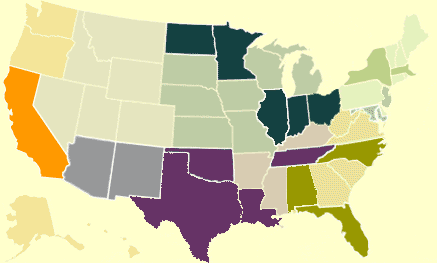
The State Coverage Expansions map - http://www.familiesusa.org/resources/state-information/expansions/state-expansion-map.html guides you to information on key state expansions, with fact sheets, links to legislation, and links to state advocacy groups. Comparing State Expansions - http://www.familiesusa.org/resources/state-information/expansions/table-of-contents.html is a series of tables that show you the key elements of these new proposals/laws state-by-state. How are states financing their expansions? Who is covered? What benefits do they get? Will small businesses be helped? All this and more is covered in the tables.
If your state is doing similar efforts that are not yet on our map, we'd love to hear from you. Click here to give us a call or send us an e-mail - http://familiesusa.org/resources/state-information/across-states/web-form.html
GAO Reports about Health
Medicaid Demonstration Waivers: Lack of Opportunity for Public Input during Federal Approval Process Still a Concern.
GAO-07-694R, July 24 -
http://www.gao.gov/cgi-bin/getrpt?GAO-07-694R
HCBS - Clearinghouse for the Community Living Exchange Collaborative
Infrastructure development resources for people with disabilities and older adults - http://www.hcbs.org/
NOTE: This is a great resource for information about what states are doing with their Medicaid grants. Be sure to sign up for their newsletter e-Clips.
Register for the Sibling Leadership Network Conference, November 10-11, 2007
The Sibling Leadership Network (SLN) is pleased to announce that registration for the Sibling Leadership Network Conference is now open. Please share this announcement with adult siblings of people with disabilities, researchers, family members, service providers and appropriate listservs.
SLN is a community of adult siblings, researchers, and service providers committed to sibs' concerns. Our goal is to provide siblings of individuals with disabilities the information, support, and tools to advocate with their brothers and sisters and to promote the issues important to them and their entire families. We passionately believe that siblings with and without disabilities can effectively advocate for policies that will benefit people with disabilities and their families.
Despite the ever-changing roles they will assume in the lives of their siblings with special needs, there is relatively little research on siblings and their concerns. The Sibling Leadership Network is interested in research that investigates resilience, support opportunities, and life choices across the lifespan.
Sibling Leadership Network Conference will be a conversation among siblings, researchers, people with disabilities, service providers, and policymakers. The goal of this event is to move the conversation into a plan of action. During this conference, we'll ratify the SLN's mission and values, discuss siblings' concerns with researchers and policymakers, and learn what current research reveals about brothers and sisters. Finally, we'll develop an action plan and a white paper on sibling issues, policy recommendations, and a research agenda.
Please join us for this exciting, historic event!
Where: Renaissance Hotel, Washington DC
When: Friday and Saturday November 9-10, 2007
Cost: $75 until 10/19/07 and $90 thereafter
Registration form with agenda and additional details: http://www.uic.edu/orgs/rrtcamr/SLN_Brochure.pdf
Questions: John Kramer 312-996-7988; jkrame3@uic.edu
Sponsors/Key Partners: The Rehabilitation Research and Training Center on Aging with Developmental Disabilities; Vanderbilt Kennedy Center; NIDRR; AUCD; The Arc; The Ohio State Nisonger Center; The Sibling Support Project
Don Meyer, Director, Sibling Support Project, A Kindering Center program, 6512 23rd Ave NW, #213, Seattle, WA 98117, 206-297-6368, donmeyer@siblingsupport.org, http://www.siblingsupport.org/, Online training calendar: http://plus.calendars.net/sibshop Our brothers, our sisters, ourselves
National Organization on Disability Invites Cities to Enter Accessible America Competition
Deadline: October 31, 2007
The National Organization on Disability (http://www.nod.gov) is
calling on America's mayors and chief elected officials to enter
their communities in the seventh annual Accessible America awards
competition, open to all U.S. cities and towns. The purpose of
the competition is to highlight and inspire replication of best
practices/concepts in disability programs, services, and
initiatives.
To enter the competition, communities must submit an official
Accessible America 2007 application signed by their mayor or
chief elected official describing how their city or town (or
county representing unincorporated communities within its
borders) provides opportunities for citizens with disabilities to
participate fully in community life.
There will be one cash prize of $25,000. The cash award will be
presented to the chief elected official in the winning city,
town, or county. The award funds should be used to further the
community's efforts in closing the participation gaps for
citizens with disabilities.
Any city, town, county, or sovereign tribal government in the
United States and its territories may submit entries for the
competition.
RFP Link:
http://fconline.foundationcenter.org/pnd/10008592/nod
Until Next week
The Arc of the United States,1010 Wayne Avenue, Ste. 650,Silver Spring, MD 20910, Phone: 301-565-3842, Fax: 301-565-3843, Email: mmwdc@info.thearc.org, Web: www.thearc.org
Disclaimer: MMWDC publishes information about issues and events that we believe to be important and likely to be of interest to advocates and others interested in inclusion of persons with disabilities in all parts of society. However, MMWDC and The Arc of the United States and TheArcLink Incorporated do not necessarily endorse all events, sponsoring organizations and reports which appear.