Banner for Monday Morning in Washington, DC


Volume 07 Issue 33 August 20, 2007

Welcome to Monday Morning in Washington, D.C., published weekly by The Arc of the United States. We will bring to you news of interest to self advocates and their families, volunteers, professionals, and supporters of the disability movement. Please send any comments to mmwdc@thearc.org. You are welcome to reproduce and distribute items from Monday Morning in Washington, D.C., but please credit Monday Morning in Washington, D.C. (The Arc of the United States, 2007).

The Arc of the United States advocates for the rights and full participation of all children and adults with intellectual and developmental disabilities. Together with our network of members and affiliated chapters, we improve systems of supports and services; connect families; inspire communities; and influence public policy.

[NOTE: Having trouble reading this newsletter? Read it online.] [Past Issues]

IN THIS ISSUE:

National Respite Conference

Just a quick reminder to register now for the National Respite Conference to be held in Huntsville, Alabama, October 3-5, 2007. Early registration fee is $150 if received by September 21, 2007. To access the registration brochure click here - http://www.archrespite.org/2007_Conf_Brochure.pdf

Also, make your hotel reservations now before the conference rate expires in early September. The conference will be held at the Embassy Suites Hotel and Spa Botanica located at 800 Munroe Street, Huntsville, AL. To receive the special hotel conference rate of $124 per night (taxes not included), including a full breakfast, call 1-800-Embassy (1-800-362-2779) or reserve online at www.embassysuiteshuntsville.com. Please refer to Conference Code CPH.

Please distribute this email widely to ALL your email lists. We look forward to seeing you and your members in Alabama in October.

CMS Releases Promising Practices Reports for Persons with Autism Spectrum Disorders

The Centers for Medicare and Medicaid Services (CMS) is pleased to announce the availability of three new promising practices reports that focus on Services for Individuals with Autism Spectrum Disorders (ASDs). Since 1999, CMS has developed an on-line repository of more than 75 Promising Practices in Home and Community-Based Services (HCBS) to highlight State efforts to enable persons of any age who ave a disability or long-term illness to live in the most integrated community setting appropriate to their individual support requirements and preferences, exercise meaningful choices, and obtain quality services. The new reports focusing on ASDs are at: http://www.cms.hhs.gov/promisingpractices/

The on-line Promising Practices Reports disseminate timely information on program and policy innovation. These reports on ASDs are part of the CMS' participation in the Interagency Autism Coordinating Committee (IACC), created through the Combating Autism Act of 2006. The Centers for Disease Control and Prevention estimates that about 1 in 150 children have an ASD, with males predominantly affected. ASDs are developmental disabilities that create impairments in social interaction and communication, and include unusual behaviors and interests. Individuals with ASDs have unusual ways of learning, paying attention, and reacting to different sensations. The abilities of children and adults with ASDs can vary, from gifted to challenged. An ASD typically begins before age three and lasts throughout an individual's lifetime.

We invite you to visit the Promising Practices Website to view all of the resources posted, including our new reports:

California - Single Process for Diagnosis and Service Delivery
Two multi-county regions in California established one-stop clinics to diagnose ASDs and coordinate service planning across the education and developmental disabilities systems. Both regions also established ongoing collaborative teams to coordinate supports and improve the local service system for children with ASDs. An evaluation reported a four-month reduction in the average age of diagnosis.

Connecticut- Pilot Program for Young Adults with Autism Spectrum Disorders
Connecticut is operating a State-funded HCBS pilot program to help adults with ASDs gain skills to join the regular workforce. The program serves people with ASDs who do not qualify for the State's Medicaid HCBS waivers. This pilot program targets individuals who need continued supports to pursue employment opportunities and improve their independent living skills.

Delaware - Supported Employment for Adults with Autism Spectrum Disorders
Delaware has helped adults with autism ASDs work alongside people without disabilities, using both supported and competitive employment. The State emphasizes early transition planning for youth exiting the school system. It also provides additional hours of support for Medicaid waiver participants with challenging behaviors. Over 50 HCBS waiver participants with ASD who live in Delaware are employed in the community.

REFERENCE POINTS:
Customized Employment Resources from ODEP

CUSTOMIZED EMPLOYMENT: PRACTICAL SOLUTIONS FOR EMPLOYMENT SUCCESS: VOLUME I
This resource provides a general overview of the following topics:
Customized Employment: A New Competitive Edge; Principles and Indicators; Job Seeker Exploration; Creating a Blueprint for Job Development; and Negotiating with Employers;

CUSTOMIZED EMPLOYMENT: APPLYING PRACTICAL SOLUTIONS FOR EMPLOYMENT SUCCESS: VOLUME II
Expands on those topics presented in Volume I and provides ideas on how to use these strategies with job seekers for their own Customized Employment success. Both resources can be found on ODEP's website at http://www.dol.gov/odep/categories/workforce/CustomizedEmployment/deliverables/index.htm

Online Tools for People with Disabilities

The National Service Inclusion Project (NSIP) is a Corporation for National and Community Service (CNCS) training and technical assistance provider. Through comprehensive training, technical assistance, and product dissemination, NSIP strives to ensure meaningful service experiences for all Americans, regardless of their abilities. http://www.serviceandinclusion.org/index.php See the Toolbox for lots of great resources http://www.serviceandinclusion.org/index.php?page=toolbox

"Low Cost and No Cost Online Tools for People with Disabilities"
provides a wide array of information and resources. The main purpose of the guide is to provide technology resources that increase access to computers for people with disabilities. For example, the guide can be used to help identify resources for people with disabilities who would benefit from such software as voice output programs to compensate for speech or reading disabilities. There are many other types of resources in this guide that will help the reader learn about what technologies exist, how to obtain funding for various types of computer technology-hardware, software and assistive, as well as how to use existing legislation to advocate for assistive technology, and many other related topics. To review this guide, go to: http://www.ataccess.org/resources/lowcostnocost.html [psted on the Digital Divide Network Listserv]

'Local Connections' Helping Low-Income Adults Find Affordable Care
As locally crafted responses to health system failures, community health initiatives have been steadfast in their efforts to connect uninsured and low-income Americans to coverage and care by assisting with outreach, coordinating health services, and helping clients use limited resources efficiently. A new Commonwealth Fund report, Lessons from Local Access Initiatives: Contributions and Challenges, presents case studies of five notable programs targeting low-income adults under age 65. http://tinyurl.com/3y4laf [posted on The Commonwealth Fund e-Alert]

Postsecondary Resources for Students with Intellectual Disabilities

COLLEGE OPTIONS FOR STUDENTS WITH INTELLECTUAL DISABILITIES
The Postsecondary Education Research Center Project, coordinated by TransCen, has launched a web site that provides information and resources on college options for students with intellectual disabilities. The site provides answers to frequently asked questions related to developing or expanding services for students with intellectual disabilities in college settings. It also provides access to a free online evaluation tool, the PERC Self-Assessment Tool, that allows users to evaluate aspects of programs or services for students with intellectual disabilities on college campuses. This self-assessment tool provides a snapshot of the quality of existing services and provides users with a concise evaluation report. It also provides users with the opportunity to create an itemized action plan that can be used to address areas in need of improvement. The website can be found at http://www.transitiontocollege.net

INDIVIDUAL SUPPORTS TO INCREASE ACCESS TO AN INCLUSIVE COLLEGE EXPERIENCE FOR STUDENTS WITH INTELLECTUAL DISABILITIES
The purpose of this online training module is to provide guidance on developing an Individual Support Model (ISM) to increase access to inclusive college experiences and to improve chances for the success of students with intellectual disabilities. An ISM approach provides students with individualized services and supports (e.g., educational coach, tutor, technology, natural supports) in college courses, certificate programs, internships, and/or degree programs. Offered by the On-Campus Outreach project at the University of Maryland; funded by the U.S. Office of Special Education Programs. http://www.education.umd.edu/oco/training/oco_training_modules/IndividualSupports/start.html

TRANSITION SERVICES FOR STUDENTS WITH SIGNIFICANT DISABILITIES IN COLLEGE AND COMMUNITY SETTINGS: STRATEGIES FOR PLANNING, IMPLEMENTATION, AND EVALUATION
This resource is recommended for professionals responsible for designing or implementing transition services for students with autism, developmental, multiple, or other significant disabilities. The book, guides readers through each phase of developing, implementing, and evaluating effective and appropriate transitions services for students with significant disabilities. For purchasing information, go to http://www.proedinc.com/customer/ProductLists.aspx?SearchWord=TRANSITION%20SERVICES%20FOR%20STUDENTS%20WITH%20SIGNIFICANT%20DISABILITIES%20IN%20COLLEGE%20AND%20COMMUNITY%20SETTINGS:%20STRATEGIES%20FOR%20PLANNING,%20IMPLEMENTATION,%20AND%20EVALUATION

REFERENCE POINTS, transition updates from the TATRA Project, features resources and information to help parent organizations, advocates and professionals better serve adolescents and young adults with disabilities, and their families. Administered by the TATRA Project at PACER Center www.pacer.org, REFERENCE POINTS was launched with the initial support from the National Center on Secondary Education and Transition www.ncset.org. TATRA is funded by the U.S. Department of Education, Rehabilitation Services Administration.

DisabilityInfo.gov
Youth Update: Best Practices Guide in Mentoring Youth with Disabilities

A guide on best practices and programs for mentoring young people with disabilities, as well as information on how mentoring programs can benefit youth with disabilities. This document is in .pdf format.This information has recently been updated, and is now available - http://www.disabilityinfo.gov/digov-public/public/DisplayPage.do?parentFolderId=5146

Grants & Funding in Health Update: MRDD Center Core Grants

The National Institute of Child Health and Human Development (NICHD) invites applications for Center Core Grants designed to advance the diagnosis, prevention, treatment, and amelioration of mental retardation and developmental disabilities (MRDD). The closing date for applications is December 21, 2007. This information has recently been updated, and is now available - http://www.disabilityinfo.gov/digov-public/public/DisplayPage.do?parentFolderId=5104

Employment News & Events Update: Improvements to the Ticket to Work and Self-Sufficiency Program--Notice of Proposed Rulemaking

The Ticket to Work program provides beneficiaries with disabilities expanded options for access to employment, vocational rehabilitation, and other support services. The Social Security Administration (SSA) is proposing revisions to its current Ticket to Work program rules to simplify and improve the definition of using a ticket and requirements for measuring timely progress toward self-supporting employment. Deadline for comments is October 12, 2007. This information has recently been updated, and is now available http://www.disabilityinfo.gov/digov-public/public/DisplayPage.do?parentFolderId=10

Mental Health Update: The Science of Mental Illness--A Training Module for Science Teachers

The lessons in this module present fundamental information about mental illnesses. The Science of Mental Illness has several objectives, including introducing students in grades 6-8 to the key concept that mental illnesses have a biological basis and are therefore not that different from other illnesses or diseases. Through inquiry-based activities, students gain a better understanding of what mental illnesses are and what they are not. This information has recently been updated, and is now available - http://www.disabilityinfo.gov/digov-public/public/DisplayPage.do?parentFolderId=151

FY 2006: Medicaid Expenditures for Institutions versus Community-Based Services, Information Bulletin # 222 (8/17).

Medicaid data for FY 2006 provides extremely helpful information to analyze and compare how your State distributes and allocates its Medicaid Long Term Care expenditures between its institutional versus
community-based services.

Nationally, for all disabilities, 60.6% of MA's long term care expenditures went to institutions, i.e, both to nursing homes (for disabled persons of all ages, "PD/A," physical disabilities/aged) and to intermediate care facilities (for persons with "MR/DD," mental retardation/ development disabilities). In contrast, 39.4% of all MA's long term care expenditures went for community services, i.e., for waivers (i.e., both PD/A and MR/DD), personal care option, and home health services in the community.

To understand the balance or ratio, think of a scale, with nursing homes and ICF MR/DD on the side, representing institutional expenditures, and, on the other side of the scale, with waivers, personal care and home health services, representing the community-side expenditures.

To have a clearer or more accurate picture of the scale, it's necessary to break down and compare specific institutions with specific community services.

When disabilities are broken down by MR/DD and PD/A, a dramatic difference exists in the 60.6% national long term care distribution.

For persons receiving MR/DD services, nationally only 39.3% went for institutions (ICF-MRs) and 60.7% was spent for community-based services. That's correct: less Medicaid funds go to institutionalize persons with MR/DD in the institutions than goes to provide community-based services.

In dollars, $12.5b was spent on MR/DD institutions versus $19.3b spent for community-based services. While it's still much too much for MR/DD institutionalization, it's a significantly better balanced than for
persons with disabilities.

For persons with PD/A (regardless of their age), 71.4% was expended on nursing facility institutional services and 28.6% on community-based services. In dollars, nursing homes received $47.7b to institutionalize persons with PD/A versus $19.2b was spent for community-based services.

In dollar amounts that we can identify with, for people with PD/A, $2.48 was spent on nursing homes for every $1.00 in the community. Compare that with MR/DD, where "0.65 was spent on the ICF/MR institutions for every $1.00 spent in the community.

Quite a difference. Why the lopsided distribution based on type of disability?

Have advocates for persons with PD/A devoted as much effort as advocates for persons with MR/DD to eliminate the a state's institutional bias?

Are the MR/DD advocates better organized than the PD/A advocates? More aggressive? Better at the political process?

Do MR/DD advocates have more clout at the State level than PD/A advocates?

Why hasn't there been a public discussion on the lopsided MR/DD versus PD/A distributions?

Surely, people with MR/DD or with PD/A are equally valuable and important, and they deserve the same opportunity to reside in the community.

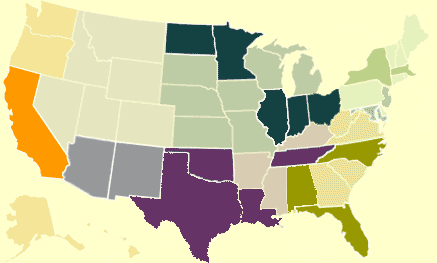
Let's look at the differences in each State. The following chart provides two columns - the first for MR/DD and the second for PD. For each, we provide the ratio of expenditures, i.e., the amount of institutional
expenditures for each $1 of community expenditures.

How does your State compare?

Ratio of expenditures for institutional versus community; that is, how much MA funds were spent in institutions for each MA $1 spent in the community?

Ratio of Expenditures for institutional versus community for people with MR/DD and PD
STATE MR/DD PD STATE MR/DD PD
 
Institution vs Community
 
Institution vs Community
Alabama
0.15 to $1
$7.94 to $1 Montana
0.20 to $1 $2.47 to $1
Alaska
$0 to $1
0.94 to $1 Nebraska
0.43 to $1 $3.93 to $1
Arizona*
n/a
$1.53 to $1 Nevada
0.44 to $1 $2.10 to $1
Arkansas
$1.42 to $1
$2.84 to $1 New Hampshire 0.02 to $1 $6.47 to $1
California
0.53 to $1
$1.07 to $1 New Jersey
0.84 to $1 $3.87 to $1
Colorado
0.19 to $1
$1.99 to $1 New Mexico
0.11 to $1 0.86 to $1
Connecticut
0.68 to $1
$4.02 to $1 New York
0.74 to $1 $1.77 to $1
Delaware
0.34 to $1
$6.63 to $1 North Carolina
$1.30 to $1 $1.32 to $1
D. C.
$4.51 to 1
$2.69 to $1 North Dakota $1 to $1 $16.60 to $1
Florida
0.40 to $1
$6.88 to $1 Ohio
$1.11to $1 $3.74 to $1
Georgia
0.46 to $1
$5.16 to $1 Oklahoma 0.51 to $1 $2.75 to $1
Hawaii
0.10 to $1
$4.89 to $1 Oregon
0 to $1 0.82 to $1
Idaho
$1.04 to $1
$1.48 to $1 Pennsylvania 0.48 to $1 $7.31 to $1
Illinois
$1.66 to $1
$3.88 to $1 Rhode Island 0.04 to $1 $7.60 to $1
Indiana
$1.50 to $1
$11.33 to $1 South Carolina
$3.99 to $1 0.84 to $1
Iowa
$1.05 to $1
$3.05 to $1 South Dakota 0.27 to $1 $8.51 to $1
Kansas
0.28 to $1 $1.79 to $1 Tennessee
0.66 to $1 $87.31 to $1
Kentucky 0.74 to $1 $4.18 to $1 Texas
$1.69 to $1 $1.19 to $1
Louisiana
$2.48 to $1 $4.75 to $1 Utah 0.50 to $1 $9.16 to $1
Maine
0.27 to $1 $2.99 to $1 Vermont
n/a $2.68 to $1
Maryland
0.13 to $1 $5.05 to $1 Virginia
0.74 to $1 $3.34 to $1
Massachusetts 0.24 to $1 $3.08 to $1 Washington 0.33 to $1 0.87 to $1
Michigan
0.02 to $1 $5.27 to $1 West Virginia 0.30 to $1 $3.50 to $1
Minnesota
0.19 to $1 $1.33 to $1 Wisconsin 0.35 to $1 $2.30 to $1
Mississippi* $253.60 to 0 $40.50 to $1 Wyoming
0.22 to $1 $4.03 to $1
Missouri 0.74 to $1 $2.35 to $1 National 0.65 to $1 $ to $1

* Complete data is apparently available.

This data was computed from the CMS' MA reports from each state based on actual expenditures. The data is compiled by Thompson/Medstat, to whom we are very appreciative.

Steve Gold, The Disability Odyssey continues

Back issues of other Information Bulletins are available online at http://www.stevegoldada.com with a searchable Archive at this site divided into different subjects.To contact Steve Gold directly, write to stevegoldada@cs.com

New From the Institute on Community Integration

August 2007 Update

Greetings from the Institute on Community Integration at the University of Minnesota. This is our monthly update of new publications, Web sites, projects and training activities of the Institute. For further information, visit our Web site at http://ici.umn.edu, or follow the contact information in the sections below.

This month we're announcing new resources in the following topical areas:


Residential Services for Persons with Developmental Disabilities: Status and Trends Through 2006 (July 2007).

Edited by R. Prouty, G. Smith, and K.C. Lakin

A report providing statistics by state for the fiscal year ending June 30, 2006, with long-term trends, on residential services, settings, populations and expenditures for persons with developmental disabilities in state, non-state, and Medicaid-funded residential programs in the U.S. Resident characteristics, movement and staffing patterns in large state residential facilities are included. Published by the Institute's Research and Training Center on Community Living. (2007) Cost: Free. Available only on the Web at http://rtc.umn.edu/docs/risp2006.pdf.


FRONTLINE SUPERVISORS AND DIRECT SUPPORT PROFESSIONALS

National Validation Study of Competencies for Frontline Supervisors and Direct Support Professionals

By S. Larson, R. Doljanac, D. Nord., P. Salmi, A. Hewitt, and S. O'Nell

A report from a study examining organizational workforce outcomes; characteristics of and differences between managers, Frontline Supervisors (FLS) and Direct Support Professionals (DSPs); and workplace competencies, training needs, and timing of training for FLS and DSPs. Using survey methodologies, the study validated nationally the results of two comprehensive Minnesota analyses of competencies needed by DSPs and FLS, extending the existing analyses by sampling DSPs, FLSs, and managers in 77 agencies in five states. Published by the Institute¹s Research and Training Center on Community Living. (2007)

Cost: Free. Available only on the Web at http://rtc.umn.edu/publications/.


EMERGENCY PREPAREDNESS

The Emergency Response Preparedness Self-Assessment Instrument (http://rtc.umn.edu/erp)

A newly developed online tool designed for use by state disability services officials nationwide to determine the extent to which their agency's emergency preparedness plans address issues critical to the support and protection of persons with intellectual and developmental disabilities during disaster or crisis. While designed primarily for state agencies, it may also be useful to community service providers and others. A demonstration version can be found online, as well as more information about the tool. Developed by a partnership between the National Association of State Directors of Developmental Disabilities Services and the Institute¹s Research and Training Center on Community Living.

50 State Medicaid Benefits: Online Database Updated to Reflect 2006 Survey Data

The Kaiser Family Foundation’s Commission on Medicaid and the Uninsured has issued its latest update (October 2006) of the interactive Medicaid Benefits: Online Database, available at http://www.kff.org/medicaid/benefits/index.jsp. Using this tool, Medicaid benefits can be compared across the 50 states, the District of Columbia and the US Territories or by specific service.

The online tool contains Medicaid benefits survey data from 2003, 2004 and 2006 with information about benefits covered, limits, co-payments and reimbursement. The tool includes an interactive map, an expandable list of benefits, and the ability to compare data across the three survey periods. 

For further information about this resource and the data, please contact us at kcmu@kff.org or contact Rakesh Singh at 202-347-5270 or rsingh@kff.org.

FVND Share the Wealth Week of Aug. 13
AUTISM: Caring for Children with Autism Spectrum Disorders A Resource Toolkit for clinicians 

http://www.medicalhomeinfo.org/Publications/eNews/ncbddd.html#n1

Agency for Healthcare Research and Quality (AHRQ) Launches Campaign to Get Involved in Your Healthcare

In conjunction with the Ad Council, the Agency for Healthcare Research and Quality (AHRQ) has launched a public education campaign, entitled "Questions Are The Answer", to encourage people to get involved in their healthcare. It includes public service announcements as well as on-line tools to prepare for doctors' visits. See: http://www.ahrq.gov/questionsaretheanswer/

New Oral Health Resources are available on the Family Voices Web Site

An article by Betsy Anderson, Family Voices Staff, Boston, was recently published in the March-April 2007 issue of Pediatric Dentistry - http://www.aapd.org/searcharticles/article.asp?ARTICLE_ID=2153 Based on a presentation - http://www.familyvoices.org/pub/general/AAPDFVOralHealthPPNov2006_BA.ppt given by Betsy at the American Academy of Pediatric Dentistry in November 2006, “A Look Back: Lessons in Family Activism and Recommendations to Address Today’s Oral Health Challenges for Children with Special Health Care Needs” discusses family activism in the care of CYSHCN, and examines the successes and obstacles families have encountered from the 1970s to the present regarding family centered care, availability of resources and health care services, and financing.

Recommendations are made to address these areas of concern as they relate to dental issues. Family Voices IMPACT and the National Center for Family Professional Partnerships recently hosted an informative topical call-Oral Health: Brushing Up on Issues for CYSHCN-that was attended by over 75 family members, Title V programs, dental health associations and providers. Facilitated by family leaders and professional partners, call participants learned about: Special needs and issues for CYSHCN (including implications of specific medical conditions; special importance of preventive care; medications; behavioral influences); State/Federal Policies and Financing; Oral Health Forums and State Plans for CYSHCN; and Issues for Families; Roles and Opportunities for Family Leaders. Great ideas and input from Beth Dworetzky, Massachusetts Family Voices and Gina Pola-Money, Utah Family Voices.

A resource provided during this call, Dental Health Issues for Children, Including Children with Special Health Care Needs - http://www.familyvoices.org/pub/general/BFDenHealthHandoutOct05.pdf, is available on our web site. Additional materials will be posted in the weeks ahead.  Dental Health Issues for Children, Including Children with Special Health Care Needs”, is available  on the Family Voices Web Site.

Health Care Language Services Implementation Guide

The Office of Minority Health at the U.S. Department of Health and Human Services is pleased to announce the release of the "Health Care Language Services Implementation Guide," an interactive Web-based learning tool designed to help health care professionals plan, implement, and evaluate language access services (LAS) within their organizations. The Guide is available at no cost to health care providers through www.thinkculturalhealth.org or directly from the HHS Office of Minority Health website - https://hclsig.thinkculturalhealth.org/user/home.rails .

DATA ON KEY INDICATORS OF CHILD WELL-BEING RELEASED

America's Children: Key National Indicators of Well-Being, 2007, summarizes a set of measures on important aspects of children's lives that federal agencies collect regularly, reliably, and rigorously. The 2007 report, representing the 10th anniversary edition published by the Federal Interagency Forum on Child and Family Statistics (FIFCFS), presents the conceptual framework, structure, and changes from previous annual reports, along with information on race and ethnicity data, indicators needed, and highlights. The main body of the report focuses on seven domains of child well-being, including (1) family and social environment, (2) economic circumstances, (3) health care, (4) physical environment and safety, (5) behavior, (6) education, and (7) health. A list of the FIFCFS agencies is provided. The appendix contains tabulated data for each measure and additional detail not discussed in the main body of the report. Descriptions of the data sources and surveys used to generate the background measures and the indicators are included. The report is available at http://www.childstats.gov/americaschildren/index.asp.

Children's Access to Medical and Dental Care

New data from the Data Resource Center for Child and Adolescent Health on the percentage of children who access medical and dental care have been added and are available for 2003 by state and region. Children's Access to Medical and Dental Care- http://www.statehealthfacts.org/comparetable.jsp?ind=584&cat=2

A Practical Guide for Improving Child Developmental Services

http://www.commonwealthfund.org/innovations/innovations_show.htm?doc_id=372065

Community Service: A Family's Guide to Getting Involved

One of the most satisfying, fun, and productive ways to unite as a family is volunteering for community service projects. Not only does volunteerism set a good example for your kids, it's helpful to the community as well.http://www.kidshealth.org/parent/positive/family/volunteer.html

To Tell or Not to Tell" Children About Their Disabilities

http://specialchildren.about.com/b/a/259354.htm?nl=1

Foreign Languages and Students with Learning, Hearing, or Vision Disabilities Tip Sheet

This Tip Sheet from the National Clearinghouse on Disability and Exchange offers strategies for optimizing students with learning, hearing, or vision disabilities’ world language and English language learning, and provides links to research articles related to learning disabilities, blindness, and deafness. To access the tip sheet please visit http://www.miusa.org/ncde/tipsheets/foreignlang/

Literature Review: Developmental Problems of Maltreated Children and Early Intervention Options for Maltreated Children

by Crystal Wiggins, Emily Fenichel, and Tammy Mann

This new publication from ZERO TO THREE and the Institute for Social and Economic Development (ISED) examines common developmental problems that occur as a result of maltreatment in infants and toddlers under the age of 3 and looks at the positive impact of early intervention for these vulnerable young children. It is available online at http://aspe.hhs.gov/hsp/07/Children-CPS/litrev/index.htm

Project SAVE - (Stop Abuse and Violence through Education)

The Arc of New Mexico is excited to announce that it has developed a proven model to train law enforcement personnel, prosecutorial staff and other professionals on how to interact and interview individuals with developmental disabilities who have been crime victims or witnesses to a crime. http://www.arcnm.org/index.php/news_events/article/46/

For more information contact: Randy Costales, Associate Director, The Arc of New Mexico, 3655 Carlisle NE, Albuquerque, New Mexico 87110, Phone: 505-883-4630, Fax: 505-883-5564, Toll Free: 1-800-358-6493, rcostales@arcnm.org

Kaiser Weekly Update
Report Examines Lessons From Deinstitutionalization of People with Mental Illness

The Foundation’s Kaiser Commission on Medicaid and the Uninsured (KCMU) released a new study that examines what policy lessons can be learned from the deinstitutionalization of people with mental illnesses and applied to potential long-term care reform for the elderly or those with significant disabilities. The report discusses the take-away lessons for long-term care policy, with a focus on planning, financing, living situations, workplace issues and the role of families. The study is available at http://www.kff.org/medicaid/7684.cfm

Policy Brief Explains Recent Estimates of Eligible but Uninsured Children

As Congress reauthorizes the State Children’s Health Insurance Program (SCHIP), accurate estimates of the number of children who are eligible for Medicaid and SCHIP but remain uninsured are critical for policy and budget development. This new brief - prepared by Lisa Dubay, Ph.D., of the Bloomberg School of Public Health at Johns Hopkins - describes the methodologies underlying recent estimates from the Congressional Budget Office and the Bush Administration.  It is available at http://www.kff.org/medicaid/7685.cfm

DTV Transition: Disability Coalition Submits Comment to FCC about the Problems

On August 9, 2007, the Coalition of Organizations for Accessible Technology (COAT) submitted comments at the Federal Communications Commission (FCC) on some of the problems the transition to digital television is posing for people with disabilities. Analog TV transmission ends February 17, 2009 when digital TV transmission should be fully implemented. For people with disabilities, transition problems include the technical difficulties associated with pass through of closed captioning, industry confusion over the scope of the FCC's captioning regulations, usability of TV remote controls, the barriers to resolving concerns with TV stations and cable companies, and concerns about pass through of video description for persons with vision disabilities. COAT's Comments included press articles such as "HDTV messes up service for deaf," from the Sacramento Bee, and "Digital Revolution Excludes Closed Captioning" from TVWeek Online. 

See COAT comments at: http://fjallfoss.fcc.gov/prod/ecfs/retrieve.cgi?native_or_pdf=pdf&id_document=6519610470

For information on the DTV transition generally, please visit http://www.dtv.gov/publications.html

For more information on this topic, or if you have additional concerns, please contact Jenifer Simpson at AAPD by email aapdjenifer@aol.com

Caregivers Support Broadcast

SATELLITE BROADCAST - Wednesday, September 19, 2007 - 1:00 - 3:30 p.m. Eastern Time

Objectives

The New Freedom Initiative (NFI) Subcommittee on Caregiving presents this broadcast designed to bring awareness to the range of programs and services the Department of Health and Human Services (DHHS) offers that support caregivers across the lifespan. NFI is a  government ­ wide effort to eliminate the barriers that prevent people with disabilities from participating in community life. A panel of experts will provide information about these programs to increase knowledge of partners and providers, and improve service delivery for caregiving Americans.

More Information

To register and to find more information on the broadcast and where it can be viewed, please go to:
http://www.cms.hhs.gov/apps/events/event.asp?id=378

If you have any questions, please e­mail us at caregivers@cms.hhs.gov or contact Spencer Schron at (410) 786­1075; Debbi Oxenreider at (202) 205­2118; Rick Greene at (202) 357­3586.

NCPAD NEWS: August 2007, Volume 6, Issue 8

A monthly publication of NCPAD - the NATIONAL CENTER on PHYSICAL ACTIVITY and DISABILITY www.ncpad.org To sign up for this free monthly electronic newsletter, click on http://www.ncpad.org/newsletter/ or send an e-mail to listserv@listserv.uic.edu with this message in the body of the e-mail: SUBSCRIBE NCPAD-NEWS yourfirstname yourlastname

Maytag Mom

By Samtra K. Devard, Delaware New Scripts, parent

Everybody knows the commercials featuring the Maytag repairman.  This is the guy who has nothing to fix.  Of the millions of washers, dryers and dishwashers that are sold – the guy who was hired to fix any problems that Maytag appliances may have, has nothing to fix.

Surely there is something that he can fix.  Yes, only if something is broken!

Just like the Maytag repairman has nothing to fix, Mom’s of children with disabilities have nothing to fix. We are in essence Maytag Moms.

Many of us are given a diagnosis for our kids and a laundry list of all the things that are wrong.  We are presented with scenario after scenario of circumstances too bleak to contemplate.

The problems that face children with disabilities and their families sometimes seem endless.  And for many who are faced with a problem – the natural tendency is to fix it.

A wise woman whom I love and respect once told me it took her a long time to figure out that her role in her daughter’s life was to NOT to “fix” her daughter, because she wasn’t broken.  Once she learned that, she was able to come into acceptance of what is – and find peace with that.  To function in a mindset that is about maximizing potential and life chances, rather than fixing the problems of a “broken” child or family situation is so much more meaningful.  The Maytag Mom is expending valuable energy trying to fix something that isn’t really broken.

Broken means out of order, not working, damaged, ruined, destroyed, defeated, dejected, crushed, dispirited – without hope.

Our children are anything but broken.

The sooner we stop trying to fix the situation or our children, the sooner we can begin the healing process and begin to function in a positive, less energy draining way.

I have learned I am a Maytag Mom.  I having been doing all I can to fix things.  Acknowledging this has been so profound for me.  It’s taken a lot of soul searching in a short period of time to realize that no matter what – we have some circumstances that just are what they are.  Nothing’s broken.  

The good news is Maytag Moms are good at what they do and can redirect their energies to things that are about building and growing and uplifting.  We can do with our lives what was intended – to live and love to the fullest.  Love our children and the joy they bring.  Resist any temptation to fear the unknown about what lies ahead.  Certainly, what the Moms of children with disabilities face can be different than if our children didn’t have a disability – but guess what there would still be something to deal with; just a different something.

But I believe wholeheartedly that the heart, energy and passion of the Maytag Mom is why God blessed our lives in such a great way.  Reminding ourselves of the blessings during times of turmoil all around us becomes the challenge.

Maytag Moms – there is a great future ahead!


Until Next week

The Arc of the United States,1010 Wayne Avenue, Ste. 650,Silver Spring, MD 20910, Phone: 301-565-3842, Fax: 301-565-3843, Email: mmwdc@info.thearc.org, Web: www.thearc.org

Disclaimer: MMWDC publishes information about issues and events that we believe to be important and likely to be of interest to advocates and others interested in inclusion of persons with disabilities in all parts of society.  However, MMWDC and The Arc of the United States and TheArcLink Incorporated do not necessarily endorse all events, sponsoring organizations and reports which appear.