| Volume 07 | Issue 32 | August 13, 2007 |
Welcome to Monday Morning in Washington, D.C., published weekly by The Arc of the United States. We will bring to you news of interest to self advocates and their families, volunteers, professionals, and supporters of the disability movement. Please send any comments to mmwdc@thearc.org. You are welcome to reproduce and distribute items from Monday Morning in Washington, D.C., but please credit Monday Morning in Washington, D.C. (The Arc of the United States, 2007).
The Arc of the United States advocates for the rights and full participation of all children and adults with intellectual and developmental disabilities. Together with our network of members and affiliated chapters, we improve systems of supports and services; connect families; inspire communities; and influence public policy.
[NOTE: Having trouble reading this newsletter? Read it online.] [Past Issues]
CNN "Where's Molly?" and Find Family link
CNN didn't air the "Where's Molly?" FindFamilyRegistry story last week due to breaking news from Minneapolis. You can see the story and post a comment at:
http://www.cnn.com/2007/HEALTH/08/01/wheres.molly/index.html
DisabilityInfo.gov
Grants & Funding in Education Update: Grants to Improve State Systems for Providing Educational Materials in Accessible Formats
This grant announcement supports the 2004 amendments to the Individuals with Disabilities Education Act (IDEA) which added several new provisions to improve the availability of educational materials in accessible formats for students who are blind and other students with print disabilities. The application deadline is September 4, 2007. The complete grant annoucement may be accessed by clicking here - http://a257.g.akamaitech.net/7/257/2422/01jan20071800/edocket.access.gpo.gov/2007/pdf/E7-15131.pdf
This information has recently been updated, and is now available - http://www.disabilityinfo.gov/digov-public/public/ DisplayPage.do? parentFolderId=5097
Familytalk - Nebraska
Choosing Care for a Child with Special Needs
http://www.connectforkids.org/node/5339
by: Rebecca Freshour
Sara Thompson of Endicott, Washington, has a son with ADHD, Pervasive Developmental Disorder (PDD) and anxiety. She placed her son in child care when he was still a baby. Her experience, for the most part, has been positive. She feels that the experience was a good one for her child-and that child care centers can provide parents a place where they know their child is being taken care of, while at the same time getting companionship.
"I really find that children in day care are better socialized and adjust better. I can't imagine what it would have been like for us if we wouldn't have put him in care," says Thompson. "Parents need a break sometimes. Some days I would put him in daycare so I could have a day at home."
Choosing child care for any child can be an arduous and stressful task, but for parents of a special needs child, it can also be a very confusing and emotional experience. Here are some tools that can help.
ADA 101: Parents' Basic Rights
There are many things that have to be considered when placing a special needs child with a child care provider, such as the American with Disabilities Act (ADA) child care laws, what questions to ask and what to look for when visiting a potential center or caregiver.
With the exception of child care centers run by religious entities, all child care providers, including small home based providers, must comply with Title III of the ADA laws. According to the Department of Justice Website, the basic requirements of Title III are as follows:
Tips on Choosing Care
Once a parent is ensured that the caregiver they are considering is in compliance with the ADA laws, they should visit the facility at an unannounced time to observe the activities of the center and the quality of care the children are receiving. Wendy Zwicker, Program Director for the Special Needs Unit of the YMCA Child Care Resource Service through the Department of YMCA in San Diego County, feels this is one of the most important steps of choosing a child care center or provider. "If they won't allow you into the center or home if you show up unannounced, be aware. It probably means they are not providing quality care."
Once a parent feels comfortable that a center or provider is providing adequate care, they should set up an appointment to speak with the child care administrator or provider to ask important questions about the quality and type of care their child will receive. They should also use the time in the center or home to further observe the activities and the center itself.
Parents should pay special attention to how the center is organized. "Look around and see if the center is child friendly, for example, if toys and supplies are within reach of a child to make it easier for the child to help him/herself. Look at the pathways in the center to make sure they are clear of obstructions and easy for the child to maneuver through and also observe if the restrooms are readily accessible and child friendly. You should also pay attention to the ratio of caregivers to children. Are there enough care givers that your child will be taken care of and receive the attention that he or she needs?" says Zwicker.
One indication of whether or not a child care facility is child oriented and not just geared towards parents is the location of the children's' artwork. "There are times when a center wants to showcase artwork for parents, but the artwork of the children also needs to be on THEIR eyelevel so they can see and take pride in their accomplishments," says Zwicker.
While talking to caregiver, parents need to be sure to ask specific questions, such as the experience the caregiver has in dealing with special needs children, what kind of schedules and routines the caregiver has in case accommodations need to be made for the child, what kind of experience and training (if any) are provided to other caregivers that may be taking care of your child, and what they can do to accommodate the special needs of a child.
Parents should also be sure to provide caregivers with all the pertinent information they'll need to know to assure the best quality of care. Parents need to be honest about their child's disabilities and needs and discuss any concerns the provider may have. This is an important step in assuring open and honest communication between the parent and caregiver. There should be a partnership between both parties to insure the success of the child while in the center or home.
With the right support, placing a child with special needs in a day care center or with a home based care provider can be very successful. According to Zwicker, the most important thing "is to find a provider that is both licensed and monitored." Once the emotional hurdle is overcome and the stress of finding the right center is lifted, it can be beneficial to both the parent and the child.
Comments or feedback? Share it with info@connectforkids.org.
Freelance writer Rebecca Freshour lives in Mississippi with her husband David and son Caleb.
NECTAC eNotes - August 6, 2007
What Works Clearinghouse Releases New Intervention Reports on Early Childhood Education
Source: What Works Clearinghouse, Institute of Education Sciences - August 2, 2007
The What Works Clearinghouse recently released the following new intervention reports related to Early Childhood Education:
A Science-Based Framework for Early Childhood Policy: Using Evidence to Improve Outcomes in Learning, Behavior, and Health for Vulnerable Children
Source: National Scientific Council on the Developing Child - August 6, 2007
This new report from the National Scientific Council on the Developing Child integrates the scientific knowledge base of how brain architecture is formed in very young children with those factors from the program evaluation literature that appear to offer the best course toward positive outcomes for children. It builds on the work that began with the 2000 landmark report by the National Academy of Sciences, From Neurons to Neighborhoods: The Science of Early Childhood Development, followed by the work of the National Scientific Council on the Developing Child and the National Forum on Early Childhood Program Evaluation. It is available at http://www.developingchild.net/pubs/persp/pdf/Policy_Framework.pdf
NIH Funds New Program to Investigate Causes and Treatment of Autism
Source: NIH News - August 3, 2007
The National Institutes of Health will intensify its efforts to find the causes of autism and identify new treatments for the disorder through a new research program. The Autism Centers of Excellence (ACE) program represents a consolidation of two existing programs, the Studies to Advance Autism Research and Treatment (STAART) and Collaborative Programs of Excellence in Autism (CPEA) into a single research effort. A related NIH News Release is available online at http://www.nih.gov/news/pr/aug2007/nichd-02.htm
More Final Comments on the Proposed Part C Regulations
Source: NDSS, EIFA, COPAA, AFB - July 23, 2007
Last week eNotes included a link to the final comments from Division for Early Childhood (DEC) on the Proposed Part C regulations. Below are links to the final comments from several additional National Organizations, including:
Invitation to Apply: ZERO TO THREE's State Partnership for Prevention Project
Source: ZERO TO THREE - August 6, 2007
ZERO TO THREE is seeking applications from states to enroll in its State Partnership for Prevention Project. This project seeks to help prevent child maltreatment by involving child care programs in primary prevention efforts. State leadership teams will receive consultation and training for up to 40 trainers in ZERO TO THREE's new Preventing Child Abuse and Neglect: Parent Provider Partnership curriculum. Applications are due by October 23, 2007. To learn more go to http://www.zerotothree.org/site/PageServer?pagename=ter_trng_pcan_app1
New Podcast Series to Share Latest Research on Early Child Development
Source: FPG Child Development Institute, University of North Carolina at Chapel Hill - July 31, 2007
FPG Voices, a new monthly podcast series produced by FPG Child Development Institute (FPG) at the University of North Carolina at Chapel Hill, will provide parents, child care providers, policymakers, and early childhood professionals with the latest research findings in early childhood development. Each episode will feature an interview with a researcher to learn more about a study recently published in a peer-reviewed journal. For more information go to http://www.fpg.unc.edu/news/podcasts.cfm
Two Online Continuing Education Courses on Self-Regulation
Participants: Providers involved in the assessment and intervention of young children - educators, developmental specialists, therapists, social workers, healthcare professionals, and caregivers.
Part I: What is Self-Regulation: Introduction to the SELF Process (September 10-30, 4 CEUs) provides an overview of the complex nature of self-regulation and the rationale for developing the SELF Assessment-Intervention Process. The seminar outlines the four cornerstones underlying the Process and describes the four regulation domains that provide a framework of implementing the process.
Part II: Assessment-Intervention of Self-Regulation: Application of the SELF Process (October 1-November 11, 6 CEUs) emphasizes identifying the underlying factors that impact self-regulation and includes the use of the Observation of Self-Regulation Variables tool. In addition, participants will learn how to use the SELF Strategies Menu that provide information and suggestions on changing interaction patterns and styles and adapting environments to help children better regulate their emotions and behavior.
Access a brochure (http://cdd.unm.edu/ecspd/PDFs/SELF%20trg%20Brochure.pdf) at http://cdd.unm.edu/ecspd/education.asp
The notice below is being posted on behalf of Holly Harrison, Center for Development and Disability, University of New Mexico Health Science Center
For additional questions contact: Holly Harrison hharrison@salud.unm.edu,
Center for Development and Disability,
University of New Mexico Health Science Center,
2300 Menaul Blvd. NE,
Albuquerque, NM 87107,
505-272-3000
New Products from the National Institute for Early Education Research
Source: National Institute for Early Education Research - August 9, 2007
The following new resources from the National Institute for Early Education Research (NIEER) are now available online:
The Effects of the New Mexico PreK Initiative on Young Children's School Readiness (2007), by Jason T. Hustedt, W. Steven Barnett, and Kwanghee Jung - This study looks at the effects of preschool education programs in New Mexico on entering kindergartners' academic skills. Researchers collected data on 886 children and found that children who attended the New Mexico preschool program showed greater improvement in early language, literacy and math development compared to children who did not. It is available at http://nieer.org/docs/index.php?DocID=183
Growing and Learning in Preschool - This five minute video shows the essential features of a high-quality preschool program and demonstrates: how a preschool curriculum based on solid research builds school and life-related skills, why well-qualified teachers are important, and how play is integrated into learning. It is available to be viewed in 3 parts at http://nieer.org/docs/index.php?DocID=65
New Podcast: Early Hearing Detection and Intervention: Can Your Baby Hear?
Source: National Center on Birth Defects and Developmental Disabilities
A recent podcast created by the Early Hearing Detection and Intervention Program at the National Center on Birth Defects and Developmental Disabilities (NCBDDD) and sponsored by the American Speech-Language-Hearing Association (ASHA), discusses the importance of ensuring that every child receives a hearing screening as soon as possible after birth and provides ways for parents and health providers to find out if a child has a possible hearing loss and where to get more information.
To access the podcast in English go to http://www2a.cdc.gov/podcasts/player.asp?f=5834
To access the podcast in Spanish go to http://www2a.cdc.gov/podcasts/player.asp?f=5835
Research Findings: Children Who Complete Intensive Early Childhood Program Show Gains into Adulthood
Source: National Institutes of Health - August 7, 2007
The National Institutes of Health (NIH) recently highlighted the results of a 19 year follow-up study that looked at the long-term effects of the Child-Parent Center (CPC) program. The CPC program provided intensive instruction from pre-school through 3rd grade for children and job skills training, parenting skills training, educational classes and social services for their parents. Findings provide evidence that early education programs can have a wide range of positive effects into adulthood. To read the full press release go to http://www.nih.gov/news/pr/aug2007/nichd-07.htm
Full article citation: Reynolds, A. J., Temple, J. A., Ou, S.-R., Robertson, D. L., Mersky, J. P., and Topitzes, J. W. (2007). Effects of a school-based, early childhood intervention on adult health and well-being: A 19-year follow-up of low-income families. Archives of Pediatrics & Adolescent Medicine, 161(8), 730-739. The abstract is available at http://archpedi.ama-assn.org/cgi/content/full/161/8/730
Institute for Community Inclusion National E-News 8/7/07
Increasing Placement Through Professional Networking
Job developers are often used as a bridge between employment services, job seekers, and business seeking qualified employees. To be a successful job developer, it is necessary to network with fellow placement professionals working at other provider agencies or for the state. Whether you already belong to an employment networking group or would like ot start one of your own, this Institute Brief will provide you with important information about how to make an employment networking group work best for you.
Institute Brief #23 - http://communityinclusion.org/article.php?article_id=209&staff_id=123
AAIDD F.Y.I.
- August 2007, Vol.7, No.8
Visit www.aaidd.org/FYI/ for the current issue
By State: Disabled People and Physically Restraints in Nursing Facilities -
Information Bulletin #221 (08/07)
People do not enter nursing homes pursuant to a court order
requiring them to stay involuntarily in these facilities. Unlike
mental institutions and hospitals, people in nursing facilities,
thus, can legally walk out and leave a nursing facility whenever
they wish, including against medical advice.
Nevertheless, physical devices and restraints are used throughout
the nursing home industry. In 2005, 92,303 people in nursing
facilities were kept in some kind of physical restraints,
presumably against their will and without any judicial or other
independent authority's approval. In fact, 6.9% of all the
residents in nursing facilities were either tied down or had
equipment restraints which restricted their freedom of movement.
In 2007, it has been reported that in a seven day period, every
day, 9.3% or 129,148 people with disabilities in nursing
facilities were physically restrained from leaving their beds.
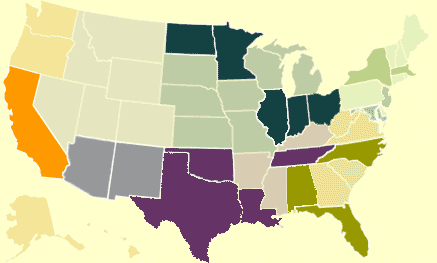
The variation from state to state is quite amazing. In six
states, more than 20% of the disabled residents were restrained in
bed on a daily basis. On the other hand, fourteen states had 1% or
less of their residents so restrained. We list each state below.
In addition to physical restraints in a bed, disabled residents
face several other types of physical restraints in nursing
facilities. Nationally, during the same time period of the last
seven days in 2007, there were 1.8 % or another 24,000 people with
disabilities restrained in chairs who were prevented from rising
from them, and 2% or 27,000 residents who had limb restraints. We
do not know if the people restrained in the chairs were also the
same people who had their limbs physically restrained.
Federal regulations clearly state that nursing facility residents
have the right to be free from physical restraints that are "not
required to treat the resident's medical symptoms." The federal
Centers for Medicare and Medicaid Services note that "restraints
may not be used for staff convenience." If they are used, they
must be only "for brief periods to permit medical treatment to
proceed."
Disabled Advocates:
Have you asked your State Medicaid officials for nursing
facilities by percentages that use these physical restraints?
This information is known.
When you go into nursing facilities, have you discussed these
restraints with the residents?
What "medical symptoms" justify bed restraints on a daily basis
for seven days?
Do the disabled residents know their rights? Have you and the
residents reviewed their "plan of care" to determine what possible
medical justification could conceivably warrant such restraints?
Do the residents know they can refuse the "medical treatment?"
Click on the website below for the percentages, by state, of nursing home residents who
were physically restrained in their beds on a daily basis for
seven day in 2007:
http://www.aapd.com/News/longtermcare/070808sg.htm
Source: Steve Gold, The Disability Odyssey continues
For more long-term care issues, see: http://www.aapd.com/News/longtermcare/index_ltc.php
AAPD
CALL FOR APPLICATIONS: THE 2008 PAUL G. HEARNE/AAPD LEADERSHIP
AWARDS (due: Sept. 21, 2007)
The Paul G. Hearne/AAPD Leadership Awards program was established
to identify and support emerging leaders with disabilities who
will carry on the disability rights movement. Administered by
AAPD and sponsored by the Mitsubishi Electric America Foundation,
the 2008 Paul G. Hearne/AAPD Leadership Awards identifies up to
two emerging leaders with disabilities to each receive $10,000 to
help them continue their progress as leaders. These individuals
will also have an opportunity to meet and network with national
disability leaders at the annual AAPD Leadership Gala in
Washington, DC in the spring. Applications are available from
www.AAPD.com.
Apply by: Friday, September 21, 2007.
Questions and submissions for the Paul G. Hearne/AAPD Leadership
Awards program to: aapdhearne@aol.com
CALL FOR NOMINATIONS: THE 2008 HENRY B. BETTS AWARD
(due: Tuesday, October 9, 2007)
The Henry B. Betts Award program, administered by AAPD, was
created by the Prince Charitable Trusts and the Rehabilitation
Institute of Chicago in 1989 to annually honor individuals who
have, in the course of their work, helped to lead the societal
transformation that is producing dramatically better outcomes and
higher expectations for the diverse groups that make up the
disability community in the United States and around the world.
Typically, one outstanding living individual is selected each year
to receive The Henry B. Betts Award with an unrestricted $50,000
cash award at AAPD's annual Leadership Gala in Washington, D.C.
Nominations are available from www.AAPD.com.
Nominations are due: Tuesday, October 9, 2007.
Questions and submissions for the Henry B. Betts Award program to: aapdbetts@aol.com.
VCU Rehabilitation Research and Training Center on Workplace Supports and Job Retention
Worksupport.com e-Newsletter - Information, resources and research about work and disability issueshttp://www.worksupport.com/news/ws_080607.html
New Data from Statehealthfacts.org
Social Security Disability Insurance (SSDI)
Data from the Social Security Administration (SSA) on beneficiaries receiving Social Security Disability Insurance (SSDI) as of December 2005 are available by state and region. Social Security Disability Insurance - http://www.statehealthfacts.org/comparemaptable.jsp?ind=344&cat=6
Social Security Income (SSI)
Data from the Social Security Administration (SSA) on SSI recipients as of December 2006 are available by state and region. The distribution of SSI recipients by eligibility category and age are also available.
Social Security Income - http://www.statehealthfacts.org/comparemaptable.jsp?ind=253&cat=4
More updates are available here: http://www.statehealthfacts.org/whatsnew.jsp
Kaiser Weekly Update - http://www.kff.org
Primer Examines Health Care Costs
Kaiser released a new primer on health care costs that examines the
rapid growth in the nation's health care costs since 1970 and the
factors that influence health care spending, including new medical technologies, population changes and changes in disease prevalence.
The primer also looks at the impact of health care costs on families,
with insurance premiums rising 87 percent between 2000 and 2006, More than four times the growth in wages. "Health Care Costs: A Primer" is
available at http://www.kff.org/insurance/7670.cfm
Fact Sheet Provides an Overview of Role of Medicaid's and SCHIP's in
Dental Coverage and Care for Low-Income Children
A new fact sheet from the Foundation's Kaiser Commission on Medicaid
and the Uninsured (KCMU) provides an overview of dental care access and
coverage for low-income children. Problems obtaining dental care
disproportionately affect low-income and minority children. Medicaid,
and to a lesser extent the State Children's Health Insurance Program
(SCHIP), are major sources of dental coverage for millions of low-income children, but barriers that leave many children without adequate
dental care remain. It is available at
http://www.kff.org/medicaid/7681.cfm
Policy Brief Examines Medicaid's Rehabilitation Services Option
In 2007, President Bush reintroduced a plan to place new restrictions
on the types of services allowable under the Medicaid rehabilitation
services option. Currently, 47 states plus the District of Columbia
provide at least some type of services under the option. This new
brief from the Foundation's KCMU provides an overview and explores
current policy issues. It is available at
http://www.kff.org/medicaid/7682.cfm
hcbs.org > Clearinghouse CLIPS: August 9, 2007
Intensive Technical Assistance to State Medicaid Agencies
The DSW Resource Center will offer individualized technical
assistance (TA) to up to five state Medicaid agencies each year from
2006 through 2008. The purpose of this TA is to help states develop
or implement initiatives that strengthen the workforce that supports
individuals with disabilities who live in home and community based
settings in their states.
Applications are due August 31, 2007.
Additional Information and Application - http://www.dswresourcecenter.org/index.php/dsw/what_s_new/2008_intensive_ta_application
ADCR-TAE Fact Sheet: How to
Secure Medicaid Federal Financial Participation (FFP) for ADRC
Functions: The Basics
Summary: The federal government will match expenditures that
it deems necessary to support the "efficient and effective"
administration of the Medicaid program. This administrative federal
financial participation (FFP) is typically 50% of the costs, but in
certain cases, enhanced match of up to 90% is available. Medicaid
administrative activities can include many of the ADRC functions.
Topic(s): Aging Issues, Developmental/Psychiatric
Disabilities, Physical Disabilities, Resource Center, Single Point of
Entry/No Wrong Door
Source: The Lewin Group
More Info: http://www.hcbs.org/moreInfo.php/nb/doc/1998
Affordable Clustered
Housing-Care: A Viable Alternative for Long-Term Care in a
Residential Setting?
Summary: For people who have disabilities and consequent
difficulty living independently, living in the community requires not
only medical and support services, but also housing. This paper
explores one approach to merging the worlds of housing and long-term
care clustered housing-care. Clustered housing-care arrangements make
it possible for individuals to age in place in secure, comfortable,
residential-like settings. The paper defines, discusses the impact
and questions the futures of this concept.
Topic(s): Aging Issues, Housing, Long-Term Care
Source: AdademyHealth-The Building Bridges Initiative
More Info: http://www.hcbs.org/moreInfo.php/nb/doc/1997
CPASS Handbooks and
Orientation Material: Hawaii
Summary: These materials help case managers and stakeholders
figure out where to get started. The Case Managers Handbook explains
the roles and responsibilities, plus worksheets and evaluations. The Self-Advocate Handbook helps identify goals and create a person
centered plan. The Community Support Guide and Orientation
Presentation provide an overview of terms and ways to implement
personal assistance programs. A one page handout on stakeholder
values and vision plus the overview brochure are included.
Topic(s): Consumer Direction
Source: Grantee produced, Hawaii
More Info: http://www.hcbs.org/moreInfo.php/nb/doc/2002
CPASS Hawaii Final Report(s)
2006
Summary: The CPASS Hawaii project identified stakeholders,
particularly people with developmental disabilities and their
families, willing to participate in collaborative efforts towards
systems change. This report will elaborate on the accomplishments of
the project related to their 5 goals including barriers and areas of
success, as well as further recommendations. Also included are two
matrixes summarizing accomplishments and training efforts, a
demonstration report and an evaluation summary.
Topic(s): Consumer Direction, Developmental/Psychiatric
Disabilities, Physical Disabilities
Source: Grantee produced, Hawaii
More Info: http://www.hcbs.org/moreInfo.php/nb/doc/2003
Memorandum of Understanding
(MOU): Montana's Medicaid office and ADRC
Summary: This agreement represents a mutual understanding and
establishes a partnership for meeting the goals of the State's Aging
and Disability Resource Center grant. The parties to this
understanding are Senior and Long Term Care Division and its Aging
Services Bureau and the Home and Community Services Division and
their local contractors and offices in the areas that the ADRC is
being implemented. The agreement outlines the background and the
general responsibilities of each party.
Topic(s): Aging Issues, Developmental/Psychiatric
Disabilities, Resource Center, Single Point of Entry/No Wrong Door
Source: Grantee produced, Montana
More Info: http://www.hcbs.org/moreInfo.php/nb/doc/1999
Moving from Place to Place: A
Consumer Navigation Guide for Seniors Involved in Health Care
Transitions
Summary: This guide was created to help serve as a resource
for seniors and caregivers when making decisions about transitions.
The guide can be used as a tool to help think about many important
aspects of transitions from hospitals, nursing homes, assisted living
facilities, and community based living. The guide was written in
collaboration between numerous organizations in Maine.
Topic(s): Aging Issues, Developmental/Psychiatric
Disabilities, Physical Disabilities, Resource Center, Single Point of
Entry/No Wrong Door
Source: Grantee produced, Maine
More Info: http://www.hcbs.org/moreInfo.php/nb/doc/2000
Reaching Out to Elderly
Minorities, Immigrants, and Refugees
Summary: Iowa offered this web-based seminar to assist senior
Medicare patrols in educating and reaching out to diverse older
populations. There are three presentations which offer information on
demographics and outreach. Certain specific populations are addressed
including Asians, Eastern Europeans, East Africans, and Religious
Communities, African Americans, Latinos, and Native Americans.
Topic(s): Aging Issues, Resource Center
Source: Iowa Project EXPORT Center of Excellence
More Info: http://www.hcbs.org/moreInfo.php/nb/doc/2001
Reasonable Accommodation:
Presentation, Articles and FAQ
Summary: How do you define reasonable accommodation? The
process is about accommodating a qualified person with a disability;
it is about problem resolution and is a key nondiscrimination requirement. Alaska MIG grantees put together a presentation to
explain that not every employee with a disability is going to need an
accommodation but, others are excluded because of unnecessary barriers in the workplace. Two articles are included that generate interest in
the training plus a two-page FAQ fact sheet.
Topic(s): Employment, Medicaid Infrastructure Grant
Source: Grantee produced, Alaska
More Info: http://www.hcbs.org/moreInfo.php/nb/doc/2004
Recruiting and Interviewing:
Presentation and Quiz
Summary: What are the steps of the hiring process? According
to a training presentation from the Alaska MIG program, the four step
process includes recruitment, interviewing, selection and retention.
The slides cover ways to overcoming perceived barriers and the hiring
process. The presentation also included an exercise and quiz.
Topic(s): Employment, Medicaid Infrastructure Grant,
Workforce
Source: Grantee produced, Alaska
More Info: http://www.hcbs.org/moreInfo.php/nb/doc/2005
Redesigning Case Management
Services for People with Disabilities in Minnesota
Summary: Minnesota, like many states, faces the challenge of
limited resources in the face of increasing consumer demand for more
consumer control of services. This report includes recommendations
for providing choice of case manager, streamlining administration,
funding options, standardizing caseload size, regionalizing some
county functions, standardizing performance measures across
disability groups, and maximizing individualization. Innovations in
case management in other states are also presented.
Topic(s): Consumer Direction, Developmental/Psychiatric
Disabilities, Physical Disabilities
Source: Institute on Community Integration, University of
Minnesota
More Info: http://www.hcbs.org/moreInfo.php/nb/doc/2010
Valuing the Invaluable: A New
Look at the Economic Value of Family Caregiving
Summary: This AARP Public Policy Institute Issue Brief
discusses the financial impact of caregiving on the caregivers
themselves as well as the economic value of their contributions to
society. It compares the economic value of family caregiving to other
benchmarks in order to underscore the magnitude of these unpaid
contributions, presents estimates of productivity losses to U.S.
businesses, and highlights the critical role that family caregivers
play in the nation's long-term care system.
Topic(s): Aging Issues
Source: AARP Public Policy Institute
More Info: http://www.hcbs.org/moreInfo.php/nb/doc/2011
Working Disabled Program -
Marketing Material
Summary: The Arkansas MIG grantees developed a number of
resources to spread the word about the ways that people with a
disability or severe long-term illness can work. The program designed
brochures, posters, newspaper ads, coffee mugs, t-shirts, magnets, and
table displays all designed for agency workers, consumers,
advocates.
Topic(s): Developmental/Psychiatric Disabilities, Employment,
Medicaid Infrastructure Grant, Physical Disabilities
Source: Grantee produced, Arkansas
More Info: http://www.hcbs.org/moreInfo.php/nb/doc/2006
Until Next week
The Arc of the United States,1010 Wayne Avenue, Ste. 650,Silver Spring, MD 20910, Phone: 301-565-3842, Fax: 301-565-3843, Email: mmwdc@info.thearc.org, Web: www.thearc.org
Disclaimer: MMWDC publishes information about issues and events that we believe to be important and likely to be of interest to advocates and others interested in inclusion of persons with disabilities in all parts of society. However, MMWDC and The Arc of the United States and TheArcLink Incorporated do not necessarily endorse all events, sponsoring organizations and reports which appear.