Banner for Monday Morning in Washington, DC


Volume 07                                                                     Issue 30                                                              July 30, 2007             


Welcome to Monday Morning in Washington, D.C., published weekly by The Arc of the United States. We will bring to you news of interest to self advocates and their families, volunteers, professionals, and supporters of the disability movement. Please send any comments to mmwdc@thearc.org. You are welcome to reproduce and distribute items from Monday Morning in Washington, D.C., but please credit Monday Morning in Washington, D.C. (The Arc of the United States, 2007).


The Arc of the United States advocates for the rights and full participation of all children and adults with intellectual and developmental disabilities. Together with our network of members and affiliated chapters, we improve systems of supports and services; connect families; inspire communities; and influence public policy.


[NOTE: Having trouble reading this newsletter?  Read it online.] [Past Issues]


IN THIS ISSUE:


Justin Dart's ADA Statement

The following ADA statement by Justin Dart appeared in the fall, 1990 ADA Special Issue of "Worklife," published by The President's Committee on Employment of People with Disabilities.

ADA: Landmark Declaration of Equality
By Justin Dart

President George Bush signed the Americans with Disabilities Act on July 26, 1990, a landmark date in the evolution of human culture.

Throughout all of reported history until recent decades, people perceived as having significant disabilities have been
treated as sub-humans. At worst they were killed or left as beggar-outcasts to die, at best they were cared for through subsistence welfare, out of sight and mind in institutions and back rooms.

With the development of modern medicine and social responsibility, millions of 20th Century humans are surviving previously fatal conditions and living on with significant disabilities. These individuals have a great potential to be happy, productive members of their communities. However, our best efforts to fulfill this potential have been consistently limited by a massive residue of prejudice and paternalism. Our society is still infected by an insidious, now almost subconscious assumption that people with disabilities are less than fully human, and therefore are not fully eligible for the opportunities, services and support systems which are available to other people as a matter of right.

More than two decades ago many of us in the disability community concluded that Americans with disabilities would never achieve full, productive citizenship until this nation made a firm statement of law protecting their civil rights.

The Americans with Disabilities Act is such a law. It establishes a clear and comprehensive prohibition of discrimination on the basis of disability. Taken in combination with previously existing disability rights law, it provides a sound legal framework for the practical implementation of the inalienable right of all people with disabilities to participate equally in the mainstream of society. It extends to people with disabilities the same protection of their rights that is already enjoyed by the members of all other minorities.

Most importantly, ADA is a landmark commandment of fundamental human morality. It is the world's first declaration of equality for people with disabilities by any nation. It will proclaim to America and to the world that people with disabilities are fully human; that paternalistic, discriminatory, segregationist attitudes are no longer acceptable; and  that henceforth people with disabilities must be accorded the same personal respect and the same social and economic opportunities as other people.

ADA opens the doors of opportunity for millions of isolated, dependent Americans to become employees, taxpayers and welcome participants in the life of their communities. It prepares the way for the emancipation of more than half of a billion of the world's most oppressed people.

I am proud of America. I am proud of President Bush, Attorney General Thornburgh and Boyden Gray. I am proud of Senators Harkin, Hatch, Kennedy and Dole. I am proud of Congressmen Hoyer, Owens, Bartlett, Mineta, Fish, Brooks and all the great members of Congress who supported ADA. I am proud of former members Lowell Weicker and Tony Coelho. I am proud of Bob Silberstein, Bill Roper, John Wodatch, Melissa Schulman, Bob Tate, Maureen West and all the great Congressional and Administrative staff who authored and fought for ADA.

I am proud of Pat Wright, Lex Frieden, Evan Kemp, Sandra Parrino, Paul Marchand, Wade Blank, Elizabeth Boggs, Liz Savage, Marca Bristo, Judy Heumann, Arlene Mayerson and the thousands of other patriots who have struggled for long, hard years in a wilderness of prejudice and paternalism for the victory of ADA.

Once again America has passed the torch of liberty and productivity to the world.

All who love justice must unite in action to protect our hard won ADA rights, and to ensure that they are implemented
through strong regulations, and enforced in every community.

We of the disability community must communicate to America that full compliance with ADA can be profitable for all citizens, and we must join in cooperative action with government and the private sector to ensure that all will profit.

But ADA is only the beginning. It is not a solution. Rather, it is an essential foundation on which solutions will be
constructed.

We must undertake a courageous reallocation of our society's resources from paternalism to independence and productivity. We must invest in a continuum of new and strengthened programs to liberate people with disabilities from dependency, and empower them to be equal and productive participants in the mainstream: Productivity-oriented education for all citizens. Economic, technological, independent living, vocational rehabilitation, transitional, personal assistance and community based supports for productivity and quality of life. Prevention. Affordable insurance and health care for all. Incentives for productivity to replace disincentives. Accessible communications, transportation, housing, and completely new communities that are accessible as a whole.

A large agenda? Certainly! But no larger than that which faced our patriot forefathers at the successful conclusion of the revolutionary war.

Like them, we have accomplished much. Like them, we have a profound responsibility to make a bold declaration of equality real in the lives of hundreds of millions of people in future generations.

I believe that we will unite to fulfill that responsibility. Because I believe in you, the patriots of ADA. And I believe in
you, the patriots to be. 

Together we have overcome. Together we shall overcome.

Justin Dart, Chairman of the President's Committee on Employment of People with Disabilities, is a lifelong advocate for human rights. As a three term member of the National Council on Disability, he was an active participant in the development of ADA. For the last 32 months he chaired the ADA focused Congressional Task Force on the Rights and Empowerment of Americans with Disabilities. Since 1982 he has traveled to every state at least three times promoting a vision of full civil rights for people with disabilities.
 

National Council on Disability Says Americans with Disabilities Act Findings Encouraging-With More to be Done


WASHINGTON-The National Council on Disability (NCD) today released two reports on the Americans with Disabilities Act (ADA) that show that ADA implementation is not only possible and practicable, it is also good for business.


The first, The Impact of the Americans with Disabilities Act: Assessing the Progress toward Achieving the Goals of the ADA (http://www.ncd.gov/newsroom/publications/2007/ada_impact_07-26-07.htm), describes a retrospective study and review of the impact the ADA has had on the lives of Americans with disabilities during the first sixteen years since its passage, with particular focus on the four major goals of the ADA-equality of opportunity, full participation, independent living, and economic self-sufficiency. Progress toward the goal of economic self-sufficiency appears to be the goal having the least success.


The purpose of the ADA is "to provide a clear and comprehensive national mandate for the elimination of discrimination against individuals with disabilities." This report describes a two-year retrospective study and review of the impact the ADA has had on the lives of Americans with disabilities over a sixteen-year period, with particular focus on the four major goals of the ADA-equality of opportunity, full participation, independent living, and economic self-sufficiency. NCD-funded researchers consulted disability experts and ADA stakeholders from around the country through interviews, public forums, and focus groups, and analyzed existing data and information sources to gather information about the impact of the ADA. The findings are encouraging but far from complete.


The provisions of the ADA addressing architectural, transportation, and communication accessibility have changed the face of American society in numerous concrete ways by enhancing the independence, full participation, inclusion, and equality of opportunity for Americans with disabilities. People with disabilities report having greater access to goods and services from businesses, state and local governments, and their local communities. People with mobility impairments have experienced substantial improvements in physical access to transportation, businesses and government agencies. As workers, people with disabilities are more likely to receive accommodations and less likely to be terminated due to their disabilities. However, obtaining employment remains difficult for people with visible and severe disabilities. Disparities still exist in access to health insurance, health care, and financial assets for people with disabilities, as compared to people without disabilities. Access to information, particularly the Internet, is inconsistent, at best, for people who are visually impaired. Progress toward the goal of economic self-sufficiency appears to be the goal having the least success.


The ADA impact report contains recommendations for addressing the barriers that are preventing full achievement of the overarching goals of the ADA.


The second report, Implementation of the ADA: Challenges, Best Practices, and New Opportunities for Success(http://www.ncd.gov/newsroom/publications/2007/implementation_07-26-07.htm), highlights many strategies for ADA implementation that have been successful, as well as obstacles that are preventing ADA implementation. This report reflects the experiences and ideas of ADA stakeholders from around the country, including small and large businesses, employers, judges and legal professionals, governmental entities, and individuals with disabilities, concerning ADA implementation. Through this extensive stakeholder input, NCD learned of the many strategies for ADA implementation that have been successful, as well as obstacles that are preventing ADA implementation.


One important finding is that meaningful ADA implementation is both possible and practicable. Some effective ADA implementation practices were identified that can serve as models and that illustrate how diverse covered entities are going about making the promise of the ADA a reality. However, in many areas, the ADA remains unimplemented, and gaps in information, knowledge, and interest in compliance with the ADA still exist. Therefore, this study also focused on understanding why certain sectors of our society have made little progress in ADA implementation and on developing recommendations to address those implementation gaps.


The ADA implementation report contains extensive recommendations for improving ADA implementation, and NCD remains committed to working with the Administration, Congress, and the public to achieve the promise of the ADA for all Americans-the elimination of disability-based discrimination in all aspects of society.


Despite extensive ADA technical assistance and training available from federal agencies, however, people with disabilities report widespread failure to comply with the ADA by small businesses, especially those in small towns and rural areas. Input from small businesses revealed that many in the small business community still do not understand the specific requirements of the ADA. Some mistakenly believe the ADA does not apply to them, while others believe the ADA requires much more than it does. NCD's ADA implementation report contains an ADA public awareness campaign prototype targeting small businesses, and calls for Congress to provide specific funding to DOJ and all technical assistance organizations, such as the ADA & IT Technical Assistance Centers, for outreach to chambers of commerce, Rotary Clubs, and other small business organizations. NCD also recommends that building renovation requests trigger an ADA compliance review.


According to NCD chairperson John R. Vaughn, "It is 17 years since the ADA was enacted and yet public awareness and societal attitude issues are still factors that inhibit the full promise of the ADA to truly level the playing field for people with disability. NCD conducted this ADA implementation project to learn from the successes, best practices and to bring together people with disabilities and covered entities to develop recommendations to advance ADA implementation. This dialogue resulted in 167 recommendations. So, there is much to do, and we look forward to working with all ADA stakeholders to further the progress toward a fully accessible America."


NCD is an independent federal agency and is composed of 15 members appointed by the President, by and with the advice and consent of the Senate. It provides advice to the President, Congress, and executive branch agencies to promote policies, programs, practices, and procedures that guarantee equal opportunity for all individuals with disabilities, regardless of the nature or severity of the disability and to empower individuals with disabilities to achieve economic self-sufficiency, independent living, and inclusion and integration into all aspects of society.


For additional information, please contact Mark S. Quigley or Julie Carroll at 202-272-2004 (V) or 202-272-2074 (TTY).


NECTAC eNotes - July 27, 2007

DEC's Final Comments on Proposed IDEA Part C Regulations

Source: Division for Early Childhood - July 23, 2007
The Council for Exceptional Children's Division for Early Childhood (DEC) has submitted its final comments on the Part C Notice of Proposed Rule Making. They are available online at http://www.dec-sped.org/pdf/Policy/DEC_Final_Part_C_Comments_7_23_07.pdf. The deadline for comments was July 23, 2007.

New Briefs Related to State Early Childhood Comprehensive Systems (ECCS) Initiatives

Source: Project THRIVE, National Center for Children in Poverty - July 26, 2007
The following new briefs from Project THRIVE at the National Center for Children in Poverty are now available online. Project THRIVE provides policy support to the State Early Childhood Comprehensive Systems (ECCS) initiatives funded by the Maternal and Child Health Bureau.

  • State of the States' ECCS Initiatives by Kay Johnson and Suzanne Theberge - summarizes the findings of a recent review of state ECCS plans, reports, and other related documents related to early childhood systems. Go to http://www.nccp.org/publications/pub_748.html
  • Reducing Disparities Beginning in Early Childhood by Kay Johnson - reviews research on disparate risks and outcomes in early childhood and discusses the role of State ECCS initiatives in reducing these disparities. Go to http://www.nccp.org/publications/pub_744.html

State and Community Policy Roundup: Progress on Infant-Toddler Issues Across the United States

Source: ZERO TO THREE Policy Network - July 24, 2007
A new State Policy Roundup from the ZERO TO THREE Policy Network provides highlights of state and community policy activities during the first six months of 2007 and reviews progress states and communities are making in serving infants, toddlers and their families. It is available online at http://www.zerotothree.org/site/DocServer/PolicyRoundupJuly07.pdf?docID=3821

Literature Review - Developmental Problems and Early Intervention for Maltreated Children

Source: ZERO TO THREE and the Institute for Social and Economic Development - Retrieved July 24, 2007
Literature Review: Developmental Problems of Maltreated Children and Early Intervention Options for Maltreated Children
by Crystal Wiggins, Emily Fenichel, and Tammy Mann - This new publication from ZERO TO THREE and the Institute for Social and Economic Development (ISED) examines common developmental problems that occur as a result of maltreatment in infants and toddlers under the age of 3 and looks at the positive impact of early intervention for these vulnerable young children. It is available online at http://aspe.hhs.gov/hsp/07/Children-CPS/litrev/index.htm

2007 KIDS COUNT Data Book Available Online

Source: Annie E. Casey Foundation - July 26, 2007
Data from the Annie E. Casey Foundation's 2007 KIDS COUNT Data Book are now available and can be searched in an online database that allows users to generate custom graphs, maps, ranked lists, and state-by-state profiles. Go to http://www.kidscount.org/sld/databook.jsp. This year's essay focuses on the 726,000 children who spend time in foster care each year and outlines steps that can be taken to ensure that every child has a genuine chance to be part of a lifelong family. It is available at http://www.kidscount.org/sld/db_essay.jsp

Analysis of the Benefits and Costs of Head Start

Source: Society for Research in Child Development - July 27, 2007
The current issue of Social Policy Report includes a cost-benefit analysis of Head Start's impacts on participating children and on society as a whole by researchers Jens Ludwig of the University of Chicago and Deborah Phillips of Georgetown University. Commentaries from Thomas D. Cook and Vivian C. Wong of Northwestern University and Steve Barnett, Director of the National Institute on Early Education Research (NIEER) are included. It is available online at http://www.srcd.org/documents/publications/spr/21-3_early_childhood_education.pdf

Early Intervention and Recovery Among Children With Failure to Thrive: Follow-up at Age 8

Source: Pediatrics - Retrieved July 23, 2007
The results of a study examining the impact of early intervention provided to infants with failure to thrive on growth, academic/cognitive performance, and home/classroom behavior at age 8 was published in the July issue of Pediatrics. Findings demonstrated that clinical intervention and home visiting programs lessoned some of the negative effects of failure to thrive. An abstract with more information is available online at http://pediatrics.aappublications.org/cgi/content/abstract/120/1/59?etoc

Article citation: Black MM, Dubowitz H, Krishnakumar A, et al. 2007. Early intervention and recovery among children with Failure to Thrive: Follow-up at age 8. Pediatrics, 120(1):59-69.

[FCTD] July News & Notes: Adapted Physical Education

Adapted Physical Education & AT: To Play or Not to Play

In this Issue.... http://www.fctd.info/resources/newsletters/index.php 

For generations children with disabilities nationwide received little or no physical education. More recently they have been consigned to special education PE classes. Still, many with severe and profound disabilities were left out by well-meaning phys ed teachers who possessed little or no training in how best to include them in a class*s physical activities.

Today, however, an increasing number of educators trained in adapted physical education * a growing number of whom are certified by the Adapted Physical Education National Standards (APENS) -- are applying their training nationwide. The result: aided by the AT students are accustomed to using, plus less sophisticated AT, more children with severe and profound disabilities are experiencing the exultation of play and the health benefits of physical activity. This issue examines the role of assistive technology in adapted physical education.

This month we feature and interview with Dr. Timothy Davis, associate professor of adapted physical education at the State University of New York/Cortland.  Dr. Davis was born to his profession. The son of former National Association of State Directors of Special Education (NASDE) director Larry *Smokey* Davis and former Council on Exceptional Children (CEC) executive Judy Smith Davis, Tim entered the field inadvertently around age eight.

Today, in addition to his teaching duties, Tim is national chairman of APENS, which is housed at SUNY/Cortland. He*s an aggressive advocate for nationwide standards for adapted physical education teachers.

Supporting our interview with Dr. Davis are resources to assist parents and others in furthering their knowledge of the role of assistive technology in adapted physical education. We also feature members of our Knowledge Network.  The members spotlighted this month focus on adapted physical education supported by the use of assistive technology.  We invite you to contact these members for further information.

Please share this newsletter with other organizations, families and professionals who may benefit from it.  We invite you to contact us at http://www.fctd.info.   We welcome feedback, new members and all who contribute to our growing knowledge base.

Statehealthfacts.org, from the Henry J. Kaiser Family Foundation
New data on Medicaid Spending and Enrollment, Medicaid Managed Care, etc

You can also view a list of all recent updates at recent updates - http://www.statehealthfacts.org/whatsnew.jsp

Medicaid Payments and Enrollment, FY2004
Updated information on Medicaid spending and enrollment based on Kaiser Commission on Medicaid and the Uninsured (KCMU) analysis of the latest Centers for Medicare and Medicaid Services (CMS) data.  Total spending and the distribution of spending by Medicaid eligibility group, including children, adults, elderly, and individuals with disabilities, as well as payments per enrollee have been updated to FY 2004.  Total enrollment in Medicaid by eligibility group has also been updated to FY 2004 and is available by state and region.
Medicaid Payments and Enrollment, FY2004 - http://www.statehealthfacts.org/comparebar.jsp?ind=182&cat=4

Medicaid Spending by Service Type, FY2006
KCMU analysis of FY 2006 CMS data on total Medicaid spending and spending on acute care, long term care, and disproportionate share hospital (DSH) payments is now available for all states and the nation.  The distribution of spending among acute care services and long term care services by type of service is also available by state and region.  
Medicaid Spending by Service Type, FY2006 - http://www.statehealthfacts.org/comparetable.jsp?ind=177&cat=4

Medicaid Managed Care
Updated data from CMS as of June 30, 2006 on the total number of Medicaid beneficiaries enrolled in managed care plans and enrollment by plan type are available by state and region.  Total enrollment of dual eligibles in Medicaid managed care plans and enrollment by plan type have also been updated and are available by state and region.

Medicaid Managed Care - http://www.statehealthfacts.org/comparemaptable.jsp?ind=216&cat=4

Children's Access to Medical and Dental Care (NEW)
New data from the Data Resource Center for Child and Adolescent Health on the percentage of children who access medical and dental care have been added and are available for 2003 by state and region.

Children's Access to Medical and Dental Care - http://www.statehealthfacts.org/comparetable.jsp?ind=584&cat=2

Unemployment Rate
The latest unemployment rates for May 2007 from the U.S. Bureau of Labor Statistics have been added and are now available for all states and the nation. Unemployment Rate - http://www.statehealthfacts.org/comparebar.jsp?ind=23&cat=1

SCHIP Related Resources
Statehealthfacts.org offers numerous resources related to the ongoing debate over the reauthorization of the State Children's Health Insurance Program (SCHIP).  Visit our children's health section for customized fact sheets for each state, a directory of all children's health topics on the site, and the latest children's health research from KCMU and headlines from kaisernetwork.org. SCHIP Related Resources - http://www.statehealthfacts.org/children.jsp
 

Isn't Twenty Years Enough Time - MR/DD and Nursing Facilities?  - Information Bulletin #219 (7/07)

In 1987 Congress enacted the Medicaid Nursing Home Reform Act. This Act placed specific requirements on States regarding persons who had a diagnosis of "Mental Retardation/Developmental Disability" and who were either in a nursing facility or were entering one.  In 2007, there are still 33,000 persons in nursing facilities who have a MR/DD.

Since 1987, the "State mental retardation or developmental disability authority must review and determine" if persons with MR/DD meet two specific criteria:

  1. whether or not the nursing home resident "because of [his/her] physical and mental condition, requires the level of services provided by a nursing facility;" and

  2. whether or not the resident requires specialized services for mental retardation."

The State authority cannot delegate this responsibility to a nursing facility. The State office of MR/DD must be the entity to "review and determine" the need for "specialized services" for each person in the nursing home.

States "must ... provide for (or arrange for the provision of such specialized services) for the ... mental retardation."  "Specialized services" for persons with MR/DD are above and beyond the typical nursing facility services and be directed to the MR/DD.

In most States, the Medicaid office, which reimburses nursing facilities, and the State Department of Health, which inspects and monitors the nursing facilities, are entirely separate from the "State mental retardation or developmental disability authority."

Are nursing facilities in your State providing "specialized services" to each person with MR/DD who requires such services? Has your State office of MR/DD reviewed each individual and determined what "specialized services" that person needs?  How does your State office ensured that "specialized services" are actually being provided to persons who need them?

There are about 33,000 persons who have MR/DD in nursing facilities.  Twenty years is a long time to implement this aspect of the Nursing Home Reform Act.  Whether these 33,000 people were dumped in these nursing facilities, or somehow got passed through the PASSAR screening, it is quite difficult to believe that they are in fact receiving "specialized services," or that your State office for MR/DD reviews each person individually and holds the nursing facilities accountable for failure to provide "specialized services."

Advocates should not let State MR/DD officials off the hook.

What a great opportunity for the older American and disability advocates to work with the Arcs and Protection and Advocacy Agencies in your State and to offer them assistance in navigating the nursing facility maze.

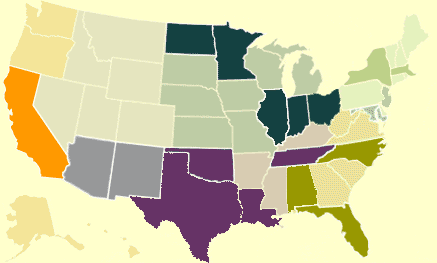
Following is a list of States and the approximate number of persons in each States who has Mental Retardation/ Developmental Disabilities.


Alabama   

784

Kentucky    

721

North Dakota     

133

Alaska   

6

Louisiana        

869

Ohio          

1779 

Arizona           

86

Maine          

102

Oklahoma        

514

Arkansas         

605

Maryland        

435

Oregon         

141

California    

2406

Massachusetts   

1053

Pennsylvania      

1942

Colorado         

238

Michigan        

877

Rhode Island    

133

Connecticut     

665 

Minnesota       

325

South Carolina      

356

Delaware     

53

Mississippi       

403

South Dakota      

102

D. C.           

95

Missouri        

963

Tennessee       

1081

Florida         

1059

Montana              

78 

Texas         

2187

Georgia    

1492

Nebraska        

237

Utah                    

 88

Hawaii           

62

Nevada              

89

Vermont                  

43

Idaho     

67

New Hampshire    

112

Virginia        

1037

Illinois    

1591

New Jersey       

1473

Washington        

573

Indiana       

1168

New Mexico      

82

West Virginia      

295

Iowa           

573 

New York        

4491

Wisconsin        

 415

Kansas       

295

North Carolina    

836

Wyoming         

295


Steve Gold, The Disability Odyssey continues

Back issues of other Information Bulletins are available online at http://www.stevegoldada.com with a searchable Archive at this site divided into different subjects.  To contact Steve Gold directly, write to stevegoldada@cs.com or call 215-627-7100.  


hcbs.org > Clearinghouse CLIPS: July 26, 2007


Assessing the Barriers to Community Living: Accessible Housing in a Rural State
Summary: This statewide community-based participatory action research study was conducted to identify opportunities and barriers for persons with disabilities in obtaining accessible, affordable housing in West Virginia. Using surveys and a facilitated group technique, persons with disabilities identified existing barriers and developed a set of questions for housing industry professionals.
Topic(s): Accessibility, Consumer Direction, Housing
Source: Grantee produced, West Virginia
More Info: http://www.hcbs.org/moreInfo.php/nb/doc/1987


Benefits Counseling for a Brighter Future
Summary: The Virginia MIG grantees have developed this resource guide for transition practitioners. The manual explains Benefits Counseling and how it serves as a valuable resource for students, parents/guardians, and families to get help in optimizing needed benefits and begin planning toward a future that includes employment, earnings, self-sufficiency, and SSA benefits, if needed.
Topic(s): Accessibility, Employment, Medicaid Infrastructure Grant
Source: Grantee produced, Virginia
More Info: http://www.hcbs.org/moreInfo.php/nb/doc/1992


Community Access to Services & Supports- Final Report
Summary: One of two mini-projects aimed at engaging Medicaid-eligible consumers in an experiment with options of self-direction, the purpose of Community Access was to test creative methods that increase the opportunity of children and adults with disabilities to exercise self-determination. The project met the three objectives of supporting at least 12 individuals, develop a community advisor model to identify core competencies, and to identify barriers to full responses for requested services.
Topic(s): Aging Issues, Consumer Direction, Developmental/Psychiatric Disabilities, Physical Disabilities
Source: Grantee produced, Massachusetts
More Info: http://www.hcbs.org/moreInfo.php/nb/doc/1995
 

Employer Resource Networks Presentation
Summary: The South Dakota MIG grantees have developed this short overview of Employer Resource Networks (ERNs). The presentation is shown to prospective ERN groups and answers questions about how an ERN can address labor issues in the community and create partnerships.
Topic(s): Employment, Medicaid Infrastructure Grant, Workforce
Source: Consumer Exchange, South Dakota
More Info: http://www.hcbs.org/moreInfo.php/nb/doc/1993


Employment Liaison Resource Manual
Summary: The purpose of this manual is to provide an overview of information and referral sources available to the Employment Liaison, individuals with disabilities, and student services staff at post-secondary schools. Resources in the manual reference both National resources and those specific to job seekers in Wisconsin.
Topic(s): Employment, Medicaid Infrastructure Grant
Source: Grantee produced, Wisconsin
More Info: http://www.hcbs.org/moreInfo.php/nb/doc/1989


From Here to There...The Self-Advocacy Handbook
Summary: This unique and innovative handbook is a guide for educators, providers, support people and/or family members to use as they work closely with youth and adults with significant disabilities, mentoring them as they develop and practice self-advocacy skills that will promote the highest level of independence and success in life activities.
Topic(s): Accessibility, Consumer Direction, Developmental/Psychiatric Disabilities, Housing, Long-Term Care, Mental Health, Physical Disabilities
Source: Grantee produced, Colorado
More Info: http://www.hcbs.org/moreInfo.php/nb/doc/1986


Gateways: West Virginia's Comprehensive Employment System Overview
Summary: The West Virginia Medicaid Infrastructure (MIG) is transitioning to Comprehensive Employment Strategies (CES) Grant. The CES grant has 3 major goals: maximizing employment for people with disabilities, increasing the state's labor force through the inclusion of people with disabilities, protecting and enhancing workers' health care, other benefits and needed supports. Review the presentation and overview of their strategic plan including a comprehensive workforce infrastructure.
Topic(s): Employment, Medicaid Infrastructure Grant, Workforce
Source: Grantee produced, West Virginia
More Info: http://www.hcbs.org/moreInfo.php/nb/doc/1991


Housing Teleconference - June 2007: Think Tank Call of Integrated Long-term Care Coordinated with Supportive Housing Grantees
Summary: For over a decade, Pennsylvania's Housing Finance Agency (PHFA) has been developing products and supports that address the needs of people with disabilities of all ages. Listen as they discuss rental housing initiatives, developments in tenant-based rental assistance, and home ownership. Representatives discussed cutting edge approaches and unique responses to the challenges of working to build inclusive communities, while steadily improving the state level partnerships and leveraging resources.
Topic(s): Housing, Long-Term Care
Source: ILRU
More Info: http://www.hcbs.org/moreInfo.php/nb/doc/1979


Louisiana's Plan For Immediate Action: Providing Long-Term Care Choices For the Elderly and People with Disabilities
Summary: This plan describes fundamental changes that states have implemented and found effective in controlling the public costs of long-term care while insuring that people receive quality services of the type, and in the settings, that they choose.
Topic(s): Aging Issues, Consumer Direction, Long-Term Care, Physical Disabilities
Source: Grantee produced, Louisiana, Governor's Health Care Reform Panel
More Info: http://www.hcbs.org/moreInfo.php/nb/doc/1984


Otro Puente (Another Bridge): Final Project Report
Summary: Otro Puente was a demonstration project conducted as part of the Massachusetts C-PASS grant. The purpose was to prepare, support and empower individuals with developmental disabilities to increase access to and control of Personal Assistance Services and Supports (PASS), and to identify barriers to consumer self-direction. Otro Puente examined the successes and challenges of participants from Latino cultural backgrounds, most were persons with cognitive challenges.
Topic(s): Consumer Direction, Developmental/Psychiatric Disabilities
Source: Grantee produced, Massachusetts
More Info: http://www.hcbs.org/moreInfo.php/nb/doc/1996


Pennsylvania Employment Resource Guide for Persons with Disabilities
Summary: The Pennsylvania MIG project developed the Work Incentive Planning Assistance (WIPA) Program in order to promote employment among those receiving SSI/SSDI benefits. WIPA produced the following newsletter entitled "Employment Resource Guide for Persons with Disabilities", which sought to succinctly list services available to individuals with disabilities who wish to work. Some of these resources include Family Savings Accounts and information about the Volunteer Income Tax Assistance Program.
Topic(s): Medicaid Infrastructure Grant
Source: Grantee produced, Pennsylvania
More Info: http://www.hcbs.org/moreInfo.php/nb/doc/1980


Personal Assistance Services for Individuals with Serious Psychiatric Disabilities: Training Curriculum
Summary: This curriculum to train personal assistants has two elements: a competency or skill development component and a didactic or knowledge development component. The skill development components include Connecting, Coaching, Collaboration, and Managing Crises. The knowledge development component is a web-bases curriculum entitled Personal Assistance Services for Individuals with Serious Psychiatric Disabilities.
Topic(s): Consumer Direction, Developmental/Psychiatric Disabilities, Long-Term Care, Physical Disabilities
Source: Grantee produced, Louisiana
More Info: http://www.hcbs.org/moreInfo.php/nb/doc/1985


Real Choice Consumer Work Group - A Compilation of Consumer Position Papers
Summary: These position papers completed by a work group result from the Real Choice Consumer Work Group's determination to improve the lives of people with disabilities in West Virginia and to contribute to their own recommendations and strategies on major issues. This compilation of papers address: Waiting Lists; Strengthening Personal Assistance Programs in West Virginia; and Expanding the Horizons of Employment Options for West Virginians with Disabilities.
Topic(s): Consumer Direction, Developmental/Psychiatric Disabilities, Long-Term Care, Physical Disabilities, Workforce
Source: Grantee produced, West Virginia, West Virginia Real Choice Consumer Work Group
More Info: http://www.hcbs.org/moreInfo.php/nb/doc/1988


Recommendations for Achieving System-Wide, Sustainable Self-Determination and Self-Direction in the Commonwealth of Massachusetts
Summary: This policy development paper was written as part of the C-PASS demonstration project. The paper offers an overview and definition of self-determination plus three overall recommendations that are critical to making self-direction a reality. The challenge of moving self-direction from a relatively small scale to the foundation upon which all services to people with disabilities and older persons are built remains but the MASS-CPASS initiative, along with others, will help create that path.
Topic(s): Aging Issues, Consumer Direction, Physical Disabilities
Source: Grantee produced, Massachusetts
More Info: http://www.hcbs.org/moreInfo.php/nb/doc/1994


Rhode Island's Social Security Work Incentive Programs 1619 (a) and 1619 (b) Issue Brief
Summary: The Rhode Island MIG project produced an issue brief, which outlined the State's utilization of 1619(a) and 1619(b) waivers, their effect on disabled workers, the barriers these waivers present, and recommendations for eliminating barriers and other best practices.
Topic(s): Employment, Medicaid Infrastructure Grant, Waiver
Source: Grantee produced, Rhode Island
More Info: http://www.hcbs.org/moreInfo.php/nb/doc/1981


Self-Direction Employer Handbook
Summary: This handbook is designed to assist individuals in Louisiana that choose to participate in self-direction. The book helps train people to understand when they choose self-direction for service delivery, they choose to hire, employ, and manage your own direct service workers. The handbook also offers ideas on how to become an employer including ways to recruit, interview and determine employee benefits.
Topic(s): Accessibility, Consumer Direction, Long-Term Care, Physical Disabilities
Source: Grantee produced, Louisiana
More Info: http://www.hcbs.org/moreInfo.php/nb/doc/1983


Self-Direction Orientation: Presentation
Summary: What do people considering enrolling in a self-directed program need to consider? This presentation describes many of the considerations in detail for those living in Louisiana. The New Opportunities Waiver (NOW) is the service delivery option offered by the Office for Citizens with Developmental Disabilities. The slides offer an overview of key components and responsibilities of self-direction.
Topic(s): Accessibility, Aging Issues, Consumer Direction, Long-Term Care
Source: Grantee produced, Louisiana
More Info: http://www.hcbs.org/moreInfo.php/nb/doc/1982


Reference Points: 

Secondary School Experiences of Students with Autism

The National Center for Special Education Research at the Institute of Education Sciences has released a new fact sheet on the National Longitudinal Transition Study-2 (NLTS2) entitled Facts From NLTS2: Secondary School Experiences of Students With Autism. This fact sheet provides a national picture of the secondary school experiences of students with autism using data from the NLTS2.


This study has a nationally representative sample of more than 11,000 students with disabilities. Approximately 1,000 youth with autism are included in the sample. The fact sheet provides information on such topics as the courses taken, instructional settings, the nature of the curriculum and instruction, teacher perceptions, and the types of accommodations and supports provided for students with autism.  To view, download, and print the full report as a PDF file, please visit http://ies.ed.gov/ncser/pubs/ 


DisabilityInfo.gov

Employment: News & Events


http://www.disabilityinfo.gov/digov-public/public/DisplayPage.do?parentFolderId=10


Employment: Employer Resources: Employing People with Disabilities


http://www.disabilityinfo.gov/digov-public/public/DisplayPage.do?parentFolderId=13


Transportation News & Events  Update:  Audio Conferences on Accessibility & Public Transportation


Two upcoming audio conferences on strategies to promote the use of public transit by people with disabilities and success stories in engaging the disability community in transportation planning and accessibility. This information has recently been updated, and is now available - http://www.disabilityinfo.gov/digov-public/public/DisplayPage.do?parentFolderId=5010


Health News & Events  Update:  Researchers Develop New Prosthetic Ankle


The development of a new prosthetic ankle-foot was announced today by the Department of Veterans Affairs. The prosthesis is designed for veterans with lower-leg amputations, and is the first in a new family of artificial limbs. It will replicate natural motion by propelling people forward using tendon-like springs powered by an electric motor. This information has recently been updated, and is now available - http://www.disabilityinfo.gov/digov-public/public/DisplayPage.do?parentFolderId=138


Housing News & Events  Update:  Fair Housing FIRST Accessibility Training


Schedule of accessibility training courses sponsored by the Department of Housing & Urban Development (HUD). These courses offer an overview of the Fair Housing Act accessibility requirements and modifications to make a home accessible.  This information has recently been updated, and is now available. - http://www.disabilityinfo.gov/digov-public/public/DisplayPage.do?parentFolderId=5041


Adult day care may be right for some younger disabled people


Growing Older - Adult day care may be right for some younger disabled people By Liz Taylor
Special to The Seattle Times (http://seattletimes.nwsource.com/html/growingolder/)
 

FVND Share the Wealth Week of July 23rd


The Why, When, What, and How of Disclosure in an Academic Setting, After High School-Link: Post Secondary Education - http://www.dol.gov/odep/pubs/fact/wwwh.htm  Deciding what to do after high school is a complex decision for all youth. For starters, it is the first time additional schooling is not compulsory. You may choose to enter the work world or obtain additional training or education. Youth with disabilities are significantly less likely to start postsecondary education than are their peers without disabilities (27% of students with disabilities transition to postsecondary education compared to 68% of their peers without disabilities).1 A "postsecondary setting" is any educational training which takes place after high school. It includes four-year university degree programs, two-year community college programs, and vocational training programs.

Youth, Disclosure, and the Workplace: Why, When, What, and How-Link: Employment - http://www.dol.gov/odep/pubs/fact/ydw.htm Every job seeker with a disability is faced with the same decision: "Should I or shouldn't I disclose my disability?" This decision may be framed differently depending upon whether you have a visible disability or a non-visible disability. Ultimately, the decision of whether to disclose is entirely up to you.


Family-Centered Care Improves and Enhances Clinical Outcomes for Children with Special Needs and Support for Their Families-Link: Family-Centered Care - http://www.communitygateway.org/faq/fcc.htm  Family-Centered care was first defined in 1987 as part of former Surgeon General Koop's initiative for family-centered, community-based, coordinated care for children with special health care needs and their families. The Key Elements of Family-Centered Care (listed below) were further refined in 1994 by the ACCH (Association for the Care of Children's Health). These key elements are widely accepted by families and professionals alike as they embody both the spirit and heart of Family-Centered Care.


The U.S. Department of Health and Human Services, Administration for Children and Families recently announced the launch of the National Responsible Fatherhood Clearinghouse (NRFC) Web site. The Web site offers a variety of resources for fathers, families, community partners, policymakers, and researchers on the topic of fatherhood and improving the lives of children and families. To learn more go to http://www.fatherhood.gov/


NICHCY's Building the Legacy: A Training Curriculum on IDEA 2004-Link: Curriculum - http://www.nichcy.org/training/contents.asp  The training curriculum has five overarching themes (A, B, C, D, and E), with multiple training modules beneath each theme (1, 2, 3, and so on). These themes are: Theme A: Welcome to IDEA, Theme B: IDEA and General Education, Theme C: Evaluating Children for Disability, Theme D: Individualized Education Programs (IEPs), and Theme E: Procedural Safeguards


OSERS Publication: Technology and Communication Options for Children with Hearing Loss-Link: Resource - http://www.ed.gov/about/offices/list/osers/products/opening_doors/index.html Parents of children with hearing loss can find helpful information and resources in a publication produced for the Office of Special Education and Rehabilitative Services (OSERS) by the Academy for Educational Development (AED). Opening Doors: Technology and Communication Options for Children with Hearing Loss provides background on early intervention, the use of technology and other support available to children and their families.


U.S. Department of Education Reports Shows Increase in Students with Disabilities-Link: Report - http://www.agbell.org/DesktopDefault.aspx?p=Condition_of_Education A recent report issued by the U.S. Department of Education shows that 6.7 million (13.8%) of U.S. students received special education in the 2006 school year, up from 3.7 million (8.3%) in 1977.


Americans with Disabilities Act Anniversary-July 26-Did you know that 18 percent of Americans have some kind of disability and that, after the age of 80 that number jumps to 72 percent? Check out USA.gov's link to the U.S. Census Bureau - http://www.census.gov/PressRelease/www/releases/archives/facts_for_features_special_editions/010102.html

 to see more statistics about Americans with disabilities.


Thanks to the Americans with Disabilities Act - signed into law on July 26, 1990-those with disabilities are guaranteed equal opportunities in employment, public services and accommodations, and telecommunications. Visit DisabilityInfo.gov - http://www.disabilityinfo.gov/digov-public/public/DisplayPage.do?parentFolderId=500, the federal government's one-stop web site for people with disabilities.


Health News & Events Update: Citizenship Guidelines for Medicaid Eligibility-Final rule on citizenship for Medicaid eligibility expands the types of documentation that can be used to establish citizenship and exempts certain groups from the requirements. This information has recently been updated, and is now available. - http://www.disabilityinfo.gov/digov-public/public/DisplayPage.do?parentFolderId=138


Choosing Child Care for a Special Needs Child- http://www.connectforkids.org/ Finding quality, affordable child care can be difficult for any parent. For those with a special needs child, it can also be a very confusing and emotional experience. Rebecca Freshour looks at what the law says, and what parents need to know to find care for their children.

NADD Conference Survey


The mission of the National Association for the Dually Diagnosed (NADD) is to advance mental wellness for persons with developmental disabilities through the promotion of excellence in mental health care.  Training and education is a major part of accomplishing our mission.


As costs are rising and budget cuts occurring within the field, NADD is exploring ways to continue to provide conferences and educational opportunities in a cost-effective manner for attendees.  I am respectfully asking for your assistance and input regarding conferences by completing a  short survey located at http://www.thenadd.org/survey.


I thank you in advance for your assistance. Sincerely, Robert J. Fletcher, DSW, ACSW; Founder and CEO, NADD


The Disability Law & Policy e-Newsletter


An electronic publication of The Law, Health Policy & Disability Center at the University of Iowa College of Law - http://disability.law.uiowa.edu/ and The Burton Blatt Institute at Syracuse University - http://bbi.syr.edu


The Disability Law & Policy Newsletter is a bi-weekly publication that aims to inform disability advocates, scholars, and service providers of the most current issues in disability law, policy, research, best practices, and breaking news.


To subscribe to this free e-newsletter, go to http://disability.law.uiowa.edu/lhpdc/publications/news.html and subscribe to the "Disability Law & Policy e-Newsletter." The e-Newsletter is archived at http://disability2.law.uiowa.edu/
Re-distribution / forwarding of this e-Newsletter to your networks is encouraged.


CVS Caremark Community Grants to Support Children With Disabilities and Healthcare for the Uninsured

Deadline: October 31, 2007

CVS Caremark Community Grants target effective and innovative programs that align with the company's philanthropic values and criteria.

The 2007 Community Grants Program will focus on these two key areas:

Programs targeting children under the age of 18 that address any of the following: 1) Health and Rehabilitation Services -- grants to support programs that promote independence among children with disabilities, including physical and occupational therapies, speech and hearing therapies, assistive technology, and recreational therapies; 2) Public schools promoting a greater level of inclusion in student activities and extracurricular programs -- proposed programs must be fully inclusive insofar as children with disabilities are full participants in early childhood, adolescent, or teenage programs alongside their typically developing peers; 3) Creating opportunities or facilities that give greater access to physical movement and play -- proposed programs may include either physical activities or play opportunities and should address the specific needs of the population served.

Healthcare service for uninsured people: The CVS Caremark Community Grants Program assures that more uninsured people receive needed care, that the care received is of higher quality, and that the uninsured are served by providers who participate in accountable community healthcare programs. There is no age limit on proposed programs that create greater access to healthcare services.

To be eligible for funding, a CVS/pharmacy store must be located within the state where the applicant organization resides.

Visit the CVS Web site for program information and an online eligibility quiz. Nonprofit organizations applying for a Community Grant for children with disabilities or for healthcare for uninsured people are required to provide their EIN number before they can begin the eligibility quiz. Public schools applying for children with disabilities are not required to provide an EIN number.

RFP Link: http://fconline.foundationcenter.org/pnd/10008198/cvs

For additional RFPs in Disabilities, visit: http://foundationcenter.org/pnd/rfp/cat_disabled.jhtml
 
Ethel Louise Armstrong Foundation Offers Funding for Arts and Advocacy Programs for People With Disabilities

Deadline: September 15, 2007 (Online Application)

The Ethel Louise Armstrong Foundation (http://www.ela.org/) has a vision of "Changing the Face of Disability on the Planet." The foundation works to accomplish this vision through its grant and scholarship programs.

The ELA Foundation grants funds in the areas of the arts and advocacy to U.S. nonprofit organizations that are led by or support adults with disabilities who are 22 years of age or older. In the arts, the foundation supports programs that support professional artists with disabilities or encourage a professional environment while enhancing creativity among people with disabilities who are not professional artists themselves. In advocacy, the foundation supports programs that promote change in legislation or provide education that enhances knowledge and action to create laws and policies that will result in better lives for people with disabilities.

The foundation funds program grants only. A program grant serves a specific number of people in a set amount of time with measurable goals. Programs must demonstrate support by other foundations, corporations, and individuals in the local community.

Applicant organizations must be tax-exempt under section of the 501(c)(3) IRS Code and have been in existence for two years or longer. Grant amounts will range from $1,000 to $5,000 each.

Visit the ELA Foundation Web site for complete program guidelines and application procedures.

RFP Link: http://fconline.foundationcenter.org/pnd/10008199/ela

For additional RFPs in Disabilities, visit: http://foundationcenter.org/pnd/rfp/cat_disabled.jhtml
 

Six Years Of Progress Under The President's New Freedom Initiative

2007 Progress Report Shows Steps Taken To Reduce Barriers For Americans With Disabilities


Today, The White House Released The 2007 Progress Report On The President's New Freedom Initiative For People With Disabilities.  Announced in February 2001, the New Freedom Initiative is President George W. Bush's plan to tear down barriers to full integration into American life that remain for many of the 54 million Americans with disabilities.  This report highlights the many accomplishments of the Administration in implementing the President's vision and builds upon the reports issued in May 2002 and May 2004. 
The Full Report Is Available At:
http://www.whitehouse.gov/infocus/newfreedom/newfreedom-report-2007.html


Until Next week


The Arc of the United States,1010 Wayne Avenue, Ste. 650,Silver Spring, MD 20910,Phone: 301-565-3842,Fax: 301-565-3843,Email: mmwdc@info.thearc.org,Web: www.thearc.org


Disclaimer: MMWDC publishes information about issues and events that we believe to be important and likely to be of interest to advocates and others interested in inclusion of persons with disabilities in all parts of society.  However, MMWDC and The Arc of the United States and TheArcLink Incorporated do not necessarily endorse all events, sponsoring organizations and reports which appear.