Volume 07 Issue 25 June 25, 2007
Welcome to Monday Morning in Washington, D.C., published weekly by The Arc of the United States. We will bring to you news of interest to self advocates and their families, volunteers, professionals, and supporters of the disability movement. Please send any comments to mmwdc@thearc.org. You are welcome to reproduce and distribute items from Monday Morning in Washington, D.C., but please credit Monday Morning in Washington, D.C. (The Arc of the United States, 2007).
The Arc of the United States advocates for the rights and full participation of all children and adults with intellectual and developmental disabilities. Together with our network of members and affiliated chapters, we improve systems of supports and services; connect families; inspire communities; and influence public policy.
[NOTE: Having trouble reading this newsletter? Read it online.] [Past Issues]
A free service for students who are deaf, hard of hearing, or deaf-blind
Social Security Numbers: Use is Widespread and Protection Could Be Improved
What Works Clearinghouse Releases New Intervention Report on Early Childhood Education
New Publications on IDEA Preschool Services and Transition to Kindergarten
Policy Letters of Clarification on IDEA from the U.S. Department of Education
Students with Disabilities Show Marked Improvement under No Child Left Behind
16th National Conference on Child Abuse and Neglect Post Conference Materials
Framing Early Childhood Development: Recommendations for Infant-Toddler Professionals & Advocates
The Abbott Preschool Program Longitudinal Effects Study (APPLES)
Housing Vouchers Used for Home Ownership. Information Bulletin # 214 (6/07)
JOIN THE all-YOUTH TASK FORCE for the YOUTH INFORMATION, TRAINING AND RESOURCE CENTER, KASA
Developmental Services for Young Children in Foster Care-Source: Children's Bureau Express
Guidelines for Reporting and Writing about People with Disabilities
The George Washington University HEATH Resource Center Launches Updated Site
New products have been published on the Quality Mall website
National Organization on Disability Announces National Partnership Awards Program
UCP Releases New Medicaid Report
Today, we are offering you strategies and proven ideas on how to improve Medicaid services for people with disabilities at the local, state and national levels.
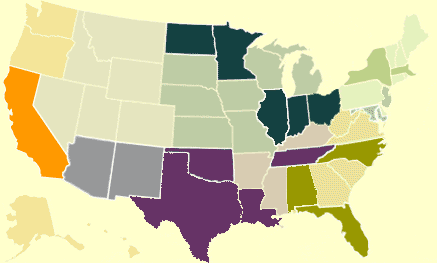
UCP has just released The Plan for Inclusion, a menu of policy options and tactics designed to work in tandem with The Case for Inclusion, a recently released UCP report which ranks and analyzes how states are serving Americans with intellectual and developmental disabilities under Medicaid. The UCP state ranking data sheds light on areas where your state is underperforming while The Plan for Inclusion offers suggestions for action.
The Plan is intended to help advocates:
Understand the unique challenges within their state;
Communicate that information to policy makers, state administrators, the media and key stakeholders;
Prioritize areas needing attention; and
Match priority areas with action steps that have proven effective in other states.
Because every state is different and states vary greatly in their success in providing community-based supports to people with intellectual and developmental disabilities, there is no one silver bullet. Every state has room for improvement and The Plan for Inclusion can be a resource to advocates as they create or review a work plan for change.
The full text of The Plan for Inclusion, the full text of The Case for Inclusion 2007 (UCP's state Medicaid rankings and analysis) and state-by-state data are available at www.ucp.org/medicaid.
Woodlands Memorial Garden Officially opened today
http://picasaweb.google.com/PenderMcNee/WoodlandsMemorialGarden
Former residents and families gather at dedication ceremony to honour those
buried in the graveyard that was forgotten.
New Westminster, BC - The formal dedication ceremony at the Woodlands Memorial
Garden created the mood to honourably remember the people with developmental
disabilities who had been buried and forgotten at the Woodlands cemetery. The
BC Association for Community Living (BCACL), the BC Self Advocacy Foundation
and the Ministry of Labour and Citizens' Services came together for the
official dedication ceremony of the Woodlands Memorial Garden.
More than 300 people attended the dedication ceremony, and many stayed on
after the ceremony to reflect on the lives of the thousands of people who died
at Woodlands and Essondale (now Riverview) institutions. The occasion was
designed to honour those buried in the cemetery, bring closure to surviving
family and friends, and wrap up the eight-year long Memorial Garden project.
The Woodlands Memorial Garden, located on the site of an institutional
cemetery that was desecrated and forgotten, is the first of its kind in
Canada. In 1977, the gravestones at the cemetery had been removed, erasing the
names of the buried from public memory. Now, the specially designed Memorial
Garden includes memorial walls with the names of all of those buried in the
cemetery, salvaged gravestones, and a sculpture of a "Window Too High,"
resonating with former residents' memories of being unable to look outside.
"After many years of working on it, we are pleased that the Memorial Garden
has become a beautiful reality, and trust that this community space will
remind us of the value of all lives and reflect the importance of inclusion,"
said Laney Bryenton, Executive Director, BCACL. "The Memorial not only honours
those who lived and died in these institutions, but also serves as a solemn
reminder of the negative impact of institutions on those who lived within
their walls.
"Across Canada, many thousands of people with developmental disabilities
continue to live in large, segregated facilities like Woodlands, without the
rights that most of us take for granted. BCACL and our partners are working to
address this issue, and this garden is a strengthening of our commitment to
carry forward the legacy of the individual human stories within such
facilities."
Anniversary of the Olmstead decision
http://www.atlantalegalaid.org/impact.htm
A free service for students who are deaf, hard of hearing, or deaf-blind
There is a free service for students who are deaf, hard of hearing, or deaf-blind! The Described and Captioned Media Program (DCMP) http://www.dcmp.org/ is funded by the U.S. Department of Education to provide free-loan described and captioned educational media and also act as a clearinghouse of information about accessible media.
Feds judge states on special ed law
http://www.stateline.org/live/details/story?contentId=218415
Wednesday, June 20, 2007,
By Pauline Vu, Stateline.org Staff Writer
Grading states on how well they're educating children with physical and mental
disabilities, the U.S. Education Department Wednesday (June 20) announced that
nine states are on track, five are lacking, and the rest lie somewhere in
between.
The evaluations
http://www.ed.gov/fund/data/report/idea/partbspap/index.html, mailed to
states June 18, are the first to judge compliance with the federal Individual
with Disabilities Education Act since Congress amended the law in 2004. The
landmark law, originally enacted in 1975, established the nation's first rules
for educating disabled students.
The U.S. Department of Education released a booklet
Entitled "Learning Opportunities For Your Child Through Alternate Assessments." This 28-page booklet introduces parents to the "big ideas" contained in school improvement efforts under NCLB and IDEA, and provides them with the information they need to help ensure that their children can benefit from these efforts. To access the booklet, go to: http://www.ed.gov/parents/needs/speced/learning/index.html
Education.com Launches To Ensure No Parent is Left Behin
http://www.education.com/
New survey reports 74% of parents
wish they had a single resource they could turn to for information and answers
about educational issues.
REDWOOD CITY, Calif., June 21 /PRNewswire-FirstCall/ -- Every parent today
struggles with finding enough time to seek out high-quality information and
resources with respect to the education of their children. Although the
information is often available, it's difficult to find and is usually more
anecdotal than authoritative. Education.com today unveiled an easy to use,
comprehensive, one-stop online destination that helps parents and educators
solve these problems. Education.com empowers parents and educators of children
ages pre-school through grade 12 to take an ever more active role in their
childrens' education. Education.com offers easily accessible, high-quality
educational and developmental content.
Bridges4Kids NewsDigest: June 18, 2007
Two New Grant Opportunities for Young People
Youth Service America Venture Program Offers Micro-Grants
for Young People to Start Social Ventures -
http://fconline.foundationcenter.org/pnd/10007661/ysa
Do Something Offering Weekly Grants for Young Social
Entrepreneurs -
http://fconline.foundationcenter.org/pnd/10007660/dosomething
GAO Reports about Health
http://www.gao.gov/cgi-bin/getrpt?GAO-07-1022T Highlights -
http://www.gao.gov/highlights/d071022thigh.pdf
Today's GAO Reports
http://www.gao.gov/cgi-bin/getrpt?GAO-07-555 Highlights -
http://www.gao.gov/highlights/d07555high.pdf
Social Security Numbers: Use is Widespread and Protection Could Be Improved
By Daniel Bertoni, director, education, workforce, and income security issues, before the Subcommittee on Social Security, House Committee on Ways and Means. GAO-07-1023T, June 21. http://www.gao.gov/cgi-bin/getrpt?GAO-07-1023T Highlights -http://www.gao.gov/highlights/d071023thigh.pdf
Too Many Children on Medicaid Not Tested for Lead
Poisoning
http://www.ehw.org/Lead/LEAD_Few_Tested.htm
In Ohio HMOs are paid a lump sum fee, in advance, for delivery of Medicaid
services. Researchers at the Government Accounting Office found that the system
creates "an incentive to underserve or even deny beneficiaries access to needed
care since plans ... can profit from not delivering services" (GAO 1997). Some
47,000 Medicaid-eligible children are born in Ohio each year (OHPa 2004).
Considering this profit incentive not to screen, it is not surprising that in
Ohio, the blood lead screening rate for one and two year-olds has yet to exceed
40% despite the requirement for HMOs to screen 100% of these children.
[nectac-enotes] NECTAC eNotes - June 18, 2007
What Works Clearinghouse Releases New Intervention Report on Early Childhood Education
Source: What Works Clearinghouse, Institute of Education Sciences
- June 11, 2007
On June 11, 2007 the What Works Clearinghouse released the following new topic
report on Early Childhood Education: Intervention: Ready, Set, Leap!. This
preschool curriculum focuses on early reading skills such as phonemic awareness,
letter knowledge, and letter-sound correspondence using multi- sensory
technology that incorporates touch, sight, and sound. To view the report go to
http://whatworks.ed.gov/InterventionReportLinks.asp?iid=416&tid=13&ReturnPage=InterventionAll.asp
New Publications on IDEA Preschool Services and
Transition to Kindergarten
Source:
National Center for Learning Disabilities - Retrieved June 12, 2007
The National Center for Learning Disabilities (NCLD) recently released the
following new publications:
Preschool Services Under IDEA -
http://www.ncld.org/images/stories/downloads/parent_center/preschool_brief.pdf
Transition to Kindergarten: Policy Implications for Struggling Learners and
Those Who May Be at Risk for Learning Disabilities -
http://www.ncld.org/images/stories/downloads/school_transition_policy_paper.pdf
http://www.inclusiveeducation.ca/documents/Final%20Summit.pdf
Policy Letters of Clarification on IDEA from the
U.S. Department of Education
Source: U.S. Department of Education - June 8, 2007
Letters from the U.S. Department of Education received by individuals during the
3rd and 4th quarters of 2006, which describe interpretations of IDEA its
implementing regulations are now available online at
http://www.ed.gov/policy/speced/guid/idea/index.html For links to
letters of clarification that address early childhood provisions of the IDEA
(Part C and Section 619) go to
http://www.nectac.org/idea/clarfctnltrs.asp
Self-Determination Synthesis Project
The
University of North Carolina at Charlotte, with a grant from the Office of
Special Education Projects/US Department of Education, is conducting a review
and synthesis of the knowledge base and best practices related to
self-determination (SD) and self-advocacy (SA) interventions in order to
improve, expand, and accelerate the use of this knowledge by the professionals
who serve children and youth with disabilities and the parents who rear,
educate, and support their children with disabilities.
Final Report
http://www.uncc.edu/sdsp/final_report.pdf
Lesson Plans: From Research to Practice: Lesson Plans for Promoting
Self-Determination
http://www.uncc.edu/sdsp/sd_lesson_plans.asp
Visit: TTAC: Transition Technical Assistance Centers
http://www.uncc.edu/ttac
Also Visit SDTAC: Self Determination Technical Assistance Centers
http://www.sdtac.uncc.edu/project_description.asp
And then there's the lesson plans:
http://www.uncc.edu/sdsp/self_advocacy/self_advocacy.asp?FileName=project_directory1
JFA Daily, 6/18/07
New AAPD Presidential Election Action Center
Stay up to date on candidate and campaign news, get-out-the-vote initiatives,
action alerts, and all things related to the 2008 presidential election through
AAPD's new Presidential Election Action Center.
By visiting the Presidential Election Action Center, one can easily do the
following:
Peruse the candidate responses to the disability questionnaire sent to each of the presidential candidates
Download a copy of the questions sent to candidates to encourage the rest of the candidates to respond
View an election timeline of important dates for debates and events
Link to every official presidential candidate's campaign website
Learn how to register to vote in your state
To
visit the AAPD Presidential Election Action Center, go to:
http://www.aapd.com/News/election/peac2008.php
SOURCE: AAPD
Students with Disabilities Show Marked Improvement
under No Child Left Behind
Two reports examine this often controversial group -- their achievement and
opportunity under the law
WASHINGTON, D.C. - The National Center for Learning Disabilities has released a
comprehensive report on No Child Left Behind (NCLB) -- Rewards and Roadblocks:
How Special Education Students Are Faring Under No Child Left Behind
http://www.ncld.org/images/stories/downloads/advocacy/
ncldrewardsandroadblocks.pdf and a companion study, State Testing
Accommodations: Their Value and Validity
http://www.ncld.org/images/stories/downloads/advocacy/ncldstatetestingaccommodationsstudy.pdf
"NCLD has provided a review of the evidence that links improved outcomes for
students with disabilities with NCLB," says Thomas Hehir, Ph.D., director of
Harvard University's Graduate School of Education School Leadership Program and
former director of the U.S. Department of Education Office of Special Education.
"Though more needs to be done, students with disabilities appear to be
benefiting from No Child Left Behind, greater access to general curriculum, and
better inclusive practices. The report provides meaningful evidence and
recommendations for our nation's policy
makers, and NCLD should be applauded for making it available."
The reports provide a compelling look at key states such as California,
Colorado, Massachusetts, Michigan, Texas and Wyoming and highlight NCLB's impact
on students who receive special education services in our nation's schools --
almost half of whom having learning disabilities. Findings include:
Improved rates of participation in state general assessments for all states
Improved performance in reading and math
Improved performance in 4th grade reading on the National Assessment of Educational Progress (NAEP), where there is no corresponding improvement for students without disabilities.
"It's
important for policy makers and educators alike to know the real impact of No
Child Left Behind on students with disabilities, since it is truly the first
time in history that we can begin to understand what achievement looks like for
all school children," says James H. Wendorf, NCLD's executive director. "Our
reports highlight the positive effects of this landmark law, as well as areas
for improvement. We hope they generate the discussion these issues deserve."
Both reports provide recommendations for the reauthorization of NCLB, now
underway in the U.S. Congress. To view to the archived Webinar and to download
the reports, please visit:
http://www.ld.org/NCLBReportCard.
SOURCE: National Center
for Learning Disabilities
16th National Conference on Child Abuse and Neglect
Post Conference Materials
Source: Child Welfare Information Gateway - June 18, 2007
Conference materials from the 16th National Conference on Child Abuse and
Neglect are now available online. The Conference Program includes information on
plenaries, workshops, seminars, roundtables, poster sessions, and experiential
learning opportunities that took place at the conference. The Commissioner's
Award Book profiles honorees from various States, the District of Columbia, and
U.S. territories. These are available at
www.childwelfare.gov/calendar/cbconference/sixteenth/
Framing Early Childhood Development: Recommendations
for Infant-Toddler Professionals & Advocates
Source: ZERO TO THREE - June 11, 2007
A new article in the framing series from ZERO TO THREE examines a number of
early childhood frames, the impact those frames have on how people think about
infant-toddler development, and the consequences for public policy. It is
available online at
http://www.zerotothree.org/site/DocServer/Framing4.pdf?docID=3541
The Abbott Preschool Program Longitudinal Effects
Study (APPLES)
Source: National Institute for Early Education Research - June
18, 2007
A new study from the National Institute for Early Education Research (NIEER) of
New Jersey's Abbott Preschool Program shows that kindergarteners who attended
the program, which serves the state's neediest districts, closed more than 50
percent of the gap between their literacy scores and the national average.
Kindergartners who attended Abbott pre-K also outperformed those who did not in
math. The full report is available online at
http://nieer.org/docs/index.php?DocID=173
Housing Vouchers Used for Home Ownership.
Information Bulletin # 214 (6/07)
Even though Congress and HUD have authorized and encouraged Housing Authorities
throughout the country to work with and assist low income persons in purchasing
their homes, less than 800 Housing Authorities out of nearly 3,000 have used
this program, and less than 10,000 eligible low-income families and individuals
have purchased their own homes.
When we inquired into why so few Housing Authorities are participating in the
home ownership program, we were told, for example, that the federal regulations
are "too cumbersome" and the down payments are difficult to put together.
Nevertheless and even with these "barriers," of the 10,000 low-income families
and individuals, nearly 7,000 have purchased their homes with Section 8 /
Housing Choice Vouchers. (The remaining 3,000 are under either the Moving to
Work or Family Self-Sufficiency programs).
Below are the Housing Authorities that participate in the Home Ownership
Program, and the number of families who have used their Section 8/ Housing
Choice vouchers to purchase a home.
We do not know how many of these families include people with disabilities.
However, we have always thought that home ownership for people with disabilities
should be pursued. For example, if two people, who are disabled on SSI and who
each had a housing voucher, jointly purchased a home, the economics could work.
Same goes for a married couple.
If your Housing Authority is not listed below, then it has chosen not to
participate in a HUD Home Ownership program. Advocates might want to talk with
your Housing Authority and ask why it does not participate.
If your Housing Authority is listed below, but has a zero listed next to its
name, it means that the Housing Authority does participate in a HUD Home
Ownership program, but it has not used any Housing Choice/Section 8 vouchers to
purchase homes. Again, advocates should explore why not.
To read how your state is doing go to:
http://www.stevegoldada.com/stevegoldada/archive.php?mode=A&id=215;&sort=D
These are NEW calendar listings that have been added this week, along with events taking place this week. To view a complete calendar of National events, visit http://www.bridges4kids.org/Conferences.html or http://www.bridges4kids.org/popupcalendar2.htm
Pittsburgh Employment
Conference for Augmented Communicators
WHEN: August 3-5, 2007
HERE: Sheraton Hotel, Station Square,
Pittsburgh, PA
FOR MORE INFORMATION: Contact Bob Conti by
phone at 412-885-8541, by fax at 412-885-8548 or by email at
minspeak@minspeak.org
Teaching Communication
Skills to Children with Autism and Other Developmental Disabilities with Dr.
Vincent Carbone, BCBA
WHEN: December 10-12, 2007
WHERE: Doubletree Hotel Augusta, 2651
Perimeter Parkway, Augusta, GA 30909
FOR MORE INFORMATION: Contact Tammy Evans at
te1969@netzero.com or 706-831-1107.
FVND Share the Wealth e-news week of June 18th
JOIN THE all-YOUTH TASK FORCE for the YOUTH INFORMATION, TRAINING AND RESOURCE CENTER, KASA
—Family
Voices. We want YOU! We are looking for teens, between the ages of 13 and 18,
who have disabilities*, to serve on the KASA Task Force. Be part of this really
cool opportunity! To check out the details, please read on! What Does The KASA
Task Force Do? The KASA Youth Information, Training and Resource Center Task
Force give advice and opinions to the KASA Advisory Board and staff about what
information and training youth with disabilities need. We review documents to
make sure young people can understand them and to make sure they are helpful.
The Task Force learns new skills on monthly calls from community members, and
from each other. We help KASA educate society about issues that affect young
people with disabilities. If you have any questions, or would like more
information please contact Naomi at 520-881-4672, or email at:
naomiortiz01@msn.com.
Visit the New and Improved Casey Foundation Website!
The new
format provides easy access to information about Casey's work, approach to
philanthropy, and lessons learned about building thriving communities for
vulnerable children and families. Take a tour and explore and find out about the
Casey initiatives in your state.
http://www.aecf.org/
The Commonwealth Fund
Is a
private foundation that aims to promote a high performing health care system
that achieves better access, improved quality, and greater efficiency,
particularly for society's most vulnerable, including low-income people, the
uninsured, minority Americans, young children, and elderly adults.
www.commonwealthfund.org
Federal
minimum wage rate increase
On May 24 Congress passed a federal minimum wage rate increase,
which will raise the minimum wage from $5.15 to $7.25 in three stages over two
years. This rise is the first for the national minimum wage in this decade, the
last having occurred in 1997. Given that many individuals with significant
disabilities earn wages at or near the minimum wage, they are likely to be
impacted by these changes. While the increase provides a wonderful opportunity
for many individuals, questions may arise. Two new publications from the
Institute for Community Inclusion review how the minimum wage increase is
relevant and provide guidance for both people with disabilities and service
providers. These fact sheets will assist service providers and people with
disabilities through the minimum wage change and its affect on benefits and
other issues. "An Aid for Disability Service Providers" can be found at
http://www.communityinclusion.org/article.php?article_id=203. "What it Means
for People with Disabilities" can be found at
http://www.communityinclusion.org/article.php?article_id=204
Developmental Services for Young Children in Foster
Care-Source: Children's Bureau Express
June 1, 2007 - A recent study looked at the extent to which child welfare and intervention agencies identify and help prevent developmental delays in high-risk young children entering foster care. For a summary of the findings go to http://cbexpress.acf.hhs.gov/articles.cfm?article_id=1350&ref=htmlEml
National Family Caregivers Association
With Great Information and Goody Bags
WHEN: Now through June 30
WHERE: Revolution Health (Enter the fair and see what it is about)
http://www.revolutionhealth.com/healthfair?msc=A62604 (some people are having problems you may want to cut and paste)
VISIT NFCA'S BOOTH
Learn how your life as a family caregiver can be healthier and happier - and why everyone will sooner or later be a family caregiver - or need one.
Take care, National Family Caregivers Association
ACT Memo
Guidelines
for Reporting and Writing about People with Disabilities
This is a good set of guidelines for preferred terms and how to
portray disability in words. It's from the Research and Training Center on
Independent Living from the University of Kansas.
http://www.lsi.ku.edu/lsi/internal/guidelines.html
How to Write - and Talk - about Disability
This article in Access Press summarizes the guidelines linked
above.
http://www.accesspress.org/archive/2007/06/story_how_to_write_about_disability.htm
The George Washington University HEATH Resource Center Launches Updated Site
I am pleased to announce the launch of our new
updated and improved website for The GW HEATH Resource Center. The new site has
been redesigned to better meet the needs of students with disabilities, their
families, school and university professionals, and others in the Internet
community.
We have updated existing features and we are proud to introduce new value-adding
features to the benefit of our visitors. Major categories include:
Home - http://www.heath.gwu.edu/
About Us -
http://www.heath.gwu.edu/node/4
Calendar -
http://www.heath.gwu.edu/taxonomy/term/1
Publications -
http://www.heath.gwu.edu/taxonomy/term/2
News -
http://www.heath.gwu.edu/taxonomy/term/3
FAQs -
http://www.heath.gwu.edu/taxonomy/term/5
Links - http://www.heath.gwu.edu/links
The new website provides a clearer structure and simplified navigation. Improved
search functions make finding HEATH Resource information easier than before.
Users of the site will benefit from the improved navigation menus, the added
features of RSS Feed subscription, and an extensive collection of links that
will provide further information.
As before, our primary contributors to the site are acknowledged experts in
their fields. All articles are peer-reviewed for technical accuracy and edited
for readability and consistency. Visitors to the site will be able to access
free downloads our collection of publications. Our publications include our
quarterly Newsletter, Resource Papers and Fact Sheets. Also included are our
archived articles published over the past six years.
Future plans include educational modules on transition. The web site will be an
invaluable resource for students, families, and professions in finding
accessible information on expanding access and success in education beyond high
school, educational support services, policies, procedures, adaptations, and
opportunities at American campuses, vocational-technical schools, and other
postsecondary training entities. Information has been efficiently categorized
for easy navigation.
The HEATH Resource Center Web site is dynamic and being dynamic you will see
that our web universe continues to develop with new value added features to the
benefit of all visitors. If you experience any problems using the new website or
if you have any suggestions, please contact me at
dmartine@gwu.edu.
I hope you will enjoy your visit to our new website.
Sincerely, Donna Martinez, Director, The HEATH Resource Center, The George
Washington University, Graduate School of Education and Human Development, 2134
G Street, NW, Washington, DC 20052, Phone: 202-973-0904, FAX: 202-994-3365,
dmartine@gwu.edu, HEATH Email:
askheath@gwu.edu, HEATH Website:
www.HEATH.gwu.edu
New products have been published
on the Quality Mall website:
"Where's Molly?" -
http://www.qualitymall.org/products/prod1.asp?prodid=3909
National Organization
on Disability Announces National Partnership Awards Program
Deadline: August 31, 2007
The National Organization on Disability (
http://www.nod.org/) has announced the National Partnership Awards program,
a new competition for forty eligible non-disability associations from across
America designed to recognize their work on behalf of people with disabilities.
The associations are invited to demonstrate, via the competition, their
leadership in supporting local initiatives that benefit people with
disabilities.
The competition, which is sponsored by Prudential Financial, Inc. (
http://www.prudential.com/ ), will
commemorate the 25th anniversary of the founding of the National Organization on
Disability.
The winners of the competition will demonstrate innovative programs or projects
that involve improving access to jobs, education, religious worship, voting,
transportation, housing, social opportunities, recreation, cultural or sports
activities, or emergency preparedness. The winning programs or projects will
help people with disabilities become full and equal participants in the life of
their community. The competition is designed to highlight the work of the
association's chapters or affiliates and inspire others to create equally
effective programs or projects.
Five winning associations will receive $2,000 each to acknowledge one of their
chapters or affiliates for an outstanding program or project that showcases how
their members help citizens with disabilities participate in and contribute to
the economic, social, and cultural vitality of the community.
The list of eligible associations, program guidelines, and entry form are
available at the NOD Web site.
RFP Link:
http://fconline.foundationcenter.org/pnd/10007788/nod
The
ADA
Update
is a publication of the
Until Next week
The Arc of the United States, 1010 Wayne Avenue, Ste. 650, Silver Spring, MD 20910, Phone: 301-565-3842, Fax: 301-565-3843, Email: mmwdc@info.thearc.org, Web: www.thearc.org
Disclaimer: MMWDC publishes information about issues and events that we believe to be important and likely to be of interest to advocates and others interested in inclusion of persons with disabilities in all parts of society. However, MMWDC and The Arc of the United States do not necessarily endorse all events, sponsoring organizations and reports which appear.