Banner for Monday Morning in Washington, DC


Volume 07                                                                     Issue 18                                                     May 7, 2007              


Welcome to Monday Morning in Washington, D.C., published weekly by The Arc of the United States. We will bring to you news of interest to self advocates and their families, volunteers, professionals, and supporters of the disability movement. Please send any comments to mmwdc@thearc.org. You are welcome to reproduce and distribute items from Monday Morning in Washington, D.C., but please credit Monday Morning in Washington, D.C. (The Arc of the United States, 2007).


The Arc of the United States advocates for the rights and full participation of all children and adults with intellectual and developmental disabilities. Together with our network of members and affiliated chapters, we improve systems of supports and services; connect families; inspire communities; and influence public policy.


[NOTE: Having trouble reading this newsletter?  Read it online.] [Past Issues]


IN THIS ISSUE:


UCP Releases New Medicaid Report and State-by-State Data


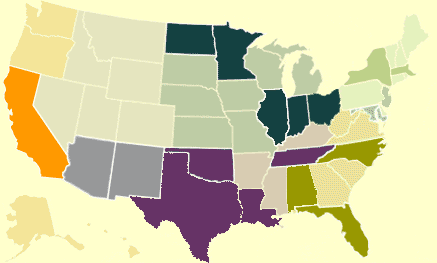
United Cerebral Palsy publicly released a report today, The Case for Inclusion 2007, on how states are serving Americans with intellectual and developmental disabilities under Medicaid. The report ranks all 50 states and the District of Columbia on how well the states are providing community-based supports.


The full report and state-by-state break-downs on more than 40 data categories (not all of which are included in the report) are available at www.ucp.org/medicaid.


The report and data provide a tool to compare how your state is doing in comparison to the rest of the country. And whether your state ranks first (Arizona) or 51st (Mississippi) in the overall rankings, the report and data clearly reveal that every state has room for improvement.

Some of the report's key findings include:

  • Forty one states have 176 large state institutions (more than 16 beds) housing 39,000 Americans;

  • Only 16 states direct more than 80% of funding to people living in the community;

  • Sixteen states report very large and long waiting lists for services; and

  • Only one in four people with disabilities participates in competitive employment.

This is the second year that UCP has scored and ranked states on their Medicaid-funded services to Americans with intellectual and developmental disabilities. The 2007 rankings were developed with a new methodology that is more comprehensive and focused and, therefore, does not allow easy comparison to the 2006 rankings. UCP plans to use this new methodology as the foundation for any future rankings, providing advocates and elected officials with a vehicle for year-to-year comparisons on how their state is performing. Additional detail on how the rankings were compiled is available on page nine of The Case for Inclusion 2007.


You are encouraged to share The Case for Inclusion 2007 with advocates, opinion leaders and elected officials in your state. If you have any specific questions about the report content, please contact the report's author, Tarren Bragdon, at tbragdon@ucp.org.


AAIDD F.Y.I.--May 2007


Visit www.aaidd.org/FYI/ to access current and past issues of this monthly newsletter. Subscribe at http://www.responsetrack.net/aaidd/sign_up

Topics in this issue:

  • Future of Disability in America report says that immediate action is essential to avoid harm and help people with disabilities lead independent and productive lives.

  • The Supports Intensity Scale assessment finds a new use in Statement of Performance planning and transition services mandated by the IDEA legislation.

  • Eighty-two countries sign landmark U.N. treaty to protect rights of 650 million people with disabilities worldwide; several disability groups urge the United States to sign treaty

  • Learn more about the best-selling Positive Behavior Support Training Curriculum for direct support professionals in Atlanta!

  • Check out these resources you can use!

The Advocacy Institute Latest Issue


Click here for the latest information - http://www.advocacyinstitute.org/


http://www.familyvoices.org/pub/fc/html/Friday's%20Child.htm

NORTH DAKOTA FAMILY OPPORTUNITY ACT IS SIGNED!


Excerpted from Angela Blanchard, KFYR-TV News Stories, Bismarck, ND, April 17, 2007

North Dakota families of children with chronic illness have another option to help pay for medical expenses. Governor Hoeven today signed a bill to relieve some of the strain put on these families of children with disabilities. North Dakota is the first state in the nation to implement this program. It falls under the Family Opportunity Act, passed by Congress in 2005. The bill allows uninsured or underinsured families to pay a premium for Medicaid services. "Health care certainly is a basic right for children," says Donene Feist, North Dakota Family Voices. "So I believe this bill supports the Family Opportunity Act and embraces the rights of families."


 Please join us in congratulating Donene and the families of children with special health care needs in North Dakota for working tirelessly to become the first in the nation to adopt the FOA in their state. Donene was instrumental in bringing other families together to see that this bill was passed. Well done, Donene! For more information about Family Voices of North Dakota, please visit their website, www.geocities.com/ndfv/.


GAO Reports about Health


TESTIMONY
Nursing Home Reform: Continued Attention Is Needed to Improve Quality of Care in Small but Significant Share of Homes by Kathryn G. Allen, director, health care, before the Senate Special Committee on Aging. GAO-07-794T, May 2
http://www.gao.gov/cgi-bin/getrpt?GAO-07-794T Highlights - http://www.gao.gov/highlights/d07794thigh.pdf

Medicaid: Concerns Remain about Sufficiency of Data for Oversight of Children's Dental Services by James C. Cosgrove, acting director, health care, before the Subcommittee on Domestic Policy, House Committee on Oversight and Government Reform.  GAO-07-826T, May 2
http://www.gao.gov/cgi-bin/getrpt?GAO-07-826T Highlights - http://www.gao.gov/highlights/d07826thigh.pdf
 

Medicare Regulation Requires RESNA Certification


Medicare will REQUIRE power wheelchair evaluations to be performed by RESNA-certified ATPs and equipment provided by RESNA-certified ATSs
beginning in 2008. . . More < http://www.resna.org/NewCertPract/MedicareRegs.php>  details.


ADAPT's Fun-Run for Disability Rights a Success; ADAPT to Meet with RNC

Washington, D.C.--- ADAPT's first National Fun-Run for Disability Rights fundraiser was an unqualified success, garnering over $75,000 in sponsorships and pledges as 200 people rolled, ran, and walked around Upper Senate Park in Washington, D.C. Sunday. Included in the Fun-Run sponsors was the Democratic National Committee (DNC), pursuant to a meeting with DNC Chair Howard Dean on April 24. ADAPT will meet with the Republican National Committee (RNC) Chair, Mike Hudson, on Tuesday, May 1.

"The money we raised today will support people with disabilities living on SSI and other disability benefits to talk face-to-face to the people here in Washington who make the laws and set the policies about our lives," said John Gladstone of Philadelphia ADAPT. "There are so many of us from allover the country who could never afford to be here in this very expensive city advocating for our civil rights without help from ADAPT."

ADAPT is in D.C. this week to assure that the Community Choice Act (CCA, S 799 and H.R. 1621), introduced in March, moves through Congress, and gets passed this session. CCA will divert people from being forced into nursing homes by providing the services and supports that people need to remain in their own homes in the community.

After the meeting with ADAPT, the DNC issued a press release that spoke to, in part, the "...persistent institutional bias in America's health care system that forces too many people with disabilities into nursing homes and institutions. Dean highlighted the Democratic Party's support for the Community Choice Act of 2007, which would allow countless Americans with disabilities the choice to live and work in their own homes and communities."

The DNC was joined in its sponsorship of the Fun-Run for Disability Rights by fellow sponsors Centene Corporation; Liberty Resources, Inc.; Tri-County Patriots for Independent Living; AmeriGroup Foundation; Mark Johnson; Topeka Independent Living Resource Center; Powers Pyles Sutter & Verville, P.C.; Acumen Accent; Cornell Pharmacy; Holiday Inn Capitol; Janine Bertram kemp and Tom Olin; Personal Assistance Services of Colorado; Alpha One; The Ability Center of Greater Toledo; American Association of People with Disabilities; Castro Enterprises-McDonald's in El Paso; Sovereign Bank; and Yoshiko Dart.

Donations to the Fun-Run for Disability Rights are still being accepted by mail at 1339 Lamar Square Drive, #101, Austin, Texas, 78704. http://www.adapt.org/freeourpeople/aar/cca1/


HHS Grant Announcement - Medicaid Infrastructure Grant


Department of Health and Human Services, Centers for Medicare & Medicaid Services, Medicaid Infrastructure Grant -
http://www.grants.gov/search/search.do?mode=VIEW&oppId=13697
 

How Many More Disabled People Must Be Injured in Nursing Homes? Information Bulletin #206 (4/07).

The Government Accounting Office in March 2007 issued another devastating indictment regarding the lack of federal enforcement against those nursing homes which have "serious quality problems" and cause injury and abuse to nursing home residents.

The GAO found that nearly half of the surveyed "homes with prior serious quality problems, continued to cycle in and out of compliance during fiscal years 2000 through 2005, causing harm to residents.  These homes corrected deficiencies only temporarily and ... were again found to be out of compliance."  Nearly 43% of the homes were "cited 69 times for deficiencies that warranted immediate sanctions, but [56%] of these cases did not result in immediate sanctions."  What a yo-yo!

How many nursing home residents disabilities, regardless of their age, must suffer actual harm or be placed in "immediate jeopardy" by the nursing home, have untreated or preventable pressure ulcers, be illegally restrained, be abused, receive substandard quality of care, or die, BEFORE the federal government and state government stop these nursing homes?  Why doesn't the federal government STOP funding the states and the nursing homes that permit these abuses to continue without sanctions?  After all, it's mostly state health departments that are supposed to monitor nursing homes. The state health departments know or are supposed to know which nursing homes have "serious quality problems" and especially those with repeated "problems."

Why is the federal government continuing to spend $46 Billion a year of Medical Assistance on any nursing home that injures persons with disabilities?  Why are federal funds, which amount to 69% of the nursing home industry's revenues, not ended where there is any repeated abuse or neglect.  Why even wait until it is life- threatening?

These injuries are endemic to institutions that warehouse poor disabled persons and this has been widely known for a long time?  Since 1998, the GAO itself has issued 15 reports identifying weaknesses in federal and state enforcement processes!  We do not need anymore reports or studies; we need federal and state officials to end this abuse, neglect and death.

CMS surveyed the effectiveness of its three most widely imposed sanctions.  The findings are distressing.

First, CMS and the states terminated nursing homes, i.e., closed the nursing home involuntarily, in less than one percent of the homes.  No need for the nursing home owners to be worried about that "sanction."

Second, "civil monetary penalties" were only $350 to $500 a day, well below even the paltry $3,000 maximum per day. And let's not forget that CMS and your States pay Medical Assistance per day for these residents while they are being injured. These nursing homes receive MA payments every day while they are abusing and injuring residents.  From a monetary calculation, it probably "pays" for the nursing home to take the civil monetary penalty while continuing to receive the MA per diem reimbursements.

The third sanction is "denial of payment for NEW admissions."  Whoopie!  But for all those people already in the institution, the Medical Assistance funds keep on flowing and nursing homes continue to pocket their profits.

CMS claims its enforcement is "hampered by the overall complexity of its immediate sanction policy."  One reason may be because CMS' sanction are only "intended to DETER repeated noncompliance." Those institutions with the "worst compliance histories ... escape immediate sanctions." Why aren't the sanctions intended to end the operations of a nursing home that has repeated violations?

The GAO's "recommendations" were incredibly weak.  It took a little while to surmise why GAO did not have the courage to really take on these nursing homes. Then we reread the GAO letter to Senator Grassley who requested the study.  In the first sentence, GAO states that the "nation's 1.5 million nursing home residents are a highly vulnerable population of elderly and disabled individuals for whom REMAINING AT HOME IS NO LONGER FEASIBLE."

Once you make that assumption, then it follows that you believe that we must have these institutions.  But what if a large percentage of the current residents could, with appropriate (and less expensive than nursing homes) home and community-based services, stay at home or return to home? Then you do not need nursing homes that abuse and injure people. That assumption also underlies the CMS goal of only "deterrence," instead of closing down repeated violators.

A few questions for advocates:

Have disability and older American advocates examined what your state Health Department's enforcement process is?  How many nursing homes in your state have been cited for "serious quality problems?" Has advocacy has occurred to force your state's to decertify nursing homes that repeatedly injure and abuse residents?  What about advocates inspecting the nursing homes?

    Steve Gold, The Disability Odyssey continues

Back issues of other Information Bulletins are available online at http://www.stevegoldada.com with a searchable Archive at this site divided into different subjects.  To contact Steve Gold directly,  write to stevegoldada@cs.com  or call 215-627-7100.  


New products on the Quality Mall


The following new products have been published on the Quality Mall web site:

"Autism and Law Enforcement: Roll Call Briefing" - http://www.qualitymall.org/products/prod1.asp?prodid=3746
"Celebrating Diversity: A Universal Message from the Real Rain Man" - http://www.qualitymall.org/products/prod1.asp?prodid=3750
"A Little Lower than the Angels" - http://www.qualitymall.org/products/prod1.asp?prodid=3760
"Sign Language for Everyone"- http://www.qualitymall.org/products/prod1.asp?prodid=3764

"Without Pity: A film about abilities"- http://www.qualitymall.org/products/prod1.asp?prodid=3766

"KidAbility": http://www.qualitymall.org/products/prod1.asp?prodid=3774
"Social Smart Kids Discussion Cards- Social Flash Cards": http://www.qualitymall.org/products/prod1.asp?prodid=3778
 

The HEATH Resource Center

ADA for children - new online course


New Online Training Course on Play Area Guidelines Available April 23, 2007

A new web-based course on the Board's accessibility guidelines for play areas is now available on the Board's website.
http://www.access-board.gov/play/course/1-0.htm 

Also see:   Scroll down the table of contents and you'll see "Building Elements Designed for Children's Use"
http://www.access-board.gov/ada-aba%5Cadaag%5Cabout/AIAcourse/supplement.doc


NEW REPORT: STATES MOVING FORWARD ON CHILD HEALTH


Strong SCHIP Reauthorization Critical
 

WASHINGTON, D.C. - A new report by the Georgetown Center for Children and Families (CCF) confirms that state governments are taking strong steps to strengthen and expand children's health coverage, but quick supportive action by Congress is critical to the success of these efforts. The report, Children's Health Coverage: States Moving Forward, released by CCF at an event sponsored with the PICO National Network of more than 1,000 faith communities and the New England Alliance for Children's Health (NEACH), highlights actions in 29 states and the District of Columbia.

"State leaders are making children's coverage a priority," said Jocelyn Guyer, CCF Deputy Executive Director. "But this is a critical time, and they need quick and decisive action from Congress to support their actions."

The report highlights that, since January 2006, states from Alaska to Ohio to New York have enacted or advanced proposals to increase enrollment of uninsured children already eligible for public coverage and, in some instances, to expand eligibility for these programs. The report also underscores the bipartisan support for children's coverage in state capitals, noting examples of leadership by Democratic and Republican officials.

"This is not a partisan issue, it's a kids' issue, a families' issue and a communities' issue," said Amy Rosenthal, NEACH Program Leader. "Democrats and Republicans in statehouses throughout the country are taking action as private health insurance becomes less available and more expensive for families and businesses."

The report emphasizes that the upcoming congressional debate on reauthorizing the State Children's Health Insurance Program (SCHIP) will play a critical role. Congress has taken strong initial steps, by passing budget resolutions that allocate $50 billion in new resources for SCHIP over five years.

State efforts will stand a better chance of success if Congress follows up with timely and effective SCHIP legislation that:

Provides the full $50 billion or more in additional resources;

Offers states fiscal incentives and new tools to enroll in SCHIP and Medicaid the nearly seven in ten uninsured children who already are eligible for public coverage; and,

Maintains and strengthens state options to expand eligibility for uninsured children and strengthen quality care.

"Faith communities firmly believe that America's children should have the blessing of good health, and we commend state leaders for their work to expand children's coverage," said Rev. Cory Sparks of the PICO National Network. "But if Congress drops the ball or delays action, it could mean chaos - and even collapse - for state efforts to strengthen coverage for children. Congress has a moral obligation to act quickly and decisively to support state children's coverage initiatives."

The
Children's Health Coverage: States Moving Forward
report is available for download at http://ccf.georgetown.edu. States cited in the report are: Alaska, Arizona, California, Colorado, Connecticut, District of Columbia, Florida, Hawaii, Illinois, Iowa, Massachusetts, Minnesota, Montana, New Hampshire, New York, North Carolina, North Dakota, Ohio, Oklahoma, Oregon, Pennsylvania, Rhode Island, South Carolina, Tennessee, Texas, Utah, Vermont, Washington, West Virginia, and Wisconsin.
###
The Center for Children and Families (CCF) is an independent, nonpartisan policy center based at Georgetown University's Health Policy Institute whose mission is to expand and improve health coverage for America's children and families.

PICO is a national network of more than 1,000 religious congregations and 53 faith-based federations working to improve communities in 150 cities and 18 states.

The New England Alliance for Children's Health is a regional coalition of consumers, health care providers, business leaders, educators, interfaith organizations, and advocacy groups working to ensure that all children have access to high quality health care.


NERCEP Releases its NEW Summer Calendar!

Look online and in your mailbox for NERCEP's new summer calendar. It is filled with upcoming trainings and events covering a variety of topics including assistive technology, customized employment, social security, and more. Also available are summer online tutorials, providing a more relaxed and leisurely format.


Register online or via post mail to take advantage of these training opportunities. Check out NERCEP's Summer Trainings! - http://www.nercep.org/index.php?page=training


NCD Call for Research: The Vocational Rehabilitation Act:  Transition Outcomes and Effects


Funding Opportunity for a Cooperative Agreement:  NCD-07-02

Application materials will be made available on May 7, 2007 at www.ncd.gov

You can also request applications by writing to:

Joan Durocher, National Council on Disability, 1331 F Street, NW  Suite 850, Washington, DC  20004

Or by e-mail request at: jdurocher@ncd.gov
Applications will be due on June 15, 2007
Maximum amount available for this project:  $100,000
All potential applicants are eligible to apply
Cost sharing is not required

Project Overview:

NCD is seeking researchers to assess the implementation of the Rehabilitation Act of 1973, specifically related to transition from school to work and/or post-secondary education; as well as collaboration with post-secondary educational systems.  Traditionally, the VR program has been justified as a good investment, with supporters pointing to cost-benefit studies showing high positive ratios of earnings gains of former clients to money spent on program services and administration. But questions have been raised about whether the program is able to serve all those who are eligible and desire services, whether the services provided are sufficient in scope and suitably targeted to meet the needs of a diverse clientele, and whether the program's effects persist over the long term.

Now, more than ever perhaps, effective vocational rehabilitation programs are necessary. Those responsible for decisions about the state-federal VR program need information about how those with disabilities are being served and what works. Individuals with disabilities are more likely to be unemployed or living in poverty than are Americans without disabilities. But many individuals, especially those with severe disabilities, are also in need of education, skill training, and other assistive services to effectively prepare them to take advantage of work opportunities.  There is a persistent high rate of unemployment among people with disabilities. Though the high unemployment rate is due to a number of factors, there does appear to be a correlation between employability and education and training. To be competitive in today's world, one most often needs education and training beyond the secondary school level. 

NCD expects that the resulting report will be used by policymakers and the public to refine and strengthen the on-going implementation of the Rehabilitation Act.

ICI Workforce Development Excellence Seminars


ICI and UMass Boston's College of Management are hosting a series of three seminars about Workforce Development Excellence. Specific areas being covered include the relationship between workforce and economic development fields, how to use labor market information to it highest potential, and how One-Stop business services can find the broadest range of human resource talent.


Seminars occur on May 23, June 13, and June 27. The cost of each is $20, or attend all three for $50. Learn more and sign up at www.communityinclusion.org/workforce  Sign up now for these great seminars!


Contact NERCEP and the Institute for Community Inclusion

Email: ici@umb.edu, phone: 617/287-4300 voice, 617/287-4350 TTY,  Website: http://www.nercep.org


New Faith-Based Resource Center


We are happy to inform you that we have recently created a new Faith-Based Resource Center - http://www.familiesusa.org/resources/faith-based-resources/ on our Web site. This new resource center is intended to empower those in the faith community who wish to advocate for high-quality, affordable health care for all and, at the same time, to help advocates seeking to reach out to communities of faith.


To receive e-mails specifically related to faith-based health care access efforts, click here - http://ga3.org/familiesusa/join.html  to sign up.

The tools and resources on the site outline specific strategies for the faith community to use in achieving health care equity. In the days to come, we hope to add additional resources to this list. Some of the resources currently on the Web site include:

  • Case studies on how specific faith communities have gotten involved in health care advocacy;

  • Sample bulletins on different health care issues that can be distributed within the faith community;

  • An activity to develop strategies for addressing health policy issues on the local, state, and national level;

  • A tip sheet on how advocates can effectively engage the faith community on health care issues.

We would love to hear from you. If you have suggestions for materials we should post or organizations we should link to, please let us know - minorityhealth@familiesusa.org 


Click here - http://ga3.org/familiesusa/join.html to receive e-mails specifically related to faith-based health care access efforts.


Briana Webster-Patterson,  Program Manager of Minority Health Initiatives 


Until Next week


The Arc of the United States, 1010 Wayne Avenue, Ste. 650, Silver Spring, MD 20910, Phone: 301-565-3842, Fax: 301-565-3843, Email: mmwdc@info.thearc.org, Web: www.thearc.org


Disclaimer: MMWDC publishes information about issues and events that we believe to be important and likely to be of interest to advocates and others interested in inclusion of persons with disabilities in all parts of society.  However, MMWDC and The Arc of the United States do not necessarily endorse all events, sponsoring organizations and reports which appear.