Banner for Monday Morning in Washington, DC


Volume 07                                                                     Issue 11                                                          March 19, 2007              


Welcome to Monday Morning in Washington, D.C., published weekly by The Arc of the United States. We will bring to you news of interest to self advocates and their families, volunteers, professionals, and supporters of the disability movement. Please send any comments to mmwdc@thearc.org. You are welcome to reproduce and distribute items from Monday Morning in Washington, D.C., but please credit Monday Morning in Washington, D.C. (The Arc of the United States, 2007).


The Arc of the United States advocates for the rights and full participation of all children and adults with intellectual and developmental disabilities. Together with our network of members and affiliated chapters, we improve systems of supports and services; connect families; inspire communities; and influence public policy.


[NOTE: Having trouble reading this newsletter?  Read it online.]


IN THIS ISSUE:


Quality of Life

"Copyright Kathie Snow, www.disabilityisnatural.com used with permission."

Quality of life-it's discussed in medical settings, debated by scientists and non-scientists, and litigated in courtrooms. And for many children and adults with disabilities, a lifetime of treatments, interventions, and services are devoted to improving a person's quality of life. But who defines quality of life, and is there a definition embraced by all?

The dominant power of the medical community has, it seems, determined a "good" quality of life is related to functional skills: breathing, walking, talking, hearing, seeing, eating, behaving, eating, eliminating waste, and so forth, in the "normal" fashion. (And the dictates of the medical community heavily influence human services, education, and the general public, and then become conventional wisdom.) So if one doesn't have "normal" functional skills, a "poor" quality of life is assumed. Thankfully, people with disabilities routinely demonstrate that the absence of functional skills has little or nothing to do with quality of life!

For decades before his untimely death in 1995, Ed Roberts, the father of the Independent Living Movement, taught thousands the real meaning of quality of life. After contracting polio as a young teenager, Ed could move only two fingers on his left hand-he couldn't even breathe on his own. So he needed a power wheelchair (which he controlled with those two fingers), a portable ventilator attached to his chair, and assistance to do everything except speak! If Ed was seated next to you at dinner, he might invite you to pull the breathing tube out of his mouth, pop a bite of food in, and then put the life-giving breathing tube back in.

The strongest principle of growth lies in human choice. - George Eliot

According to conventional wisdom, Ed's quality of life would be considered "poor." But was it? He traveled the world to share the Independent Living philosophy, won a MacArthur "genius" award, and did so much more! He lived a fuller, richer, busier life than many people who can walk, breathe, feed themselves, wipe their own bottoms, and perform other "normal" functional activities. Ed personally demonstrated and professionally educated others that being in control of your own destiny represents the real meaning of quality of life. He helped others learn that the only person qualified to judge quality of life is the person living that life. Only Ed-no others-could measure his quality of life!


Ed was in charge-to decide the who, what, where, when, and how of his life-thanks to assistive technology, supports, and accommodations. With these "tools," he had the power and freedom to make his own choices. Sadly, many people do not have the tools which would enable them to be in control of their lives. Many don't have a communication device, card system, the ability to sign, or other method to effectively share their wants, needs, or feelings. Similarly, some people are denied the mobility devices they need. And still others attempt to exert control over their lives, but are routinely ignored or even punished for their efforts!

Consider this other lesson about quality of life: on your deathbed, as you're reviewing your life for the last time, will you think, "I'm so glad I learned how to walk [or talk or read at grade level or perform any other functional skill]?" Or will you be thinking, "I'm so grateful for my wonderful family and friends and all the great times we spent together..." These thoughts-about relationships and experiences-reflect the measuring stick of real quality of life!

Sandra and Chuck, the parents of 10-year-old Charlie, who has Down syndrome, were told to move to a lower altitude. This, the physician said, would improve their son's quality of life: perhaps Charlie would no longer need to sleep with oxygen and he might live a few years longer than expected. In a panic, Sandra and Chuck spent many weekends over the next year traveling around the country looking for a better place. But after all the frantic activity, they decided to stay put, in a community where Charlie was included in school and in community activities, surrounded by friends who loved him. These relationships and experiences truly represented a great quality of life for Charlie. The physician's "prediction" that Charlie might live a few years longer paled in comparison to the richness of Charlie's life in the here and now.

Twenty years ago, I was told my baby son with cerebral palsy needed therapies and specialized interventions to improve his quality of life. It didn't take long to realize, however, that these services interfered with the real quality of life for Benjamin and our entire family! The hectic schedule of therapies and interventions stole precious moments-days, weeks, and years-of family time, as well as time for Benjamin to simply be a baby, and more. I was a slow learner then and, sheeplike, I followed the orders of experts until 6-year-old Benjamin tearfully expressed his feelings: "Going to therapy doesn't make me feel like a regular person." That was the end of his therapy career. We found more natural ways of providing the assistance he needed in inclusive settings, which automatically improved his real quality of life.

Ed Roberts and others with disabilities taught me that Benjamin didn't have to walk to have a good life, but he did need independent mobility (a power wheelchair) and a good education so he could be employed as an adult. Thus, pulling him out of the general ed classroom for PT and OT would have been counterproductive, since he'd then miss academics. Similarly, a person doesn't need to talk to have a good life, but she does need effective communication (a device, cards, etc.) and a good education. And a "good" education may or may not include reading, for example. Some people may never be able to read, but that doesn't mean they can't learn-using books on tape, computers, DVDs, experiential activities, and more. Children with disabilities also need to learn how to live in the Real World-not the "special" environments of Disability World-if we expect them to be successful in the Real World as adults.

"For your own good" is a persuasive argument that will eventually make man agree to his own destruction. - Janet Frame

Trying to improve a person's quality of life (as defined by functional skills) can have profoundly negative effects on the person's real quality of life (being in control of your life, relationships, and experiences). While parents chase cures and treatments for a child with a disability, family relationships, ordinary (and precious) experiences, sanity, and contentment evaporate. When educators insist on "helping" a child in a segregated special ed resource room, what opportunities is the child missing in a general ed classroom? And when providers require adults with disabilities to spend years in "readiness" activities, real quality of life-a Real Life-remains out of reach.

It seems that the usual therapies, interventions, and services provided to "improve" quality of life (functional skills) are focused on the future. In my family's situation, therapists worked diligently on many "get ready" skills that were intended to help my son sit up, walk, feed himself, etc., at some point in the future. But very little attention was paid to what was important for him (or our family) at that moment in time! The same is true for millions of children and adults with disabilities. While we focus on tomorrow, next month, or next year, or on the next prerequisite skill, today slips away-opportunities, joys, and experiences are lost-"getting ready" for tomorrow.

Is your quality of life determined primarily by what your body or brain can do (now or in the future), or is it a result of the choices you make day in and day out, the experiences you have from morning until night, and the family and friends who surround you at home, work, and play? What will it take to ensure children and adults with disabilities have the same opportunities to control their own destinies, including the ordinary experiences and relationships needed to create their own quality of life?
 

You are invited!

The Arc of the United States would like to invite you to register on their newly updated website. Go to www.thearc.org and click on "Sign Up NOW!"


SEEKING CONVENTION WORKSHOP PRESENTATIONS

The Arc's 56th National Convention
October 11-13, 2007

Hyatt Regency, Dallas, Texas

Click on this link for all the information: http://www.thearc.org/NetCommunity/Document.Doc?&id=180


The National Leadership Consortium on Developmental Disabilities - 2007 Summer Leadership Institute


July 15, 2007 - July 20, 2007 - University of Delaware  - Newark, Delaware


Why a Leadership Institute?
In response to significant concern about training and support for the next generation of leaders in the developmental disabilities field, The National Leadership Consortium on Developmental Disabilities has been established at the University of Delaware. The Consortium offers undergraduate and graduate-level campus based programs, distance learning opportunities, continuing education programs, and a resource-rich website. The goal of the Consortium is to develop effective leaders for organizations serving people with developmental disabilities. The Consortium serves both current executive-level leaders and those who will fill those roles in the future.


What does the Institute offer?
The Leadership Institute offers a select group of about twenty future leaders from organizations across the United States the opportunity to come together with a faculty of national experts on progressive supports for people with disabilities. The Institute supports the development of skilled leaders who are passionate about quality, have the management and financial skills needed to run solid not-for-profit businesses and government agencies, are capable of assembling top-notch teams of caring staff, and have a solid commitment to progressive values that assure lives of meaning and impact for the individuals receiving support.


The course emphasizes participation and collaboration. Extensive reading and structured assignments will be required in advance. Written assignments and individual and group participation during the week will be essential.


Individualizing the Learning
After acceptance each participant will be asked to submit a list of leadership and/or organizational challenges with which they and/or their organizations are currently dealing or will need to deal with in the near future. Is there a particular problem or threat your organization faces or will face in the coming years? Do you see the need for your organization to change service models to provide more individualized supports? Is a reorganization or change of top leadership expected in the near future? Are there funding issues with which your organization is struggling? Are you as a leader trying to change aspects of your leadership or management style? Do you need to tackle a new role with which you have less comfort  or familiarity?


These Leadership and Organizational Challenges will be compiled and participants will work in small groups to address issues of particular relevance. Focusing on these challenges with others who share your concerns will provide an opportunity to develop new perspectives, hone analytical skills and explore options with considerable support from the Institute faculty and participants. Participants will analyze their organizational and leadership challenges both individually and in groups over the week and will leave with not only new skills for addressing challenges but with a network of relationships that can be drawn upon for support and advice well into the future.


Click on the link for more in-depth information: http://www.nlcdd.org/week-long-institute.html
 

For more information and a look at the most recent brochure and application form, click here - http://www.nlcdd.org/pdfs/nlcdd-brochure.pdf
 

To learn more about the Leadership Institute, e-mail Nancy Weiss at nweiss@udel.edu or call Mary Thomas at 302-831-2940.


2007 SUMMER INCLUSION INSTITUTE


Presented by the Adirondack Arc

SUNDAY AUGUST 5 - WEDNESDAY AUGUST 8, 2007

Minnowbrook Conference Center in the Adirondack Mountains - Blue Mountain Lake, NY


 HOW DO WE MOVE INCLUSION FROM A GOOD IDEA TO EVERYDAY LIFE?

 HOW DO WE BUILD COMMUNITY PARTNERSHIPS THAT REALLY WORK? 

  • Person Centered Planning

  • Asset Based Community Development

  • Inclusion

  • Community Organizing

Faculty for the Learning Community:  John O'Brien, Jack Pearpoint, Mike Green


For more information, download conference info from http://idisk.mac.com/arcmtnman-Public?view=web, or send e-mail to: Les@AdirondackArc.org  or contact Les Parker at 518-891-6565 ext. 114


Minnowbrook Conference Center http://www.minnowbrook.org/


The Summer Inclusion Institute is an in-residence program and is all-inclusive — tuition, meals and accommodations — Cost: $890 Professionals  - $740 Parents and Individuals with disabilities.


BOOK - They Created Us


I am a parent of a young adult with severe disabilities.  I am also the author of a book entitled They Created Us.  My youngest son, Danny was the inspiration for this book.  Danny was six months old when he was diagnosed with meningitis.  He was not expected to live to age 2.  Danny passed away on February 7, 2007 at age 24.  His life story and the struggles to access services are outlined in my book.  They Created Us is a valuable resource for parents of children with disabilities and professionals.  Danny's legacy is the continued fight for justice for all people with disabilities.  It is my goal to see that this fight continues until justice prevails. 


Shortly after Danny's death, family and friends from across the country made donations to Team Daniel, LLC for book distribution to identified individuals who can help make the necessary changes for children with disabilities and their families.  We need your help identifying key individuals who will take the time to read this book and become a catalyst for change.  Please send your recommendations to Team Daniel at the following email address: dmercado@teamdaniel.info 


Thanks and Happy Reading!


Denise Mercado

Team Daniel, LLC

(910) 987-3809 (office/cell)

(910) 425-5178 (fax)

www.teamdaniel.info (website)

dmercado@teamdaniel.info (email)


United Healthcare Children's Foundation Grants


New Jersey Star-Ledger  //  Tuesday - January 30th, 2007  //  Page #23

The United Healthcare Children's Foundation is offering support to meet the needs of children nationwide with assistance grants for medical services not fully covered by health insurance.

Parents and caretakers across the country will be eligible to apply for grants of up to $5,000.00 for health-care services that will help improve their children's health and quality of life.  Examples of the types of medical services covered by the foundation grants include speech therapy; physical therapy and psychotherapy sessions; medical equipment such as wheelchairs, braces, hearing aids and eye-glasses, and orthodontic and dental treatments.

"The United Healthcare Children's Foundation has already helped more than 375 families and provided nearly $1 million in financial assistance ", said Foundation President Matt Peterson.   "We are excited about the expansion of the program and look forward to the opportunity to help many more children have access to healthcare services that will enhance their health and quality of life."

To be eligible for the grants, children must be 16 years old or younger. Families must meet economic guidelines, live in the U.S. and be covered by a commercial health insurance plan.  For more information, visit: www.uhccf.org  <http://www.uhccf.org/>  
 

Military Personnel: Medical, Family Support, and Educational Services Are Available for Exceptional Family Members. March 16


http://www.gao.gov/cgi-bin/getrpt?GAO-07-317R


[nectac-enotes] NECTAC eNotes - March 16, 2007

2006 State Preschool Yearbook


Source: NIEER - March 15, 2007
The National Institute for Early Education Research (NIEER) has released its fourth annual report profiling state-funded prekindergarten programs. The 2006 State Preschool Yearbook presents data on: (1) national trends for enrollment in, quality of, and state spending on preschool; (2) profiles of each state's policies with respect to preschool access, quality standards, and resources; (3) unique features of state programs; (4) recent changes to state programs; and (5) 2005-2006 survey data from every state, as well as Head Start, child care, and U.S. Census data. It is available online at http://nieer.org/yearbook/ 

State Infant and Toddler Initiative Profiles


Source: Center for Law and Social Policy - March 12, 2007
CLASP's 2006 Starting Off Right report described strategies states are using to improve early care and education for infants and toddlers and supports for their families. These new State Infant and Toddler Initiative Profiles provide in-depth information on the state initiatives highlighted in Starting Off Right. Go to http://www.clasp.org/publications/state_infanttoddler_profiles.htm 

Grant Notice - 2007 Governors' Summits on Early Childhood


Source: NGA Center - March 12, 2007
The National Governors Association Center for Best Practices (NGA Center) has released a request for proposals for states and U.S. territories that did not receive a Governor's Summit on Early Childhood Grant in 2006. The intent of this project is to support Governors seeking to raise awareness and support for a comprehensive school readiness agenda for children ages birth to five. Proposals are due by April 24, 2007. Grants of $10,000 will be awarded to as many as 10 states. For complete information go to http://www.nga.org/Files/pdf/0703EARLYCHILDHOODRFP.PDF 

Q&A Documents on the IDEA 2004 Regulations

Source: OSEP - Retrieved March 15, 2007
The U.S. Department of Education's Office of Special Education Programs (OSEP) has published a series of Q&A documents from their recent regional implementation meetings on the IDEA 2004 regulations. These are available on the IDEA 2004 Web site at http://idea.ed.gov/explore/view/p/%2Croot%2Cdynamic%2CQaCorner%2C 

New Autism Web Site for Spanish-Speaking Families


Source: N.J. Department of Education - March 14, 2007
A new Web site, created by families for families, provides information in Spanish about Autism Spectrum Disorders (ASD). A chat room and forum area are under development. These will be moderated by parents of children with autism. Two doctors and an advocate will help to answer questions. Go to http://www.manitasporautismo.com 

Recommendations on Early Childhood Education for Hispanic Children


Source: National Task Force on Early Childhood for Hispanics - March 8, 2007
The National Task Force on Early Childhood Education for Hispanic Children has published a report entitled Para Nuestros Niños: Expanding and Improving Early Education for Hispanics, which includes a set of recommendations to remedy the under-representation of this group in public early childhood education programs.
Main Report - http://www.ecehispanic.org/work/expand_MainReport.pdf
Executive Report - http://www.ecehispanic.org/work/expand_ExecReport.pdf
Executive Summary Brochure - http://www.ecehispanic.org/work/expand_ExecBrochure.pdf 


Roommates Webinar for Interested States


TheArcLink is sponsoring webinars on its Roommates service. To register, go to http://roommates.thearclink.org/webinars/states.

TheArcLink Roommates matches people with the best possible living arrangement and supports. It supports self-determination and helps to eliminate unnecessary vacancy days. The service is available to state disability agencies or other state or regional organizations on an annual subscription basis. Indiana and Louisiana are already online.

Users can match a vacancy with a person needing a placement. They can either post a vacancy or create a listing for a person who is ready for placement. Family members and persons with disabilities can also post their own listings if their online registration is approved. No personal identification like names and street addresses are allowed in the postings.

This webinar will include a live tour of Roommates' major features, and options states have for customizing it to their needs and goals.

The session will cover:

  • How subscribing states can use Roommates to meet their goals

  • The approval process for users

  • Steps we take to prevent exploitation and abuse

We will answer these frequently asked questions (FAQs):

  • What is Roommates?

  • What does this service do?

  • Is there a fee for the user?

  • Is it safe?

  • How do I use Roommates?

  • Who can use Roommates?

Title: Roommates Webinar for Interested States

Dates: March 21, 2007
March 28, 2007

To register, go to http://roommates.thearclink.org/webinars/states

Space is limited. Reserve your Webinar seat now!

System Requirements
PC-based attendees
Required: WindowsR 2000, XP Home, XP Pro, 2003 Server

MacintoshR-based attendees
Required: Mac OSR X 10.3.9 (PantherR) or newer

Elbert Johns
The/ArcLink Incorporated
812.323.0626 voice
812.323.0726 fax
ejohns@thearclink.org

Please visit all our web sites: www.TheArcLink.org, www.TheDesk.info, www.GoVoter.org


State AT and Telework Financial Loan Programs


Assistive Technology Alternative Financing Programs and Access to Telework Loan Programs Administered by the Rehabilitation Services Administration (RSA)  http://www.resna.org/AFTAP/state/index.html


Disability, Poverty, and Systemic SSI-Related Discrimination   - Information Bulletin #201 Part A (3/07)

As a result of writing "Disabled People and Poverty in 2007" (Information Bulletin #197 A), a form of discrimination related to SSI became very apparent to me. Because I have not seen it discussed publicly, I thought you might be interested.

BACKGROUND INFORMATION:

Most folks think of Supplemental Security Income (SSI) as only the monthly check older Americans and people with disabilities receive to live in the community in their own apartments/ homes or with a spouse. They typically also think that SSI benefits are entirely from the federal government.

Those assumptions are not true.

There are also State supplementary payments made by many States "to a recipient" of SSI as a "complement" to the Federal benefit rate. The combined federal and state benefit is supposed to "increase the amount of income available to the [SSI] recipient to meet his[/her] needs."

In 2007, the SSI "Federal Benefit Rate" (FBR) is $623 a month. This is what the federal government mandates as the MINIMUM monthly benefit throughout the country. It's what federal taxes and revenue pay to SSI recipients. If an older American or person with a disability receives only $623 a month, they are being expected to survive on an amount of income that is only at 76% of the federal poverty level.

What is not widely known is that states may supplement the federal benefit rate with an "optional state supplement" (OSS). Some states pay a supplement to persons who live in the community, some states pay a supplement to persons who reside only in state institutions or group living situations (aka "community institutions"), e.g., assisted living facilities, personal care boarding facilities, foster care homes, domiciliary care facilities. Some states do not pay OSS regardless of where the person lives.

Therefore, in addition to the minimum federal benefit rate of $623 a month, states may pay an "optional state supplement "(OSS) for people to live either in the community, alone or with a relative or an attendant, or in an institution. States receive no federal match for any optional state supplement that is paid with state funds. Depending to which living situations a state pays its OSS, obviously, impacts on whether a person will be financially able to reside "in the most integrated setting" - their own home or at least with a relative in the community.

A BREAKDOWN LOOKING AT BOTH ADA DISCRIMINATION AND POVERTY
   
Let's look at the breakdown of states' monthly OSS payments based on whether they are paid to persons living in their own households in the community versus in an institutional/group/congregate setting. For the purposes of our breakdown we are including "community institutions"

(group homes, board and care homes, domiciliary care homes, adult foster care homes and any other group living situations) in our definition of "institution." It's important to remember that the optional state supplements are paid in addition to the federal benefit rate. The following data is from the SSA document "State Assistance Programs for SSI Recipients, January 2006," and can be found at http://ssa.gov/policy/ - just click on "State Assistance Programs for SSI Recipients, January 2006"

(There is a link to download the entire book in PDF), or www.socialsecurity.gov/policy/docs/progdesc/ssi_st_asst/2006/

While there is great variation by state in how OSS is paid and who qualifies, here are some of the things we know for sure.

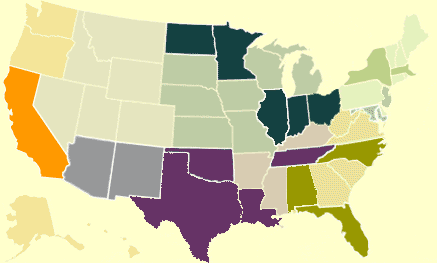
A mere 3 states pay an optional state supplement only if the person on SSI lives "independently" in the community. These states do not pay OSS to any kind of institutional setting - this encourages integration.

8 states pay NO OSS at all regardless of where the person receiving SSI lives (in the community or in an institution) - they are just cheap and keep persons on SSI in deeper poverty, but are "neutral" with integration.

23 states pay an OSS for SSI recipients who live either in their own home in the community OR in institutional settings - these states might be considered fair IF the amount of the optional state supplements were the same or higher in the community than in the institution. Because most states pay much more to the group/institutional settings, they are discriminating against "the most integrated setting" and are not significantly helping the poverty issue.

17 states pay OSS only if the person on SSI resides in an institutional setting. They do not pay any OSS to people living in their own homes in the community - these states are the most obviously discriminatory and they are perpetuating poverty for SSI recipients.

The overall discrimination occurs in several ways. As you look at the following numbers, remember to compare the total income (FBR +OSS) for each person in a community/independent setting versus the total (FBR +OSS) available to persons in institutional/group settings. You will +need to add the FBR for 2007, $623/month, to each of the following OSS numbers, and just fyi, the OSS numbers may have been rounded up or down to the nearest dollar.

THE 23 STATES THAT PAY OSS TO BOTH COMMUNITY AND "COMMUNITY INSTITUTIONAL" SETTINGS

First, these 23 states pay a monthly optional state supplement for SSI recipients regardless of where the person lives, i.e., whether in their home or in institutional settings. However, OSS payments vary markedly from state to state, and in nearly every state people living in institutions, such as group homes, receive much larger optional state supplement payments than they would receive if they lived in the community in their own household.

  • Alabama - $60 a month OSS for an individual living alone in the community versus $110 OSS a month for a person living in adult foster care and $196 a month OSS in CP treatment center.

  • Alaska - $362 OSS a month for an individual living alone in the community versus $100 a month OSS for a person living in assisted living.

  • California - $209 a month OSS for an individual living alone in the community ($274 if you are blind) versus $407 a month OSS for a person living in "non-medical out of home care, living in household of another." (There are additional OSS amounts in CA, but the effect is the same)

  • Colorado - $25 a month OSS in your own home versus $271 a month OSS in adult foster care. CO also pays an OSS of $464.15/month for people in their own homes who would otherwise qualify for a nursing home.

  • Connecticut - $168 OSS in independent community living versus an unstated, variable amount of OSS to licensed room and board facilities. Those OSS payment amounts are set based on individual cost data for the operations of each individual facility.

  • Idaho - $32 OSS for living independently or in the household of another versus $177 OSS in Room and Board facility or group home and from $319 to $453 in assisted living facility or certified family home Levels I - III.

  • Illinois - Specific amounts not reported, but OSS is paid for both living independently, and either a Room and board facility or residential facility. OSS based on given individual needs.

  • Iowa - $22 OSS for living independently or in the household of another versus $291 in Residential care. There is also an OSS of up to $480.55/mo for people who get home care to prevent institutionalization in a nursing home.

  • Maine - $10 OSS for living alone or with others versus $49 in foster care, $217 in flat-rate boarding home, and $234 in cost-reimbursement boarding home.

  • Massachusetts - $114 OSS for living independently (with higher rates paid to people who are older or blind) versus $454 in assisted living and $293 in licensed rest home.

  • Michigan - $14 OSS if living independently versus $87 domiciliary care, $157 personal care facility (group home/adult foster care home), and $179 home for aged.

  • Minnesota - $81 OSS if living independently versus $130 in non-medical group residential facility.

  • Nevada - No OSS for people with disabilities in ANY living situation versus $36 OSS for aged and $109 for blind living independently versus $391 domiciliary care for aged and blind only.

  • New Hampshire - $27 OSS for living independently or with others versus $207 for a residential care facility and $149 for a community residence.

  • New Jersey - $31 OSS for living alone or with others versus $150 OSS for a congregate care facility and $210 OSS in a residential health care facility.

  • New York - $87 OSS for people living alone, or in some cases with others versus $266 OSS in a level 1 congregate care facility, $435 in a level 2 facility, and $525 in a level 3 facility.

  • Oregon - $1.70 OSS is paid for aged and disabled in ALL living situations (living alone, household of another, and residential care facility or adult foster care facility). If someone is blind, the OSS increases to $26.70 in all living situations.

  • Pennsylvania - $27 OSS for people living alone or in someone else's household versus $389 OSS in domiciliary care facility and $394 OSS in personal care boarding home.

  • Rhode Island - $57 OSS for people living alone versus $575 in adult residential care or assisted living facility.

  • South Dakota - $15 OSS for people living independently versus $570 OSS in assisted living facility and $287 in adult foster care home.

  • Vermont - $52 OSS for people living independently versus $224 residential care home level IV and $99 custodial care family home.

  • Washington - $46 OSS for people living independently or in congregate care group facilities.

  • Wisconsin - $84 OSS for people living independently versus $180 OSS in non-medical group home.

THE 17 STATES THAT PAY OSS ONLY FOR INSTITUTIONAL SETTING
("Community Institutions" or group/congregate settings)

Second, there are 17 states that pay a monthly optional state supplement ONLY if the person on SSI resides in a "community institution" or group setting. These states pay NO optional state supplement if the person lives in the community. In these states, older Americans and persons with disabilities in the community receive only the federal benefit rate, but if they were institutionalized in assisted living facilities, personal care boarding facilities, foster care homes, domiciliary care facilities, these institutions would receive both the federal benefit rate and the following optional state supplement (OSS) for each person.

  • Delaware - $140 OSS for the person living in adult certified residential care facility.

  • DC - $347 OSS for a person living in adult foster care "home" with less than 50 beds and $457 OSS in adult foster care "home" with over 50 beds.

  • Florida - $78 OSS for a person living in either assisted living facility or adult family care.

  • Hawaii - $522 OSS in either a foster care home or domiciliary care facility level I and $630 in domiciliary care facility level II.

  • Indiana - $594 OSS for someone to live in a licensed residential facility.

  • Kentucky - $520 OSS for personal care facility and $172 in family care home. (Kentucky also pays $62/mo OSS to people in their own homes who are eligible to receive caretaker services to prevent institutionalization, so maybe it should be in previous category.)

  • Louisiana - $8 OSS in Medicaid facility only (e.g. a nursing home or a state developmental disability institution). There is no OSS paid to people living in their own home, or living in a "community institution."

  • Maryland - $184 OSS in assisted living facility, and $66 in a care home with minimal supervision, $175 in a care home with moderate supervision, $463 in a care home with extensive supervision, and $666 in a care home with specialized and intensive supervision.

  • Missouri - $156 and $292 OSS for licensed residential care facility, levels I and II, and $390 OSS for licensed intermediate care or skilled nursing home.

  • Montana - $94 OSS for assisted living facility or group home, $52.75 for an adult foster care home, and $26 for a transitional group living situation.

  • Nebraska - $118 OSS in a room and board facility, $148 in a certified adult family home, $188 in a licensed center for the developmentally disabled, and $428 in assisted living.

  • New Mexico - $100 OSS for people in an adult residential care home.

  • North Carolina - $561 OSS for an adult care home (basic), $674 for a "disenfranchised" adult care home, and $958 OSS for a special care unit adult care home.

  • Ohio - $306 OSS in adult community mental health housing, $506 OSS adult family or foster home, adult community alternative home, or adult residential care facility, and $606 OSS in an adult group home and residential care facility.

  • South Carolina - $348 OSS in a licensed residential care facility.

  • Texas - $30 OSS is paid to SSI recipients living in Medicaid facilities only (e.g. a nursing home or a state developmental disability institution). There is no OSS paid to people living in their own home, or living in a "community institution."

  • Virginia - $597 or $449 OSS is paid in assisted living facilities and in adult foster care (the OSS amount depends on geographic location).

THE 7 STATES THAT PAY NO OSS UNDER ANY CIRCUMSTANCES

The 7 states that pay absolutely no OSS whatsoever- in any living situation- are Arizona ( if person "requires housekeeping services," the state pays $70 as OSS under the auspices of the Social Security Act for those services, but does not pay any additional cash OSS benefits), Arkansas, Georgia, Kansas, Mississippi, North Dakota, Tennessee, West Virginia (while WV does not technically provide an OSS under the auspices of the Social Security Act, it does make monthly payments on behalf of each resident to providers who run Adult Family Care Homes ($814/month), Licensed Personal Care Homes, ($1056.50/month) and Residential Board and Care Homes ($1056.50/month), so maybe WV should be in the preceding category.)

THE 3 STATES THAT PAY OSS ONLY IN INDEPENDENT SETTINGS

The 3 states that pay an optional state supplement only if the person lives in their own household in the community are Oklahoma ($48 a month OSS), Utah ($3 a month OSS for someone living in the household of another ($9.70 for a couple), and $4.60 OSS for a couple living independently), and Wyoming ($10 a month OSS).

Why would States want to pay an optional state supplement to "community institutions", such as assisted living facilities, personal care boarding facilities, foster care homes, domiciliary care facilities? How do such payments satisfy the ADA's "the most integrated setting" mandate? Aren't such payments another form of institutional bias that we have seen in other situations? Supporting these "community institutions" perpetuates discrimination against persons with disabilities and older Americans.
--
Source: Steve Gold, The Disability Odyssey continues


DisabilityInfo.gov
Self Employment/Entrepreneurship Update: START-UP/USA--Self-Employment Technical Assistance, Resources & Training

START-UP/USA provides technical assistance to support self-employment and small business ownership among people with disabilities. Includes a series of Webcasts on using SSA's Plan for Achieving Self Support (PASS) to support small business ownership, developing a business plan, as well as information for veterans with disabilities. This information has recently been updated, and is now available - http://www.start-up-usa.biz/


Research & Statistics in Health Update: Longitudinal Studies of Aging


Links to several reports from the Centers for Disease Control and Prevention regarding health statistics for adults in the U.S. and longitudinal studies of aging. This information has recently been updated, and is now available - http://www.disabilityinfo.gov/digov-public/public/DisplayPage.do?parentFolderId=161


National Parks -- Comments on Access Needed by April 22


The National Park Service (NPS) is interested in knowing how to make its parks more accessible. Although most of us won't be able to attend the listening session hosted in San Francisco next week, we do have the ability to make our voices heard by submitting written comments to the NPS by April 22. This is a great opportunity to reflect on previous vacations and accompanying barriers you or a loved one may have encountered during your journeys and to offer thoughtful suggestions for greater accessibility to some of our country's most beautiful preserved spaces.

National Parks -- Comments on Access Needed by April 22

* Have you ever visited a national park?
* Would you like to do so?
* Would you like to assure that the parks are accessible to you, AND your great grandchildren?

Then take a few minutes to provide feedback to the NPS, so they know how to make the parks more accessible to you...

The National Park Service will celebrate its' centennial in 2016, and is initiating a nation-wide campaign to listen to the public about the future of the parks. See http://www.nps.gov/2016/

It is imperative that persons with hearing, visual, cognitive, and mobility disabilities express their concerns and ideas about programmatic and physical access at National Park Service areas.

A session is scheduled in San Francisco, next Thursday, March 22, 2007. 5:30 PM - 7:30 PM, Presidio Officers Club, 50 Moraga Avenue, San Francisco, California, 305-242-7714

National Park Centennial Initiative Listening Session

Description: You can help to shape the future of America's national parks! Please come to this listening session to share your ideas.

Meeting Directions: For directions, please visit: www.presidio.gov/event/rental/officersclub/

The agenda of the San Francisco meeting has been set, and apparently it will be the same format as used in all other meetings:

The principal department representative will make some welcoming remarks and then participants will be asked to circulate to various workstations where their comments and suggestions will be recorded. Such a format eliminates the opportunity for individuals to grandstand on their pet issues and is also less intimidating to many individuals. Unfortunately, it is unlikely that the format for the meetings will be announced in advance as it has been for San Francisco. In other words, you may arrive with a two-minute statement prepared only to find out that the format is workstations.

Attendees will apparently be asked three questions:

  1. Think of your children and grandchildren enjoying national parks in 2016 and beyond. How do you imagine their visit? What are your hopes and expectations?

  2. What role do you think national parks should play in the lives of Americans and visitors from around the world?

  3. What are the signature projects and programs that you think should be highlighted for completion over the next 10 years?

To comment on the National Park Centennial Initiative via the Internet, use the form on the following web page.

http://parkplanning.nps.gov/commentForm.cfm?parkID=442&projectID=17892&documentId=18372 


However, they must be received in Washington by April 2, 2007, 11:59 p.m.
--------
Source: This information is being forwarded to you by staff of the California SILC, for educational purposes only. The Council neither endorses nor recommends action on such re-transmitted items unless specifically noted.


Statehealthfacts.org Updates Data on Medicare Prescription Drug


Plans, Medicare Advantage Plans, Medicaid Medically Needy Enrollment and Spending, Unemployment, and More Statehealthfacts.org has updated data on Medicare Prescription Drug Plans (PDPs) for 2007 including penetration rates, organizations offering PDPs, PDP Premiums, and PDP deductibles. Data from the Centers for Medicare and Medicaid Services (CMS) as of January 16, 2007 on the number of beneficiaries receiving the Medicare Drug Benefit low-income subsidy have been added. Also updated are data on Medicare Advantage Plan Penetration for 2006 and Medicare Advantage Total Enrollment for 2007. Information from the Guttmacher Institute on Medicaid coverage of family planning has been updated to February 2007 for all states and the nation. Data on Medicaid Medically Needy enrollment and spending for FFY 2003 from CMS have been updated and are also available by eligibility category. Seasonally adjusted unemployment rates from the Bureau of Labor Statistics (BLS) have been updated to January 2007. The updates are available at http://www.statehealthfacts.org/r/whatsnew.html.


New Products added to the Quality Mall


"Individuals with Disabilities in Emergency Preparedness-Executive Order 13347 (July, 2005)" - http://www.qualitymall.org/products/prod1.asp?prodid=3530

"Recollections of the Institution" - http://www.qualitymall.org/products/prod1.asp?prodid=3669

"Ed Roberts: His Words, His Vision" - http://www.qualitymall.org/products/prod1.asp?prodid=3708


[Want to read previous issues of the Monday Morning in Washington, DC?  View them online.]


Until Next week


The Arc of the United States, 1010 Wayne Avenue, Ste. 650, Silver Spring, MD 20910, Phone: 3015653842, Fax: 3015653843, Email: mmwdc@info.thearc.org, Web: www.thearc.org


 Disclaimer: MMWDC publishes information about issues and events that we believe to be important and likely to be of interest to advocates and others interested in inclusion of persons with disabilities in all parts of society.  However, MMWDC and The Arc of the United States do not necessarily endorse all events, sponsoring organizations and reports which appear.