Volume 07 Issue 26 July 2, 2007
Welcome to Monday Morning in Washington, D.C., published weekly by The Arc of the United States. We will bring to you news of interest to self advocates and their families, volunteers, professionals, and supporters of the disability movement. Please send any comments to mmwdc@thearc.org. You are welcome to reproduce and distribute items from Monday Morning in Washington, D.C., but please credit Monday Morning in Washington, D.C. (The Arc of the United States, 2007).
The Arc of the United States advocates for the rights and full participation of all children and adults with intellectual and developmental disabilities. Together with our network of members and affiliated chapters, we improve systems of supports and services; connect families; inspire communities; and influence public policy.
[NOTE: Having trouble reading this newsletter? Read it online.] [Past Issues]
NCTQ (National Council on Teacher Quality) issued their State Teacher Policy Yearbook
Parents with cognitive/intellectual disabilities - Resources
New Knowledge Path Focuses on Child and Adolescent Social and Emotional Development
Grant Notices from the Office of Head Start, Administration for Children and Families
Building Relationships: Parallels Between Infant-Toddler Development and the Public Policy Process
New National Resource Center Launched and Seeks Members for National Steering Committee!
Rebalancing Long-Term Care: The Role of the Medicaid HCBS Waiver Program
Open Invitation to Join the NCD Chicago Quarterly Meeting July 24-26
Viable Futures Toolkit Offers Guidance on Sustainable Community Development
The Disability is Natural E-Newsletter - Disability is Natural Free Press
New Research Shows Simplifying Medicaid Can Reduce Children's Hospitalizations
REFERENCE POINTS: Research Project Evaluates
20 Years of What Works for Youth with Disabilities
NCTQ (National Council on Teacher Quality) issued their State Teacher Policy Yearbook
There are 10 focus areas of the report - one being special education. The
executive summary (http://www.nctq.org/stpy/primaryFindings.jsp)
includes the following:
"States do not ensure that
special education teachers are well-prepared to teach students with
disabilities." The report notes that state standards are "woefully inadequate"
with only 4 states having strong clear explicit comprehensive standards. Few
states require special education teachers to have subject matter knowledge, the
report holds. States are not requiring the teacher preparation programs assume
any responsibility for ensuring that secondary special education teacher are
highly qualified, leaving the task up to districts, the report concludes. States
give teacher preparation programs "free rein" over the professional coursework
they require of special education candidates, the report notes.
The National Leadership Consortium on Developmental Disabilities
Recommended Books
About the Disability Experience Nancy R. Weiss, The National
Leadership Consortium on Developmental Disabilities, Center for Disabilities
Studies, University of Delaware, 461 Wyoming Road, Newark, DE 19716, home
office: 410-323-6646, www.nlcdd.org
Friend with nimble fingers
Information or training for parents and/or soon-to-be parents with cognitive
impairments who want to keep/ regain custody of their children.
The National Health Policy Forum announces the availability of a new issue brief
Trading Places: Real Choice Systems Change Grants and the Movement to
Community-Based Long-Term Care Supports.
NECTAC eNotes - June 29, 2007
New Knowledge Path Focuses on Child and Adolescent Social and Emotional
Development The Maternal and Child Health Library
has developed an electronic guide to resources for professionals on healthy
social and emotional development in infants and young children, school-age
children, and adolescents. Selected topics include developmental stages; factors
that impact social and emotional development; policies and programs to promote
social and emotional well-being in homes and community settings; and strategies
for integrating health, development, and education services. A section for
families is also included. It is available at
http://www.mchlibrary.info/KnowledgePaths/kp_Mental_Healthy.html. Source: Federal Register - June 28,
2007 (Volume 72, Number 124) The Department of Education recently
posted the following request for comments in the Federal Register: Title:
Comment Request; Part D Discretionary Grant Application - Individuals with
Disabilities Education Act. Interested persons are invited to submit comments on
or before July 30, 2007. For complete information go to
http://www.ed.gov/legislation/FedRegister/other/2007-2/062807b.html
Grant Notices from the Office of Head Start, Administration for Children and
Families Source: Office of Head Start,
Administration for Children and Families - June 26, 2007 The Office of Head Start (OHS),
within the Administration for Children and Families, recently announced the
following two grants notices: Title: Head Start Hispanic/Latino
Service Partnerships URL:
http://www.acf.hhs.gov/grants/open/HHS-2007-ACF-OHS-YP-0011.html Title: Head Start Tribally
Controlled Land Grant College and University Partnerships URL:
http://www.acf.hhs.gov/grants/open/HHS-2007-ACF-OHS-YT-0012.html Closing
date for applications: Aug 20, 2007
New from the Early
Childhood Outcomes Center Source: Early Childhood Outcomes
Center - June 28, 2007 The Early Childhood Outcomes Center
recently posted updates to the following documents on their Web site: Updated Activity Table: What States
are Doing Regarding Family Outcomes (June 28, 2007) -
http://www.fpg.unc.edu/~eco/whatstates.cfm#Family_activities Updated Activity Matrixes and Maps:
States' Child Outcomes Measurement System Activities for Part C and Part B
preschool programs (June 28, 2007) -
http://www.fpg.unc.edu/~eco/whatstates.cfm#whatstates
Building Relationships: Parallels Between Infant-Toddler Development and the
Public Policy Process Source: ZERO TO THREE Policy Center -
June 25, 2006 This recent article from the ZERO TO
THREE Policy Center explores relationship-building in early childhood and in the
world of policy and advocacy. It is available online at
http://www.zerotothree.org/site/DocServer/BuildingRelationships.pdf?docID=3641
The California P&A (PAI) issues first investigation
of restraint and of children with disabilities in California schools
One-Stop Toolkit Resources of the Week Technical
Assistance Project -
www.onestoptoolkit.org
ODEP-Funded Customized Employment Materials and Other Technical Assistance
Resources: Customized Employment Portfolio Series--Volumes I and II
Customized Employment: A New Competitive Edge
Principles and Indicators
Job Seeker Exploration
Creating a Blueprint for Job Development
Negotiating with Employers
Customized Employment: Applying Practical
Solutions for Employment Success - Volume II
Students with disabilities drop out of school at
significantly higher rates than their peers who do not have disabilities.
In the 2001-02 school year, only 51 percent of
students with disabilities exited school with a standard diploma.
Arrest rates are relatively high for students with
disabilities who drop out. Overall, at least one-third of students with
disabilities who drop out of high school have spent a night in jail; this rate
is three times that of students with disabilities who have completed high
school.
Of those who do not complete high school, about
61.2 percent are students with emotional/behavioral disabilities, and about 35
percent are students with learning disabilities.
JFA Daily: Investigation of
Restraints-Students with Disabilities
New National Resource Center Launched and Seeks
Members for National Steering Committee!
Babes Among Elders: Nursing-Home Kids Parents Want Cheaper Home Care, but
Medicaid Pays to Institutionalize; Ronnie's Journey
The economic impact of informal caregiving on the U.S. economy is massive
according to a new AARP Public Policy Institute study, Valuing the Invaluable: A
New Look at the Economic Value of Family Caregiving. The study found that the
contributions of family caregivers often go unnoticed, but in fact, their
contributions are the foundation of the nation's long-term care system with an
estimated economic value of $350 billion in 2006. More on this release >>
http://www.aarp.org/research/press-center/presscurrentnews/family_caregiving.html
Rebalancing Long-Term Care: The Role of the Medicaid HCBS Waiver Program
The Medicaid home and community-based services (HCBS) waiver program is the
major public financing mechanism for providing long-term care services in
community settings. Authorized under section 1915(c) of the Social Security Act,
states have used HCBS waiver programs to serve a wide variety of populations,
including seniors; people with physical disabilities, HIV/AIDS, mental
retardation and developmental disabilities (MR/DD), and traumatic brain injury
(TBI); and children who are medically fragile and/or technology-dependent (such
as ventilator dependent due to paralysis). Under the waiver program, states are
permitted to provide HCBS to individuals who require the level of care provided
in institutional settings [that is, hospitals, nursing homes, or intermediate
care facilities for people with mental retardation (ICFs/MR)]. Because of the
diversity of the populations served, as well as other factors such as unique
state delivery systems, payment structures, and service models, it is difficult
to generalize about the programs that have been implemented under the authority
of section 1915(c).
http://www.nhpf.org/pdfs_bp/BP_HCBS.Waivers_03-03-06.pdf
National Council on Disability
Open
Invitation to Join the NCD Chicago Quarterly Meeting July 24-26 guarantee equal opportunity for all
individuals with disabilities, regardless of the nature or severity of the
disability; and empower individuals with
disabilities to achieve economic self-sufficiency, independent living, and
inclusion and integration into all aspects of society. To carry out our purposes, we believe
it is vital that NCD hears from disability communities around the country on
what works and what does not for people with disabilities. We are delighted to
have the opportunity to visit Chicago and learn first hand about the experiences
of people with disabilities from Illinois and the surrounding states. Please
save the date and do not miss this opportunity to meet NCD board members and
staff and offer your comments during the public comment sessions.
Disabled
entrapped by ID rules A week after his first birthday,
Bobby Hartwell's parents dropped him off at the Colorado State Home and Training
School for Mental Defectives northwest of Denver. He never saw them again.
Viable Futures Toolkit Offers Guidance on Sustainable
Community Development
The Disability is Natural E-Newsletter - Disability is Natural Free Press The
newest edition is now available -
www.disabilityisnatural.com Copyright June 2007 by Kathie Snow
Family Voices
Health
Indicators by State
Until Next week
The Arc of the
United States, 1010 Wayne Avenue, Ste. 650, Silver Spring, MD 20910, Phone:
301-565-3842, Fax: 301-565-3843, Email:
mmwdc@info.thearc.org,
Web:
www.thearc.org
Disclaimer:
MMWDC publishes information about issues and events that we believe to be
important and likely to be of interest to advocates and others interested in
inclusion of persons with disabilities in all parts of society. However,
MMWDC and The Arc of the United States do not necessarily endorse all events,
sponsoring organizations and reports which appear.
Parents
with cognitive/intellectual disabilities - Resources
Parents with disabilities -
http://www.developmentaldisability.org/parents_with_disabilities.htm
Through the Looking Glass -
http://lookingglass.org/id_parents/index.php -
http://lookingglass.org/index.php
Curricula for supporting parents with cognitive disabilities -
http://www.ct.gov/dcf/lib/dcf/external_affairs/pdf/curricula.pdf
Working with Parents Who Have Cognitive Limitations: Teachers Supporting Student
Learning -
http://www.childdevelopmentmedia.com/parents-with-special-needs/90340a.html
The Colorado Cross-Disability Coalition, CCDC -
http://www.ccdconline.org/
Parents with disabilities: Abledata -
http://www.abledata.com/abledata.cfm?pageid=113573&top=16046&ksectionid=19326
The Internet's One-Stop Resource for Parents with Disabilities -
http://www.disabledparents.net/
Celebrating autistic Parents -
http://cap.autistics.org/
Blog on having parent with autism -
http://ballastexistenz.autistics.org/?p=41
Aspar-Parents -from the children's view -
http://www.aspar.klattu.com.au/
Beach Center: http://www.beachcenter.org/
Parents with ID -
http://www.intellectualdisability.info/lifestages/ds_parent.htm
Guidelines for Identifying Children with Intellectual Disability/Mental
Retardation (2000) -
http://www.ctserc.org/id/
From UK:
http://www3.fhs.usyd.edu.au/fssp/parents/our_research/support.htm
Report on International Conference on Parents with Disabilities & their Families
http://www.disabilityworld.org/04-05_02/news/families.shtml
Parenting with a disability -
http://www.fpg.unc.edu/~ncodh/orchid/pages/parenting.cfm
Learn More about Working with Parents with Cognitive Limitations -
http://www.trainingmatters-nc.org/tm_vol5_no2/tm_vol5no2.htm
Parents with Cognitive Disabilities -
www.dhfs.wisconsin.gov/bdds/b3etn/200305/spbriefing.doc
The Real Choice Systems Change grant program was created to help states
transform their long-term care service systems from ones that rely on
institutions to ones that are more community-based. The grants are intended to
help states develop the infrastructure needed for seniors and individuals with
disabilities to live in integrated community settings. This issue brief provides
information about Systems Change grants and the kinds of activities state
Medicaid agencies have undertaken to transform their institutionally based
systems. In addition, this paper reports on some of the qualitative and
quantitative responses to the changes. This brief also raises critical policy
questions related to public spending for long-term care in different settings
that might be considered in tandem with future grant funding decisions.
http://www.nhpf.org/pdfs_ib/IB822_SystemsChange_05-30-07.pdf
Source: MCH Alert - June 29, 2007
Closing date for applications: Aug 20, 2007
A 10-year old boy with significant disabilities was bound to his wheelchair and
left in the school van on two separate days. One school built a locked seclusion
room where an 8-year old boy with psychiatric and developmental disabilities was
routinely locked away. Other children were dragged by their teachers into
seclusion areas and then barricaded from leaving.
These are some of the more serious complaints that in 2006 led PAI to open a
full-scale investigation into the extent of dangerous and prohibited restraint
and seclusion practices currently in effect in the California school system. "This investigation starkly revealed both the failure of school personnel to
comply with existing regulations and the failure of current law to sufficiently
regulate these dangerous practices," stated Leslie Morrison, author of the
report.
Attorney Morrison, head of PAI's Investigations Unit, further explained that
over the years, with insufficient training and oversight, the use of restraint
and seclusion in primary and secondary California schools has become routine and
is no longer reserved for situations posing imminent risk of harm.
The 61 page investigation report, entitled "Restraint & Seclusion in California
Schools: A Failing Grade," included extensive review of records; on-site
inspections in a rural school district in the northeast part of the state, a Bay
Area school district and a non-public school in the Los Angeles area; victim and
witness interviews; and consultations with experts in restraint and seclusion.
Morrison and her investigations team made numerous recommendations for
improvements that will bring the practices of schools-based behavioral restraint
and seclusion in line with those applied in other settings. This includes
prohibiting the use of seclusion; limiting the use of restraint to the most dire
circumstances; ensuring compliance with state laws and regulations limiting the
use of emergency interventions; and ensuring that school personnel proactively
address serious student behavior problems through individual assessments.
The report can be downloaded from the organization's website:
http://www.pai-ca.org/pubs/702301.htm or
http://www.pai-ca.org/pubs/702301.pdf. For print copies, contact PAI's
Oakland office at (510) 267-1200.
SOURCE: Protection & Advocacy, Inc., 1330 Broadway, Suite 500, Oakland, CA
94612
U.S. Department of Labor Employment and Training Administration
News Release - June 20, 2007
http://www.dol.gov/opa/media/press/eta/eta20070880.htm
[The following is excerpted from the ETA News Release.]
On June 20th, Secretary of Labor Elaine L. Chao announced the U.S. Department of
Labor's third generation of Workforce Innovation in Regional Economic
Development (WIRED) regions. Each of the 13 self-identified areas successfully
competed for $5 million to be awarded over a three-year period. "The WIRED
program recognizes that local economies often transcend geographical
boundaries," said Secretary Chao. "These grants are catalysts to mobilizing the
diverse array of stakeholders in a community to focus on developing the human
talent that will be key to any successful regional economic plan." The
department launched WIRED in late 2005 with a competition among the nation's
governors. In February 2006, 13 competitively selected regions were awarded a
total of $195 million to transform their economies. In January 2007, 13
additional regions, which also were among the best nationally, were presented
awards to reposition their regional economies. Today's announcement launches the
third generation of selected regions.
Generation III WIRED projects are as varied and unique as the regions
themselves. For example, rural Minnesota will use its know-how and ingenuity in
agriculture to grow emerging bioscience and renewable energy industries. Central
New Mexico will combine the capabilities of industry, research and development
at its universities, and national laboratories to become a focal point for clean
energy and advanced manufacturing. Oregon's Northern Willamette Valley will
align regional services to respond to needs for talent in advanced manufacturing
and other industries.
"These 13 regions join 26 others in transforming their regions into innovative,
entrepreneurial economies, and preparing their workers with the education and
skills necessary to be successful in the 21st century global marketplace," said
Assistant Secretary of Labor for Employment and Training Emily Stover DeRocco.
"We are already encouraged by the results of the WIRED strategic partnerships,
demonstrating that talent development can drive economic transformation."
WIRED's Generation III regions include: five counties in central New Jersey; 25
cities and counties in southeastern Virginia; 15 counties in central Kentucky;
18 counties in southeastern Mississippi; 12 counties in south central and
southwest Wisconsin; 36 counties in south central and western Minnesota; 14
counties in southeast Missouri;10 counties in south central Kansas; eight
counties in central New Mexico; four counties in southern Arizona; eight
counties in south central Idaho; seven counties in greater Portland and Salem,
Ore.; and five counties in Washington's Pacific Mountain region.
For more information on the WIRED initiative, go to:
http://www.doleta.gov/wired/
http://www.dol.gov/odep/categories/workforce/CustomizedEmployment/deliverables/index.htm
Customized Employment: Practical Solutions for Employment Success - Volume I
http://www.dol.gov/odep/documents/572b6c60_2f5e_46dd_8439_1b18da4bd731.pdf
http://www.dol.gov/odep/categories/workforce/CustomizedEmployment/practical/index.htm
Provides a general overview of the following topics:
http://www.dol.gov/odep/documents/2e984b1d_f2de_40dd_b3c4_3b4073b67ca5.pdf
http://www.dol.gov/odep/documents/0f4c8970_ac6c_4ece_800e_9387366a0917.doc
Expands on those topics presented in Volume I and provides ideas on how to use
these strategies with job seekers for their own Customized Employment success.
Diversitydata.org
http://diversitydata.sph.harvard.edu/
Diversitydata.org, a website from the Harvard School of Public Health, allows
visitors to explore how metropolitan areas throughout the U.S. perform on a
diverse range of social measures. Available data relevant to education include:
proportion of the population that is foreign born, non-English language spoken
at home, child poverty rate, composition of public school enrollment by
race/ethnicity, poverty rate of school where average primary school student
attends by race/ethnicity, and segregation of the population.
Prepared by the National High School Center
http://www.betterhighschools.org/docs/NHSC_DropoutPrevention_052507.pdf
[The following is excerpted from the Issue Brief.]
The purpose of this issue brief is to provide information and guidance to state
education agencies (SEAs) regarding their accountability for IDEA 2004
legislative mandates in the area of dropout prevention for students with
disabilities.
There are significant costs to individuals with disabilities who do not complete
high school. These costs include unemployment, underemployment and higher rates
of incarceration. There are also significant costs to society related to lost
tax revenues and welfare expenditures. The extent of the problem is illustrated
in the following statistics:
The National Resource Center for Human Service Transportation Coordination was
recently unveiled during the United We Ride Executive Council Meeting. The goal
of the National Resource Center is to provide states and communities with the
support they need to coordinate transportation services for people with
disabilities, older adults, and individuals with lower incomes. The Center will
be administered by the Community Transportation Association of America through a
cooperative agreement with the Federal Transit Administration.
The Center's major activities include (1) Expansion of United We Ride (UWR)
Coordination Ambassadors for every federal region; (2) UWR information
clearinghouse; (3) Coordination among federal and non-federal technical
assistance centers; (4) Support of the National Consortium on the Coordination
of Human Services Transportation; (5) Delivery of training classes and
informational sessions; and (6) Research. The Center will also provide technical
assistance to the Federal Interagency Coordinating Council on Access and
Mobility (CCAM) and its member agencies.
The National Resource Center is also SEEKING members for the National Advisory
Committee. The deadline for applications is July 20, 2007. For more
information:
http://www.ctaa.org/ntrc/steering_committee.asp or call 1-800-527-8279.
By Clare Ansberry
June 28, 2007
COMMERCE, GA - Ronnie Rivera, a 15-year-old in braided pigtails, sits in a
wheelchair in a narrow hallway of Hill Haven senior-citizen nursing home. A
half-dozen other residents, many with dementia and most four to six decades
older, sit nearby. Around them, a maintenance worker mops the linoleum floor.
Ronnie has lived in this single-story red-brick building since she was 10 years
old, the only child among elders. Her mother, Iris Rivera-Smith, has tried
unsuccessfully for years to get the financial help she would need to bring her
daughter home.
Thousands of other children are growing up in nursing homes across the country,
many for the same reason as Ronnie. Federal disability insurance guarantees
nursing-home care for the disabled. But in many states, its coverage isn't
enough to let those people, children included, live at home -- even when the
cost to taxpayers, and the strain on families, is often much lower.
...
To read the rest of the article, go to:
http://www.aapd.com/News/medicaid/070629wsj.htm
SOURCE: Wall Street Journal (Thank you to Mitsubishi Electric of America
Foundation for flagging this.)
AARP: Family Caregiving Valued at $350 Billion
On behalf of the National Council on Disability (NCD), I would like to invite
you to participate in NCD's Chicago quarterly meeting. The meeting will take
place at the Crowne Plaza Chicago Metro at 733 West Madison on Tuesday, July 24,
2007, from 8:30 a.m. until 3:30 p.m.; Wednesday, July 25 from 8:30 a.m. until
12:30 p.m.; and Thursday, July 26 from 8:30 a.m. until 4:00 p.m. These events
are free of charge and open to the public. There will be time in the agenda each
day for public comment and your input is appreciated. You can also provide us
with your written comments by E-mail, fax, or mail. The meeting facility is
fully accessible.
NCD is an independent federal agency and is composed of 15 members appointed by
the President, by and with the advice and consent of the Senate. We provide
advice to the President, Congress, and executive branch agencies to promote
policies, programs, practices, and procedures that:
For more information, please contact NCD's Director of Communications Mark S.
Quigley at mquigley@ncd.gov or by
telephone at 202-272-2004 (V), 202-272-2074 (TTY). And please visit our website
at http://www.ncd.gov.
For the next 30 years, Hartwell, who has cerebral palsy and mental retardation,
lived at the school and at a nursing home. In 1980, Wade Blank, a preacher and
activist for the disabled, got Hartwell out, helped him get public assistance
and a home, and taught him to live on his own.
Now, at 57, Hartwell may lose it all, starting with his apartment-because he
can't prove he's a U.S. citizen.
http://www.denverpost.com/search/ci_5351362
Information Courtesy:
Law, Health Policy
& Disability Center, The University of Iowa
To subscribe to this free e-newsletter, go to
http://disability.law.uiowa.edu/lhpdc/publications/news.html
and subscribe to the "Disability Law & Policy e-Newsletter." The e-Newsletter
is archived at
http://disability2.law.uiowa.edu/.
Rehabilitation Service Administration (RSA) Parent Information and Training
Projects Outcome Data (2005-2006)
The Technical Assistance on Transition and the Rehabilitation Act (TATRA)
Project released a publication summarizing the performance of the seven RSA
funded Parent Information and Training Programs. The report contains data
regarding the number and type of disability of children served through the
projects, and the locations of currently funded RSA projects.
To view the report in its entirety, use the following link: Technical Assistance
on Transition and the Rehabilitation Act (TATRA) Project, Rehabilitation Service
Administration (RSA) Parent Information and Training Projects Outcome Data
2005-2006: Helping Families Transition to the Future, 2007,
http://www.pacer.org/tatra/RSA/RSA.pdf
The Viable Futures Toolkit is an online resource for "planners, policymakers,
service providers, and funders about how to create solutions for older
generations that simultaneously address needs of younger generations and their
communities." The toolkit provides a structural framework for how to develop
sustainable communities by emphasizing lifelong education, civic engagement,
wellness, economic development, affordable housing, and the efficient and
sustainable use of natural resources.
For more information: Just Partners, Inc., Sustainable Communities for All Ages:
A Viable Futures Toolkit, available at
http://viablefuturestoolkit.org/welcome.htm
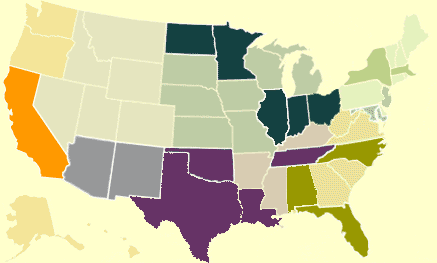
June 13, 2007- The Commonwealth Fund Commission on a High Performance Health
System released the first-ever comprehensive comparison of health system
performance in all 50 states. Aiming Higher: Results from a State Scorecard on
Health System Performance ranks states on 32 performance indicators of access,
quality, avoidable hospital use and costs, equity, and "healthy lives."
The report compares each state's performance to benchmarks that have already
been achieved in states across the country. Although some states ranked highly
on multiple indicators, no single state or group of states scored top marks in
every area. Some, however, far surpassed others: Hawaii and states in the
Northeast and Upper Midwest often rank high in multiple areas, while states with
the lowest rankings tend to be concentrated in the South. Across states, health
care access and quality were found to be highly correlated.
"Where you live clearly matters: for access to care when you need it, the
quality of care you receive, and opportunities to live healthier lives," says
Fund senior vice president Cathy Schoen, one of the report's authors. The
analysis also estimates how much the nation would save in human and economic
costs if all states attained the level of performance reached by the top states.
The report is now available for free download on
www.commonwealthfund.org, where
you can also find an interactive U.S. map containing rankings and performance
data for each state.
New Research Shows Simplifying Medicaid Can
Reduce Children's Hospitalizations
The Center on Budget and Policy Priorities this month released a 2-page report
by Leighton Ku—"New Research Shows Simplifying Medicaid Can Reduce Children's
Hospitalizations." This summary of research conducted by Dr. Andrew Bindman and
his associates at the University of California at San Francisco, "indicates that
improving the continuity of Medicaid coverage through what is known as ‘12-month
continuous eligibility' can improve children's health and avert unnecessary
hospitalization costs." To view the report, go to
www.cbpp.org/6-11-07health.pdf.
REFERENCE POINTS: Research Project Evaluates
20 Years of What Works for Youth with Disabilities
The What Works Transition Research Synthesis Project funded by the Office of
Special Education Programs (OSEP) has published the first report in a series to
be released. The project was established to review and synthesize the past two
decades of research and advancements in the area of transition for youth with
disabilities. By reviewing 50 previous studies, this first report examines how
teaching life skills as an intervention affected the lives of 482 youth with
varying levels of intellectual disabilities. To read the first report "A
Systematic Review of the Effects of Curricular Interventions on the Acquisition
of Functional Life Skills by Youth with Disabilities, What Works Transition
Research Synthesis Project, 2006" go to the National Secondary Transition
Technical Assistance Center web site. As they become available, additional
reports will be posted on the site.
REFERENCE POINTS, transition updates from the TATRA Project, features
resources and information to help parent organizations, advocates and
professionals better serve adolescents and young adults with disabilities, and
their families. Administered by the TATRA Project at PACER Center
www.pacer.org, REFERENCE POINTS was launched
with the initial support from the National Center on Secondary Education and
Transition www.ncset.org. TATRA is funded by
the U.S. Department of Education, Rehabilitation Services Administration.